
Multi Language Translation Services for Travel and Business
You're at a foreign car rental desk, your driving licence is valid, your reservation is confirmed, and the queue behind you is growing. The agent can see your name and photograph, but the licence categories, dates, and restrictions are printed in a script they can't read. A generic phone translation may help with a phrase, but it won't give the agent a dependable, field-by-field document to check.
That's where multi-language translation services earn their place. For identity and travel documents, translation isn't a cosmetic conversion of words. It makes the original licence understandable to the people who must verify it, while preserving the original document's role and legal status. The practical question isn't whether software can produce another language. It's whether the result will be clear, reviewable, secure, and suitable for the desk, checkpoint, or insurer in front of you.
Table of Contents
- Why Travelers and Agencies Need Multi Language Translation Services
- Understanding Certified Translation Companions and Their Scope
- Key Features That Make Translation Services Reliable
- Comparing Delivery Options and Pricing Models
- Real-World Use Cases for Travelers and Businesses
- How to Choose the Right Translation Service
- When Translation Is Essential and When It Is Not
Why Travelers and Agencies Need Multi Language Translation Services
At a foreign rental desk, the agent must identify the licence holder, read the driving categories and dates, then decide whether the document supports the rental. A marketing translation has no role in that decision. If those fields remain unclear, the agent may pause the transaction, request another document, or refer the case to a supervisor. Multi-language translation services provide the document support needed for that review.

The document problem is field-level, not conversational
A travel app can translate a sign or help a traveler ask for directions. A licence translation has a different operational task. It maps information from the national document into a language the receiving party can read, while keeping the original document's identity and legal role intact.
The translation must preserve structured details such as:
- Identity fields: Names, birth details, and other personal information must match the original.
- Validity information: Issue and expiry dates need to remain clear and unambiguous.
- Driving entitlements: Categories and restrictions must be rendered accurately, without changing their meaning.
- Document references: Numbers and labels should remain traceable to the source licence.
The translation normally travels alongside the original licence. It serves as a readable reference for a rental employee, border officer, or insurer who needs to compare fields against the source document. It does not replace the original, create a new licence, or automatically meet every local legal requirement.
Why businesses face the same friction at greater volume
One traveler may need assistance at a single desk. A rental agency, relocation provider, travel platform, or corporate mobility team handles these checks repeatedly across destinations. The operational requirement is consistency: staff need a repeatable method for collecting documents, reviewing translated fields, checking authenticity, and recording the outcome.
The global language services market shows the scale of this work. Nimdzi estimates the language services market at USD 71.7 billion in 2024, with projected expansion to USD 92.3 billion by 2029. Its estimate also identifies interpreting as a major growth driver. For travel operations, language support functions as process infrastructure rather than a niche accessory.
Practical rule: Carry the original licence and its translation companion together. Presenting only the translation creates the uncertainty the companion is meant to remove.
At a police checkpoint or during an insurance review, “close enough” is a poor standard. Staff may need to confirm that each field matches the original and that the document came through a credible process. A readable, verified companion makes that comparison easier, but acceptance remains a local decision.
Understanding Certified Translation Companions and Their Scope
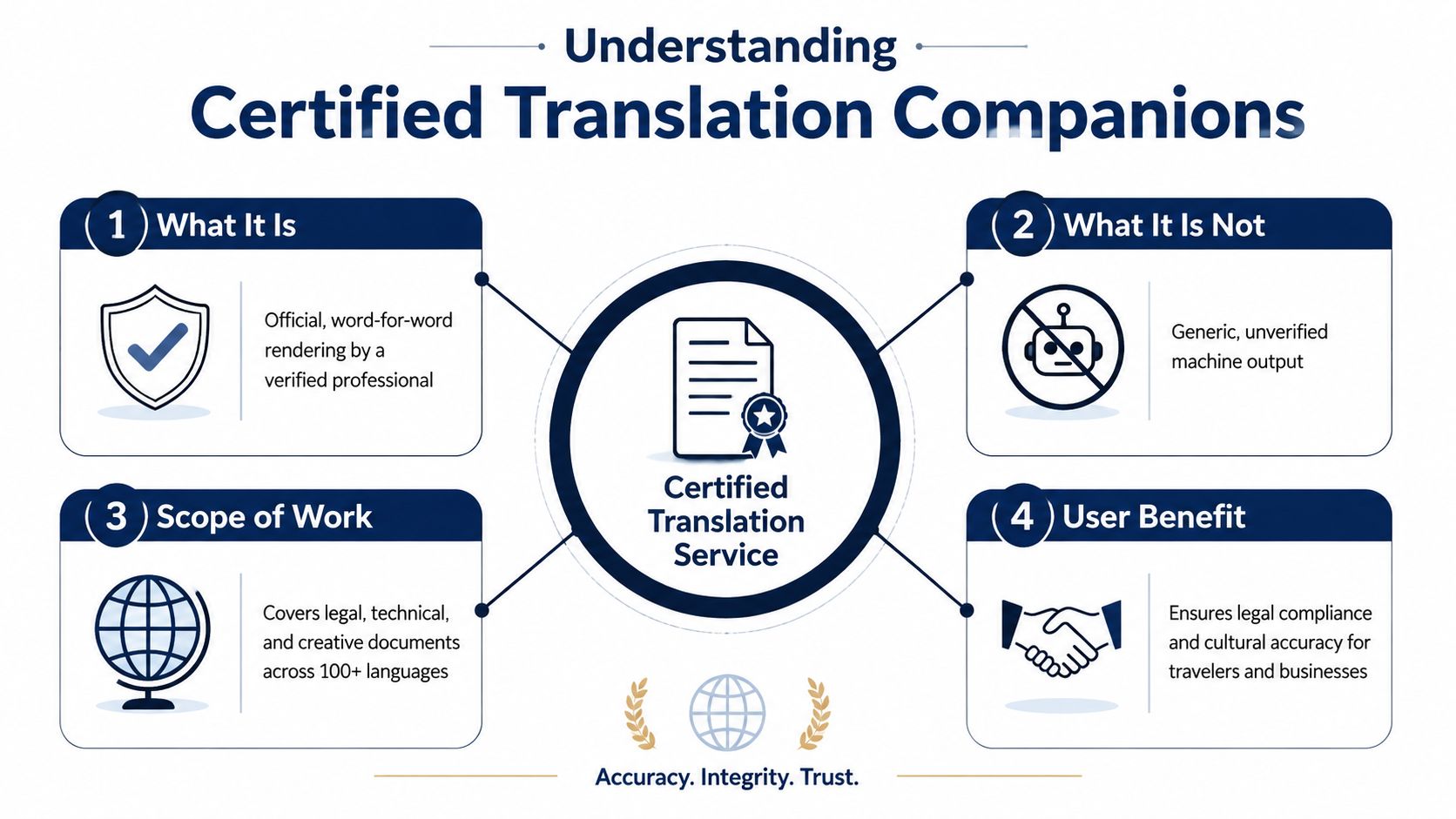
A certified translation companion is a professionally prepared rendering of an existing national driving licence into other languages. Its purpose is readability and verification. It doesn't grant permission to drive, change the licence holder's entitlements, or function as a government-issued permit.
Start with the original document. The translation service uses the licence as its source, extracts the relevant text and fields, renders them in the requested languages, and provides a certification or statement connected to the translation process. The finished document should allow a receiving party to compare the translated content with the original rather than asking the translation to stand alone.
What the companion does
A useful translation companion should make the document legible in the destination context. That includes names, dates, categories, restrictions, labels, and other relevant fields. The format also matters. A clean PDF can be useful at a counter, while a printed booklet may be easier to hand over during repeated checks or when connectivity is uncertain.
Look for four properties:
- Traceability: The translated fields should correspond to the source licence.
- Professional review: A qualified person should check the output, especially where OCR or machine translation is involved.
- Clear scope: The provider should state exactly what the document is and what it isn't.
- Verification: A receiving party should have a practical way to confirm the document's reference or authenticity.
Certified translation isn't the same as a generic machine translation. A translation app may produce useful informal text, but it normally doesn't provide a controlled document workflow, certification, secure customer record, or verification path. For an identity document, those controls matter more than instant phrasing.
Translation companion versus official IDP
An International Driving Permit is a separate document issued through an authorized channel where applicable. It may be required by local law, a rental company, an insurer, or a border authority. A private translation companion isn't an IDP, and a provider shouldn't imply otherwise.
The correct approach is simple:
- Use a translation companion when the problem is that staff can't read your existing licence.
- Obtain an official IDP when the destination or provider requires one.
- Carry both when the rules call for both.
- Confirm acceptance with the rental company and relevant local authority before departure.
Acceptance is always determined locally. A translation can make an authentic licence understandable, but it can't override a legal requirement for another document.
Key Features That Make Translation Services Reliable
Reliable services treat a driving licence as a structured identity record, not as a paragraph of text. That changes the quality standard. The reviewer must confirm that the translated name, dates, categories, and restrictions correspond to the source document and that the final layout remains usable.
The WMT25 evaluation framework illustrates why a single machine-translation score isn't enough. Its shared task uses human-judged dimensions including accuracy, completeness, fluency, and coherence, then maps those assessments into an overall score. For a licence, completeness and field fidelity deserve priority over smooth-sounding prose.
OCR speeds intake, but review protects meaning
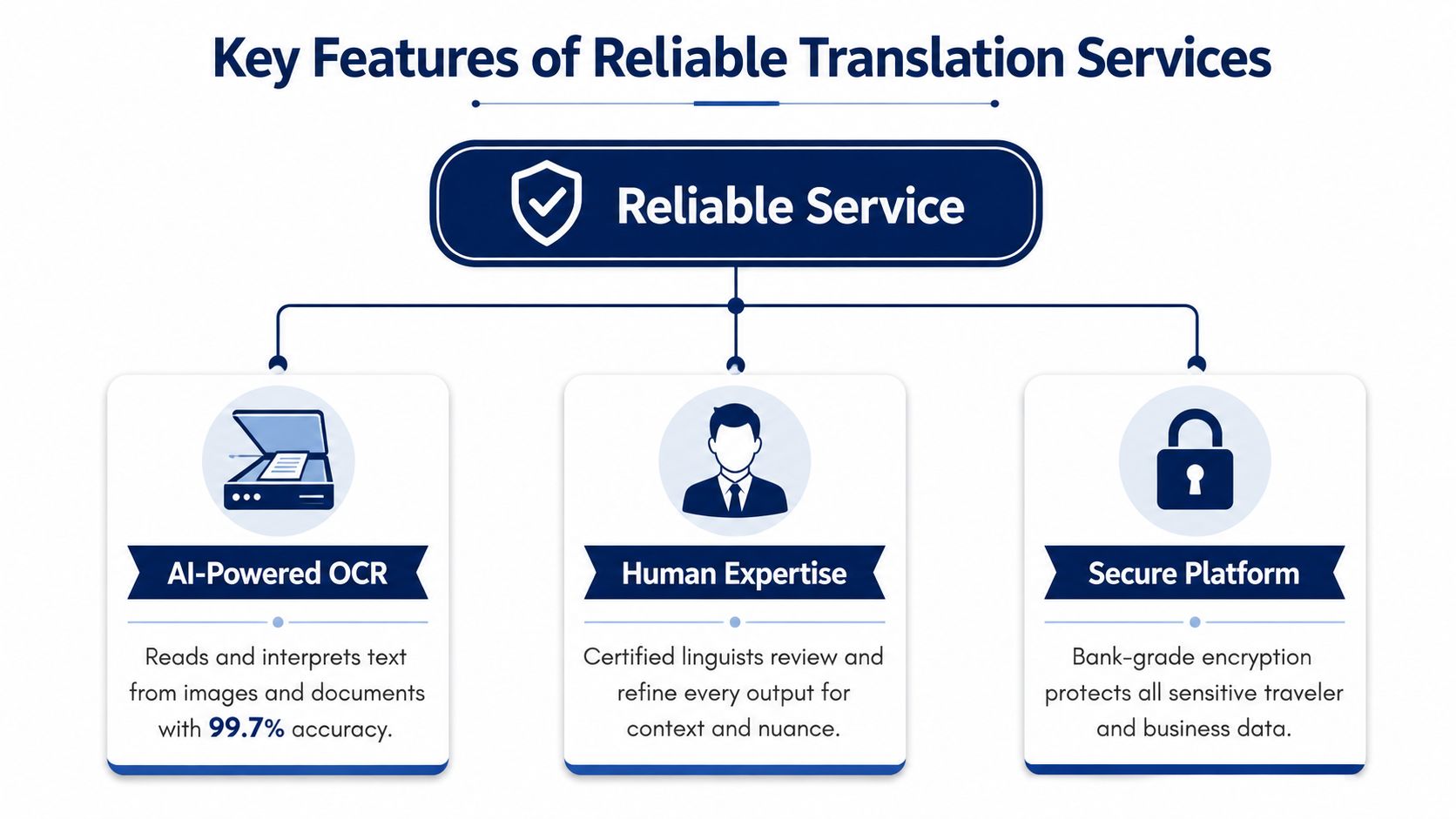
AI-powered OCR can read information from varied licence layouts and reduce manual data entry. That's useful when travelers upload photographs, scans, or documents with different visual structures. OCR should be treated as an intake tool, not as proof that the extracted data is correct.
Human review provides the control layer. A reviewer can catch a misread character, an inverted date, a missing restriction, or a category that doesn't make sense in context. The 2025 benchmark study on multilingual translation quality notes uneven performance across languages and domains, especially where benchmarks don't represent the full cultural and linguistic range of real-world material. Formal documents therefore need locale-aware checking and domain-specific review.
Coverage should include the actual receiving environment
Language coverage isn't just a count on a sales page. The service should render the document in the scripts people at the destination can read, including right-to-left scripts where relevant. It should also avoid forcing users to order each language separately when a multi-country itinerary requires several languages.
A strong workflow combines:
- Source capture: OCR or structured upload, with clear image-quality requirements.
- Linguistic review: A human checks terminology, names, dates, and document conventions.
- Layout control: The output preserves a logical relationship between the source and translated fields.
- Verification infrastructure: A QR reference or public portal lets a receiving party validate the issued document.
- Data protection: Encryption, restrained retention, and deletion controls reduce exposure for sensitive identity information.
For a practical overview of document-focused workflows, see this guide to travel document translation. The best provider will also explain its correction process. If a customer spots an error, the service should have a defined way to fix it rather than forcing the traveler to start again.
Comparing Delivery Options and Pricing Models
The right delivery format depends on how you travel and who must handle the document. A person flying out tomorrow has different priorities from a rental agency preparing documents for recurring reservations. Don't pay for a physical booklet if a secure digital pack meets the receiving desk's needs, but don't rely on a phone file if you'll face repeated checks in places where paper is easier to inspect.
| Option | Format | Best For | Key Features |
|---|---|---|---|
| Digital Pro | Certified PDF | Last-minute travelers and digital-first users | Multi-language document, QR verification, priority review, and re-download access |
| Digital + Print | Digital pack plus printed booklet | Frequent drivers and travelers who prefer paper | Professionally printed passport-format booklet with the digital version |
| Family Bundle | Multiple certified translations in one purchase | Couples or households traveling together | Several traveler documents managed in one order |
| Agency or Business Plan | Shared digital workspace | Rental, relocation, and travel operations teams | Multi-user access, consolidated invoices, and priority handling |
| API or Bulk Program | System-to-system delivery | Platforms and high-volume workflows | REST access, sandbox environment, volume pricing, and service-level options |
Digital delivery
Digital-only delivery is the fastest and easiest to store. Keep the file offline, save a backup in a secure location, and make sure the name and source licence details are easy to match. A QR verification reference can help a desk agent validate the document without relying on an email thread.
Before ordering, check the provider's system requirements. A blurry photograph, cropped licence edge, or glare across a date can create delays regardless of the package you select.
Print and household options
A printed booklet is useful when you're moving through several desks, carrying physical travel documents, or sharing paperwork with staff who don't want to handle a phone. It costs more in time and fulfillment than a PDF, but it can be more practical during road travel.
A household bundle reduces administrative clutter when several people need translations. Confirm whose documents are included and whether every traveler receives an individual translation rather than a shared summary.
Business and API plans
Agencies should prioritize workflow controls over retail checkout convenience. A multi-user workspace, consolidated billing, status tracking, and priority handling help managers keep documents tied to reservations or customers. Platforms that collect licence data at scale may need API access, sandbox testing, volume pricing, and defined service levels.
The market itself is substantial, although estimates differ by scope. Fact.MR places the translation services market at USD 42.2 billion in 2024, while other estimates cover broader language services that include localization and interpreting. That variation is a reminder to compare providers on deliverables, review, security, and acceptance guidance, not on a headline market figure or the lowest displayed price.
Real-World Use Cases for Travelers and Businesses
A traveler on a multi-country itinerary may encounter several languages before returning home. The operational risk isn't only at the first rental counter. A replacement vehicle, roadside inspection, insurer, or local authority may need to read the same licence information in a different script.

Different travelers, different pressure points
Leisure travelers benefit from a single organized document pack. They can keep the original licence, translation companion, insurance details, and rental confirmation together instead of improvising at the counter.
Business travelers and expatriates need repeatable access. A secure dashboard and re-download capability matter when a stay involves several vehicles, destinations, or work assignments. They should also check whether the local jurisdiction requires an official permit in addition to a translation.
Students and short-term visitors often have limited time to prepare. A digital document can solve the readability problem without requiring an in-person appointment, but it still shouldn't be treated as a substitute for any document required by local law.
The same pattern appears outside individual travel. A car rental agency may need to prepare documents for customers whose licences come from different countries. A relocation company may need a consistent intake and review process. A travel platform may connect an OCR and translation workflow to booking data through an API, while keeping access restricted to authorized staff.
A useful service separates these roles. The system extracts information, the reviewer checks it, the platform protects it, and the customer presents it with the original licence. No single layer should be expected to solve every problem.
Real-time communication creates a different requirement. Industry reporting on translation automation describes widespread machine-translation use and a shift toward customization, governance, and deployment controls. For documents, that means terminology rules, locale-specific formatting, and clear handling of personal data. For meetings, support channels, and live operations, it points toward context-aware translation that can work with speech and other formats.
The following video offers additional context on how travelers use translation technology in everyday situations.
How to Choose the Right Translation Service
Start with acceptance, not design. Ask the rental company, insurer, or local authority what it accepts and whether it requires an official IDP, a certified translation, or both. A polished PDF is still the wrong purchase if it doesn't match the destination's documentation rules.
Then inspect the provider's process. You should be able to answer these questions before uploading an identity document:
- Who reviews the output? Look for explicit human review, not a vague promise of “AI accuracy.”
- What fields are covered? Confirm that names, dates, licence categories, restrictions, and document references are included.
- How is the result verified? A QR reference linked to a public verification portal is more useful than an internal order number that a desk agent can't check.
- How is data handled? Check encryption in transit and at rest, minimal retention, and automatic deletion policies.
- What happens if something is wrong? Read the correction, refund, and support terms before payment.
Security matters because a driving licence contains personal information. A service should explain where files are stored, who can access them, how long they remain available, and whether you can delete them. Avoid providers that demand unnecessary documents or make retention impossible to understand.
Watch for misleading convenience
A service offering many languages may still charge separately for each one, omit native-script rendering, or provide an unverified machine output. Ask whether the languages are packaged together and whether the provider supports the scripts used at your destinations.
Also check the document's practical form. Can you download it before leaving? Can you re-download it if your phone fails? Is a printed option available? Does the provider show a sample without hiding the certification wording or acceptance caveat?
One provider option is World Driving Permit, which offers certified word-for-word driving licence translations in 28 languages, digital delivery, an optional printed booklet, QR verification, and routing to authorized IDP issuers where an official permit is required. Those features fit travelers who need a readable companion, but you should still confirm local acceptance before ordering.
When Translation Is Essential and When It Is Not
At a rental desk, a valid licence can still cause a delay if staff cannot read its fields. A checkpoint officer may need to verify dates or categories, while an insurer may need to assess the document after an incident. A certified translation companion improves field-level readability, while the original licence remains the underlying authority.
Obtain an authorized IDP whenever local law or the rental agreement requires one, regardless of whether a translation is also in your possession. A private translation service provides language access and document matching, but it does not confer government recognition. Review this guide on translation instead of an International Driving Permit, then confirm the requirement with the destination authority, rental provider, or insurer.
Use this order:
- Check the rule: Confirm what the destination and rental company require.
- Solve readability: Add a certified translation companion when language blocks verification.
- Keep the original: Present both documents together.
- Add the official permit: Obtain an authorized IDP whenever the rule or contract requires it.
This prevents two errors. A translation does not replace an IDP where an official permit is required. An IDP also does not solve a communication problem when the rental agent only needs readable licence fields.
World Driving Permit provides certified, word-for-word translations of national driving licences into 28 languages, with digital delivery and an optional printed booklet. Visit World Driving Permit to review options and prepare documents for the rental desk or travel operation.