
Travel Document Translation: Complete Guide for 2026
You arrive at the rental desk with your passport, national driving licence, and a carefully prepared certified translation. The agent studies the papers, calls a supervisor, and still refuses the keys. You paid for a translation, but you didn't bring the document the agency, police authority, or licensing office accepts.
That outcome is common because travel document translation isn't a universal permission slip. It's a readability companion whose value depends on the destination's rules, the document's format, the translator's credentials, and whether the original remains available for inspection. A translation can be accurate and still fail an operational check.
The practical standard is simple: prepare for the person behind the counter, not just the translation provider. Confirm what the local authority requires, translate every relevant field, carry the original, and use an International Driving Permit when the destination requires one.
Table of Contents
- Why Your Translation Might Get Rejected
- Understanding Travel Document Translation Requirements
- Technical Requirements for Acceptance
- Choosing Between Digital and Printed Delivery
- Verification and Security Features That Build Trust
- Solving Common Travel Document Pain Points
- Best Practices for Different Traveler Types
Why Your Translation Might Get Rejected
At the rental desk, “certified” often sounds like a guarantee. It is not enough for the agent to see accurate wording. They may need to compare the translation with the original licence, identify the licence class, confirm expiry dates, and check whether an approved permit must accompany it. If the document does not support those checks quickly, the agent can refuse the rental.

A licence written in a non-Latin script creates a common problem. The translation may identify the driver but leave the licence number, vehicle categories, restrictions, or dates difficult to verify. The counter agent then has to resolve uncertainty under time pressure. That is when an accurate translation can still fail an operational check.
Carry the original licence with the translation. Austrian government guidance states that the translation is valid only when presented with the original, and local rules may also require an International Driving Permit or another administrative format. Read the Austrian guidance on translated licences and original documents.
Certification is only one part of acceptance
Authorities use “official” in different ways. One jurisdiction may request a translator's declaration and contact details. Another may accept work only from an approved organization. A third may require a treaty-based International Driving Permit instead of a standalone translation.
The UK supporting-document guidance shows how specific the checklist can be. A full translation must be independently verifiable and include the translator's confirmation, date, full name, signature, and contact details. Check the UK requirements for independently verifiable translations. Without those details, a document may look professional while failing the receiving authority's review.
Manitoba's requirements also focus on fields and supporting documents. They call for the original document, an approved translator or agency, copies of both sides of the original, and coverage of the licence number, expiry date, class, and date first licensed. Review Manitoba's translation requirements for foreign licences.
Practical rule: Ask the rental company or receiving agency which format and credentials it accepts before ordering the translation. A certified process alone does not guarantee acceptance at a particular counter.
Understanding Travel Document Translation Requirements
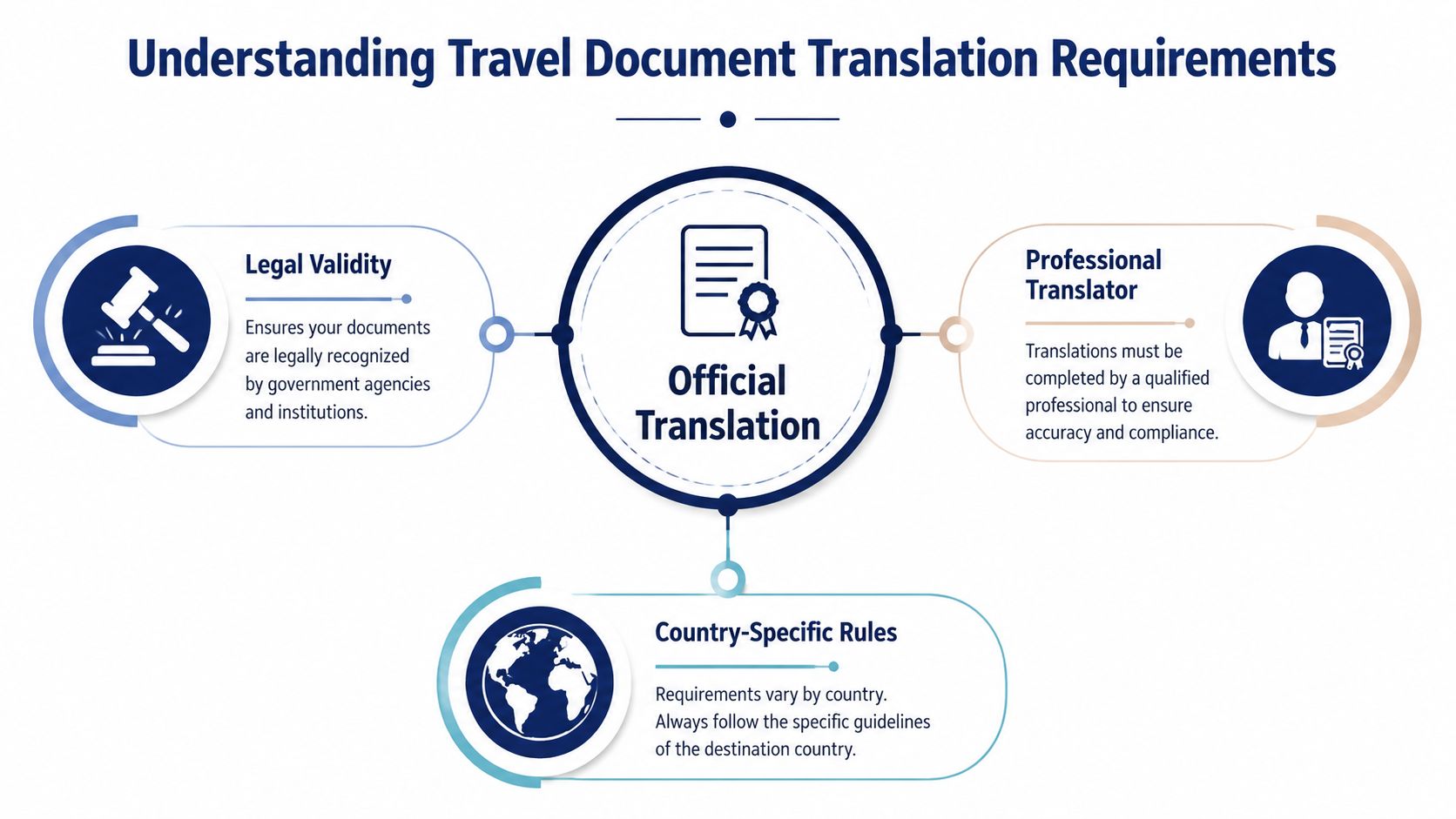
Start by separating two documents that travelers regularly confuse.
A translation companion reproduces the information on your national licence or other travel document in a language the receiving official can read. It helps an agent understand names, categories, dates, and restrictions, but it doesn't replace the original licence or create driving rights.
An International Driving Permit, by contrast, is a standardized translation governed by an international treaty framework. It may be required by the destination, the rental company, or local enforcement rules. The two documents can serve different purposes, and one cannot automatically substitute for the other. Use this guide to IDPs and translated licences to identify which document type your itinerary calls for.
Check the legal framework first
Foreign document translation is embedded in government workflows, not limited to private travel services. The Australian Passport Office requires documents that aren't in English to be translated in full and stamped by an accredited translator before submission. See the Australian Passport Office's translation guidance.
Driving rules demonstrate why one global checklist doesn't exist. Germany requires a translation of a domestic driving licence when the licence wasn't issued in the EU or EEA, isn't in German, or doesn't comply with the 1968 Convention on Road Traffic. In some situations, an International Driving Permit can replace the need for a translation. Germany also lists national exceptions for licences from places including Andorra, Hong Kong, Monaco, New Zealand, San Marino, Switzerland, and Senegal. Read Germany's rules for foreign driving licences.
Match the document to the trip
European travel guidance adds another variable, length of stay. For stays that don't exceed 185 days, a third-country licence in the EU or Schengen area must be valid and accompanied by an official translation or an International Driving Permit. Provisional and temporary licences, along with International Driving Permits, aren't regulated at EU level and might not be recognized in another EU country. The rule isn't a universal guarantee, so check the destination country and the specific rental provider.
The right sequence is:
- Identify the authority. Ask the rental company, road authority, border agency, or licensing office what it accepts.
- Confirm the original. Plan to present the original document alongside the translation.
- Check the format. Look for requirements covering certification, translator credentials, stamps, signatures, and verification.
- Determine whether an IDP is mandatory. If it is, use an authorized issuer rather than treating a private translation as a substitute.
- Prepare for exceptions. The destination, document language, treaty status, and stay duration can all change the answer.
The following explainer helps visualize the distinction between legal validity, professional translation, and local rules.
Technical Requirements for Acceptance
A rental clerk, border officer, or licensing official usually scans a translated licence for identity and driving authority fields. Missing, inconsistent, or unfamiliar details can send the document into manual review, even when the translation was completed by a qualified professional.
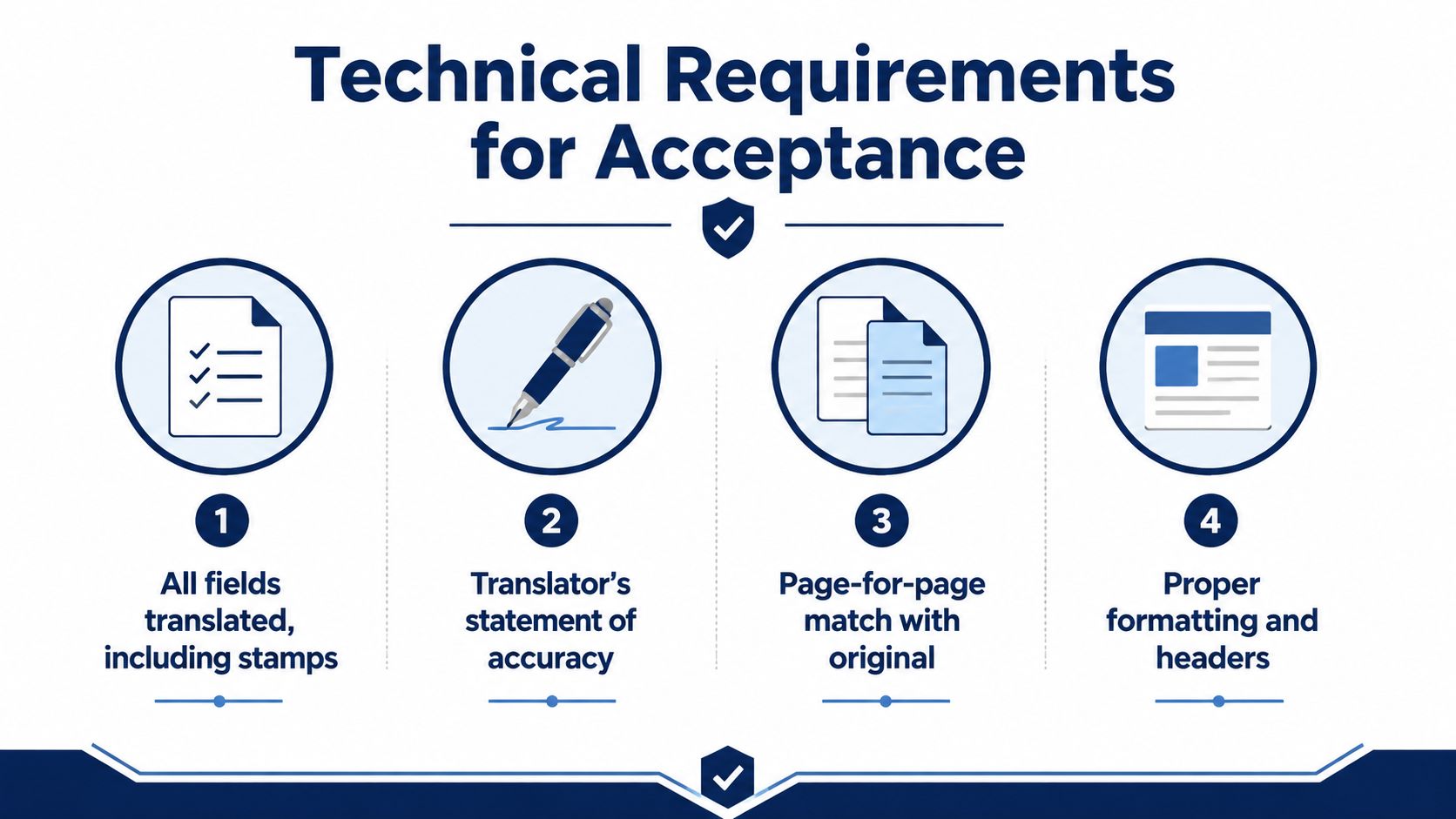
Review the entire document before translation. Names, licence numbers, dates, vehicle classes, restrictions, issuing-authority details, stamps, seals, endorsements, and handwritten entries may all affect acceptance. Field-level requirements can specify the licence number, expiry date, class, and date first licensed, as well as the original and copies of both sides. Confirm those requirements before ordering.
Script and date handling can decide the outcome
Non-Latin characters require careful treatment. Some authorities require translation when a document contains foreign characters or words, or uses a non-Gregorian calendar, with Nepal and Ethiopia cited as examples. Names, dates, and categories must remain clear and accurate after conversion.
Paragraph-style summaries make verification difficult for counter staff. A structured, page-matched format lets them locate each translated field beside its original counterpart and check the document quickly. This operational detail often determines whether a certified translation is accepted at the desk.
South Australia introduces another verification requirement. It accepts overseas licence translations through approved channels and may require a NAATI digital stamp or QR code. The verification method can therefore matter as much as the wording.
Accuracy begins before the translator writes
OCR can extract structured fields from passports, identity cards, travel documents, and residence permits across 190+ countries, including identity and expiry fields when machine-readable zones or barcodes are unavailable, according to TinyIDP's overview of international identity-document OCR. OCR supports field normalization, but it does not replace quality review.
Poor scans create predictable risks. A blurred digit can alter a licence number, a date can be misread, and a vehicle category can be confused with a restriction. Human review must compare extracted fields with the source image, then inspect the rendered translation for layout and meaning.
Field-level standard: If an official cannot locate identity, validity, and authorization details within seconds, the document is not operationally ready, even if its language is accurate.
Before ordering, use this document-requirements checklist to confirm the original, both sides, image quality, required fields, and destination format. Keep seals and annotations visible. Never ask a translator to guess an illegible mark. A responsible translation identifies uncertainty instead of manufacturing certainty.
Choosing Between Digital and Printed Delivery
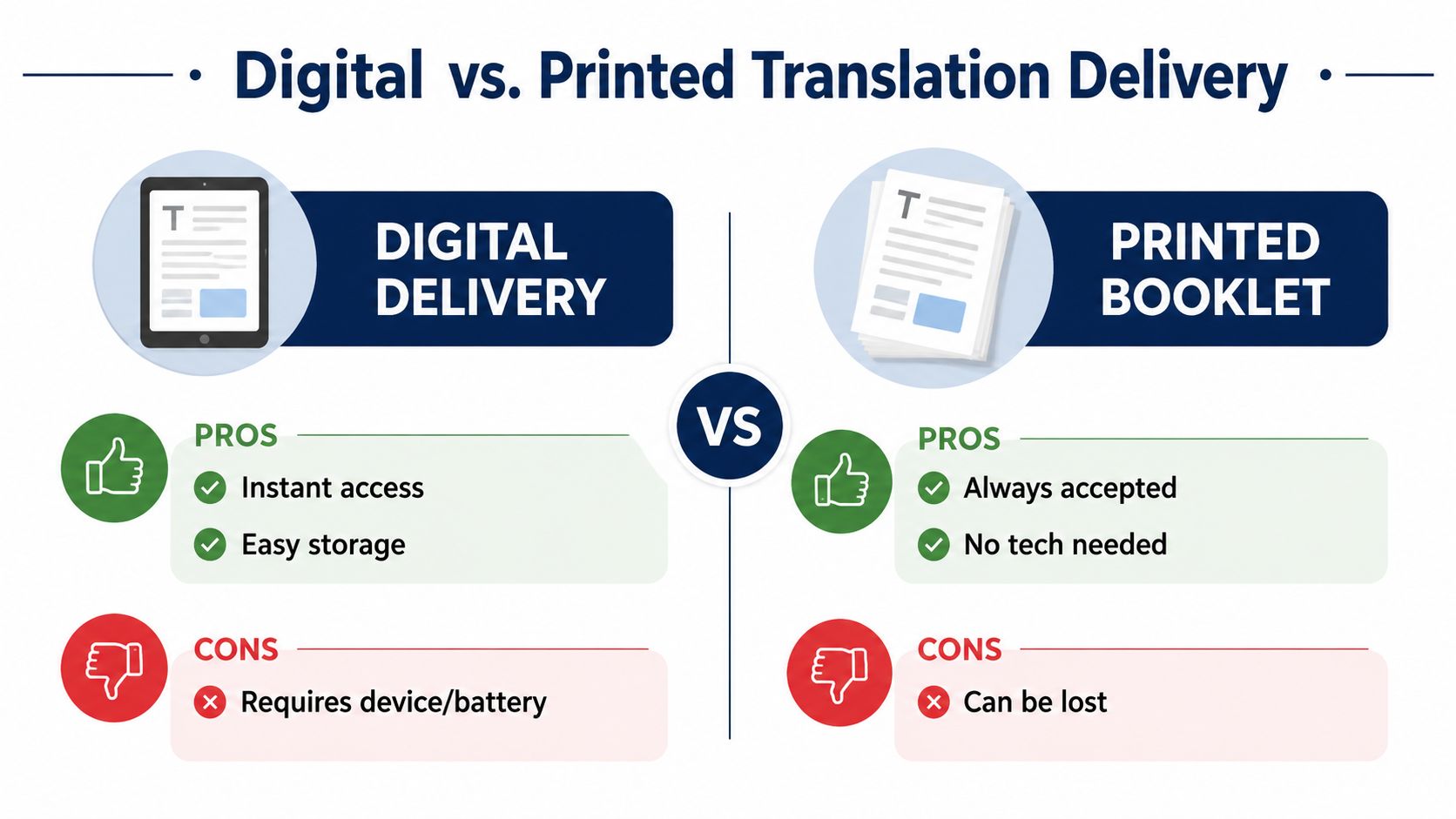
Digital delivery works well when speed and access matter most. A traveler who discovers a destination requirement shortly before departure can download a PDF, store it on multiple devices, and retrieve it from a secure account if the file is misplaced. Business travelers who move between airports and meetings often prefer a searchable document that can be shared with a rental desk or administrative contact.
The weakness is presentation. A dead phone, weak connection, locked screen, or unreadable display can turn a valid file into a delay. A rental agent may also want to compare printed pages with the original licence, especially when the desk is busy or the staff member isn't familiar with the issuing country.
Choose the format around the handoff
A printed booklet is stronger for repeated physical presentation. It doesn't depend on battery power, screen brightness, or a data connection. Families can place it with passports and vehicle papers, while expatriates who expect licensing-office visits may find a physical format easier to submit or photocopy.
Printed delivery has its own risk. It can be lost, damaged, or left in a hotel room. It also doesn't remove the need to carry the original licence, and it won't cure a destination rule that demands an International Driving Permit.
| Travel situation | Sensible primary format | Reason |
|---|---|---|
| Short rental with reliable phone access | Digital file plus a backup copy | Fast retrieval and simple storage |
| Multi-country road itinerary | Digital and printed | Different counters may prefer different presentation methods |
| Family trip with several drivers | Printed set plus digital backups | Physical organization reduces confusion at busy desks |
| Business or relocation travel | Both formats | Administrative visits often involve repeated document checks |
A digital file should be downloaded before departure, opened to confirm that every page renders correctly, and stored somewhere accessible offline. Keep a backup with the travel documents, but don't email sensitive identity files casually. A printed copy should be protected from moisture and kept with the original licence, not separated in different luggage.
The strongest choice for a complicated itinerary is dual delivery. It gives you a physical document for face-to-face checks and a digital recovery option when plans change. Neither format guarantees acceptance, so verify the destination's rules first.
Verification and Security Features That Build Trust
A translation gains practical credibility when the receiving person can verify who issued it and what it covers. A QR code should lead to a public verification page, not merely open a static copy of the same file. The page should identify the document reference, confirm its status, and make clear whether it is a translation companion rather than a government-issued permit.
Use the World Driving Permit verification portal to check how a public verification workflow works. When presenting a document, open the verification page in advance and keep the original licence available. This lets a rental employee or officer compare the source document with the translated fields instead of relying on an unexplained PDF.
Look for a clear scope statement
A transparent provider should state what the document is and what it isn't. A certified translation of a national licence isn't an International Driving Permit, doesn't replace the original, and doesn't override local acceptance rules. Those limits protect you from buying the wrong document and give the counter agent accurate context.
A signed statement of accuracy, translator identification, issue information, and a stable verification reference all support a faster review. They don't compel an authority to accept the translation, but they make the document easier to assess.
Protect the identity data inside the file
Passports and licences contain sensitive personal information. Look for encryption during upload and download, restricted account access, and a stated data-retention policy. Auto-deletion can reduce exposure after fulfillment, but read the policy carefully so you know what remains in backups, support systems, or verification records.
Don't upload a document to an unverified messaging account or a random translation form. Use a provider that explains how files are handled, who can access them, and how you can retrieve or delete them. Security is part of document quality because a rushed traveler often sends the same identity file to multiple parties without tracking where it went.
Verification habit: Test the QR code before you travel, save the verification page details, and carry the original document beside the translation.
Solving Common Travel Document Pain Points
The first pain point is time. A traveler may discover at check-in that the destination expects a readable translation or an IDP. The wrong response is to buy the first document with “international” in its name. Start with the rental company and destination authority, then choose a translation companion or an authorized IDP issuer based on the stated requirement.
The second is a changing itinerary. A document accepted in one country may not satisfy the next country's rules, especially where national recognition and treaty exceptions differ. Build a destination matrix before departure, listing the original licence, translation language, IDP requirement, and presentation format for each stop.
Solve the counter conversation before it starts
Counter agents need answers they can verify quickly. Keep the original licence open to the same page or side represented in the translation. Put the translation, original, passport, and rental reservation together in one folder. If a staff member questions authenticity, show the translator's statement and verification page instead of arguing from memory.
A family can prevent mix-ups by labeling each driver's document set. A business traveler can keep a secure digital backup and a printed copy in separate locations. An agency can request a consistent format for every client while still checking each destination separately.
Know when translation is the wrong tool
A translation is appropriate when the local authority needs help reading the original document and permits that form of support. It isn't a substitute for a government document when the destination explicitly requires an International Driving Permit. It also doesn't solve an invalid, expired, temporary, or provisional licence problem.
If a rental desk refuses the document, ask for the exact reason. Is the issue the missing original, translator credentials, absent fields, lack of an IDP, or an unacceptable format? That answer tells you whether a corrected translation can help or whether you need an authorized permit or a different vehicle arrangement.
Best Practices for Different Traveler Types
Leisure travelers renting cars abroad should verify requirements with both the rental company and the road authority. Carry the original licence, passport, translation, and any required IDP together. Before leaving the desk, confirm that the staff member has reviewed the driver's licence category and validity rather than merely glancing at the first page.
Business travelers and expatriates need a repeatable system. Keep a secure digital copy, a printed document, and a destination-specific requirements note. If you'll visit licensing offices, insurers, or employers, ask whether they require notarization, an approved translator, or a particular verification method. Don't assume that a document accepted by a rental company will satisfy an administrative office.
Families should assign one person to manage the document folder and keep each driver's papers separate. A household package can simplify ordering, but every translation must correspond to the correct original licence. Check names and dates manually before travel, especially when several documents use different scripts or date formats.
Agencies preparing documents for clients should collect destination, travel purpose, issuing country, document language, and itinerary details before ordering. Maintain a client-level checklist, record whether an IDP is required, and give travelers presentation instructions. For recurring work, a business workflow with shared access, consolidated records, and controlled document handling is more reliable than scattered email attachments.
Use this final pre-trip check:
- Original document: Carry the valid national licence or identity document.
- Translation scope: Confirm that names, numbers, dates, categories, restrictions, stamps, and relevant annotations are covered.
- Local format: Verify credentials, signatures, stamps, QR requirements, and any approved-channel rule.
- Permit status: Obtain an authorized IDP when the destination or rental company requires one.
- Presentation plan: Keep digital and printed copies accessible, but don't treat either as a replacement for the original.
- Verification: Test every verification reference before departure and save a backup offline.
World Driving Permit provides certified, word-for-word national driving-licence translations in 28 languages, with digital delivery and an optional printed booklet for presentation alongside the original licence. Visit World Driving Permit to check destination requirements, prepare a verifiable translation, and route to an authorized IDP issuer when a translation alone won't meet local rules.