
Driving License Arabic Translation: How to Get It Right
You've landed at a rental counter in Dubai or Riyadh. The agent looks at your home driving licence, pauses over the category codes, and turns it around to find dates or restrictions that aren't clear in a language they can verify. Your licence may be perfectly valid at home, but the desk still needs readable proof that you're authorised to drive the vehicle you're requesting.
A driving license Arabic translation can solve that gap, but only when it's prepared as a proper compliance document. The translation must match the original field by field, connect clearly to your identity, and satisfy the expectations of the specific rental company, insurer, police officer, or licensing authority. In the UAE, a foreign licence may need a legal Arabic translation when it isn't already in Arabic or English, alongside documents such as an eye test, passport or Emirates ID, and photographs, as described in UAE licence exchange guidance.
Table of Contents
- Understanding Why Certified Translations Matter
- Preparing Your License for Translation
- Choosing Your Translation Format
- How Translation Verification Works
- Presenting Your Translated License Successfully
- Troubleshooting and Common Questions
Understanding Why Certified Translations Matter
Acceptance is decided by whether the translated document supports the rental agreement and insurance conditions. A desk agent must be able to match your name and licence number, confirm the permitted vehicle categories and validity dates, identify the issuing authority, and spot any restrictions. If one of those details is unclear or cannot be checked against the original card, the agent may refuse the vehicle even when the licence itself is genuine.
A certified translation provides an accountable record of that information. It is not a casual bilingual explanation or a paragraph summarising the card. The document should preserve the legal meaning and structure of the licence, with the translated entries aligned clearly to the source. Standard licence translation practice typically covers personal details, vehicle categories, validity dates, issuing authority, licence number, and endorsements. That structure supports reviews for immigration, employment, insurance, car rental, and government filings. The licence translation workflow also shows why these documents must work across borders and for licences issued in different Arab jurisdictions.

Translation is part of the administrative chain
In the Gulf, the translation may be one document in a licensing or conversion file. The UAE process demonstrates that Arabic translation can be tied to foreign licence exchange, with the translated licence reviewed alongside identity documents and other supporting papers. A reported UAE exchange fee was Dh600, showing that the translation requirement can sit inside a wider paid administrative process rather than serve as an optional language service. Check the reported UAE exchange process against the current instructions from the relevant authority before applying.
Certification gives the recipient a clear party to hold responsible for the rendering. A signed statement, certification details, and a complete layout provide concrete points for inspection. A typed translation copied into a word processor may explain the licence, yet it can lack the identity checks and traceability expected during an official review.
Practical rule: Treat the translation as a companion to the original licence, not a replacement for it.
For a practical explanation of the difference between an official document translation and basic language conversion, read this guide to certified translation by a professional. The useful outcome is a document that lets a rental agent or authority verify the original quickly and confidently.
Preparing Your License for Translation
Most avoidable rejections begin before the translator sees the file. A cropped corner, a reflection across the licence number, or a missing reverse side can force a resubmission. The translator cannot certify information that isn't visible, and the receiving authority can't approve information that hasn't been translated.
Start with the physical card in good light. Place it flat on a plain surface and take separate images of the front and back. Avoid flash if it creates glare, but don't use dim lighting that obscures fine print. The recommended Dubai licence translation preparation process specifically calls for a flat, glare-free image with all four corners visible, and it requires the destination authority or use case to be identified.
Capture the complete document
Before uploading anything, check each of these areas:
- Identity fields: Make sure the full name, date of birth, photograph-related details, and other personal information are sharp enough to compare with your passport.
- Entitlements: Capture every vehicle category, class code, and limitation. A translation that omits a category can create uncertainty about what you're allowed to drive.
- Dates: Include issue dates, expiry dates, and any separate dates connected to restrictions or endorsements.
- Authority details: Photograph the issuing authority, licence number, document type, and any seals or identifiers.
- Reverse-side information: Do not assume the back is administrative or irrelevant. Categories, codes, and restrictions may appear there.
Match the name against the passport before ordering. The translator should reproduce the licence faithfully, but the recipient may compare the Arabic rendering with the passport and the original card. If your passport and licence use different name orders, initials, transliterations, or spellings, flag the discrepancy rather than hoping it will disappear in translation.
Treat dates as a technical risk
Some licences from Arab countries use both Hijri and Gregorian dates. The translation must handle those systems accurately, either by preserving both where appropriate or by presenting the conversion in a way the recipient can understand. A wrong expiry interpretation can affect rental eligibility, insurance decisions, or a licence exchange application.
Arabic terminology also varies by jurisdiction. Standard expressions can include رخصة قيادة, رخصة السياقة, and رخصة القيادة. That variation isn't automatically an error, but the translator should use consistent terminology throughout the document and avoid switching terms in a way that confuses automated or human review.
Do one final inspection at full size. If you can't read the smallest text on your own screen, assume the reviewer won't be able to verify it either. A clear, complete source image is the foundation of an accepted certified translation.
Choosing Your Translation Format
The format should follow the way you'll present the document. A traveller collecting a rental car may need a file available on a phone, while an expatriate handling a licensing application may prefer a printed document that can be placed directly into a physical file. Neither format is universally superior. Acceptance depends on the recipient and the local procedure.
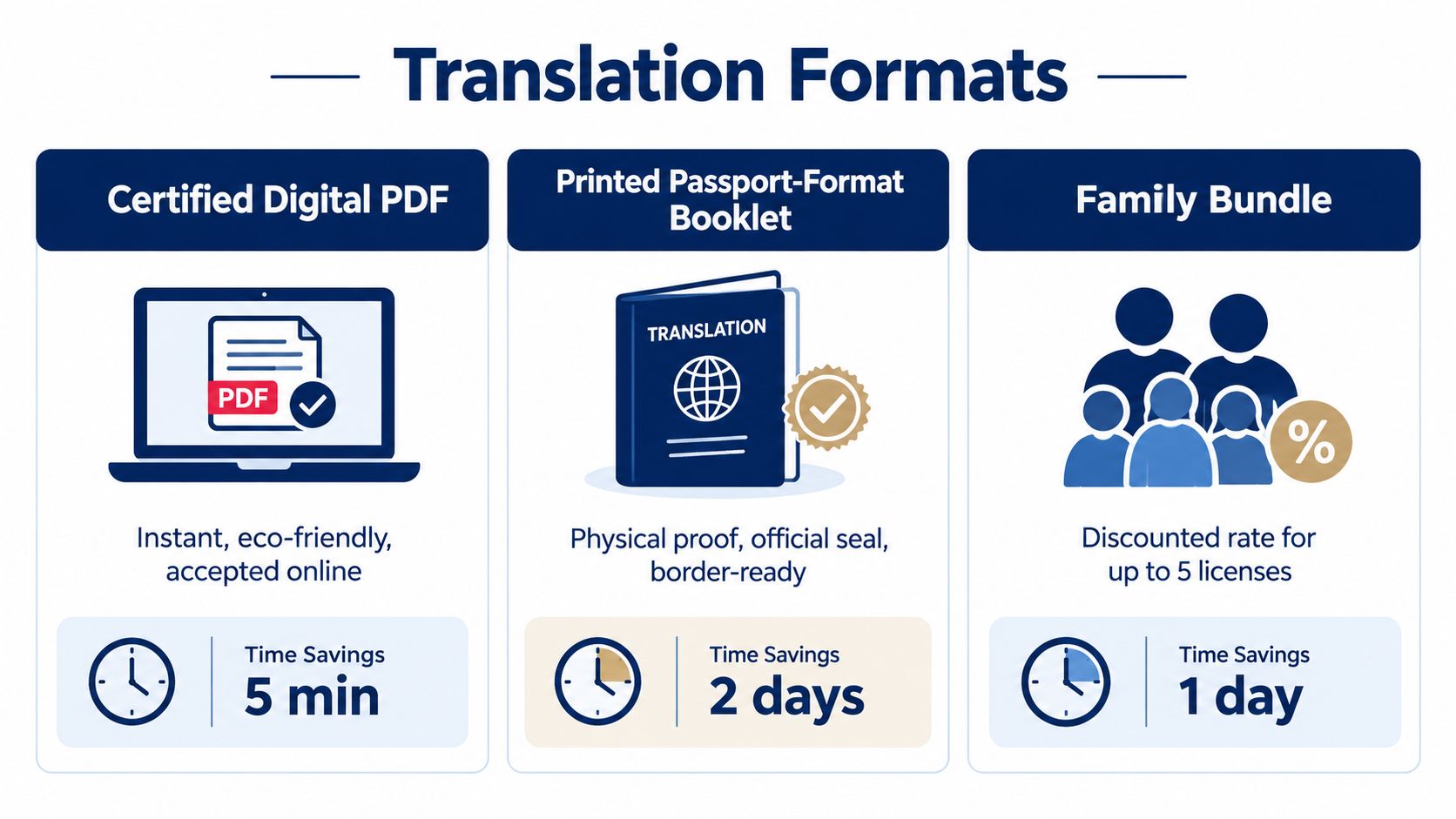
A certified digital PDF is practical when the rental company accepts electronic documents or when you need to submit files through an online portal. It can be stored with your passport scan and booking confirmation, then shown on a phone or forwarded to an agent before arrival. The trade-off is that a damaged phone, poor connectivity, or a desk that insists on paper can turn a convenient digital file into a last-minute problem.
Match the product to the recipient
| Format | Where it fits | Main trade-off |
|---|---|---|
| Certified digital PDF | Online submissions, email checks, phone presentation, and travellers who need rapid access | A desk or authority may still request a printed copy |
| Printed booklet | Physical document checks, traditional rental counters, and trips where paper backup matters | It requires delivery and should be protected from loss or damage |
| Family or group order | Couples, households, or colleagues who need several licences prepared together | Every licence still needs an individual field-by-field review |
A printed passport-format booklet can feel more familiar at a conservative rental counter because the agent can hold it next to the original card. It doesn't eliminate the need to carry the original, and it doesn't guarantee acceptance where the authority requires a different document. It gives the reviewer a physical companion that is easy to file and inspect.
A family bundle can reduce administrative repetition for a group, but don't treat it as one shared entitlement. Each traveller's name, categories, dates, and licence number must be checked separately. A mistake on one person's translation won't be corrected by the accuracy of another's.
For agencies, employers, and travel coordinators, a multi-user workspace or business API may be more suitable than individual orders. Bulk handling can centralise files and invoices, but it introduces a data-handling responsibility. Limit access to the people preparing the documents, and identify the final destination authority for each request.
The distinction between Arabic and other right-to-left languages also matters for layout. A document should render Arabic naturally, without reversed fields, broken numerals, or misplaced punctuation. Guidance on right-to-left language document handling is useful when reviewing a sample before you submit your actual licence.
How Translation Verification Works
A rental agent may reject a translation within seconds if one field is unclear. Verification begins with the licence image and the information a recipient must inspect, not with the QR code. The front and reverse sides should be legible, with every corner visible. A cropped photograph or blurred number leaves the reviewer unable to confirm what the missing text says.
A sound verification workflow has two stages. The translator or document system records the licence fields in a structured format. A human reviewer then compares the translation with the original licence and the identity document. This second check catches errors that automated text recognition can miss, especially in names, numbers, vehicle categories, dates, and restrictions.
What a reviewer checks
Review the document field by field:
- Identity consistency: Does the translated name match the licence and passport page, including the order of names and any visible spelling differences?
- Number accuracy: Are the licence number and other identifiers reproduced exactly, without transposed or omitted digits?
- Category preservation: Are every vehicle class and code included, without simplifying or expanding the driving entitlement?
- Calendar handling: Are Hijri and Gregorian dates preserved or converted clearly when both appear?
- Certification completeness: Does the final file identify the translation as certified and show how its origin can be confirmed?
Rental desks often need to verify the document while the customer is standing at the counter. A QR reference can direct the agent to a public verification page, allowing them to match the file with a certification record. This supports an authenticity check, while a logo or typed certification statement alone may provide less usable evidence.
The QR code verifies the translation record. It does not confirm that the original licence remains valid, that the holder may drive in the destination country, or that the rental company's insurance conditions are satisfied. Those decisions still depend on the original licence, passport, visa or residency status, and the rules applied by the destination authority or rental company.
A digital file should open without special access, remain readable at normal zoom, and contain the complete translated record. An online certified translation workflow can support this process when the output includes all licence fields and the recipient can validate it without relying on a private email exchange. Before travel, open the final file and test its verification reference.
Presenting Your Translated License Successfully
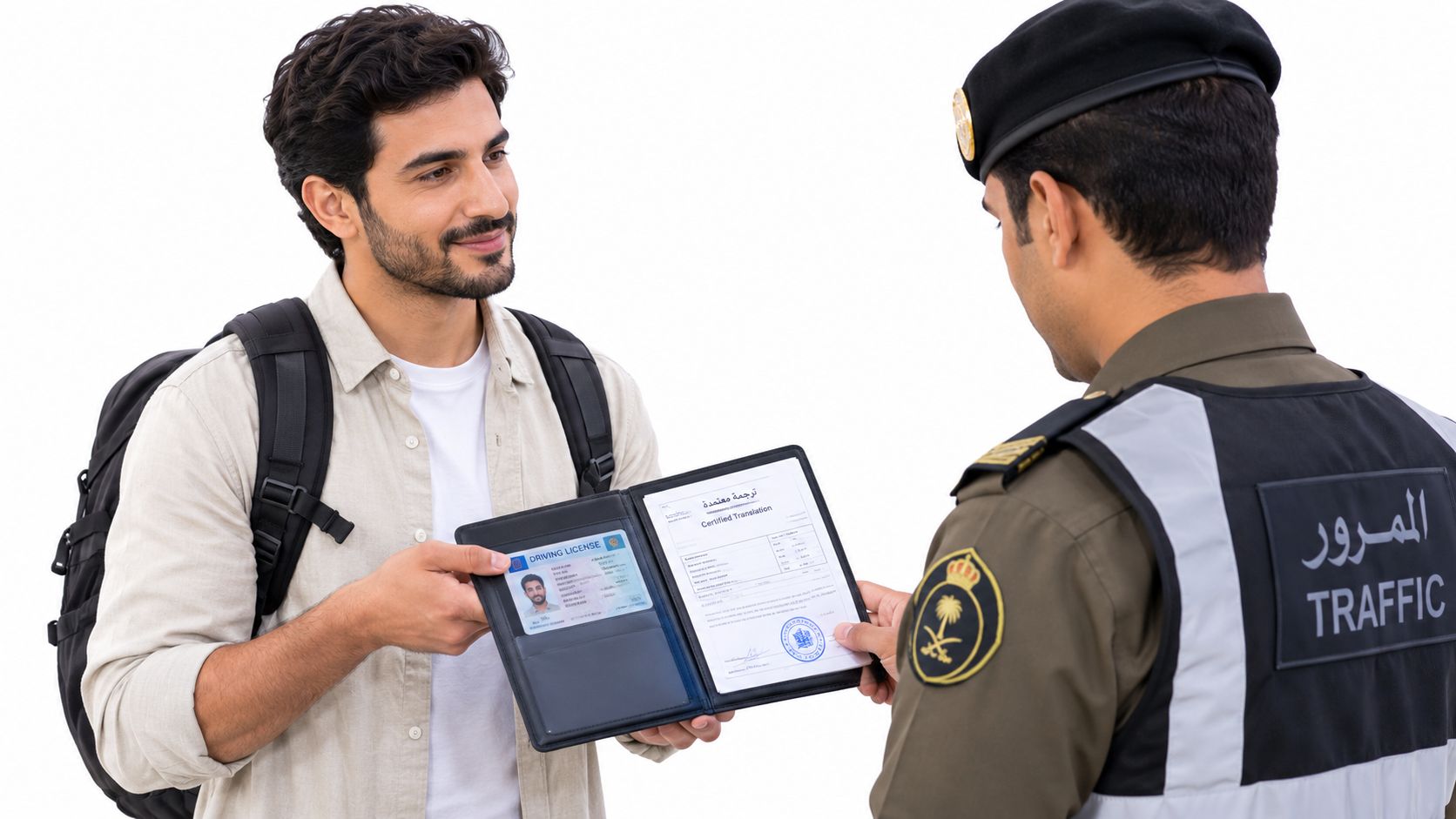
A rental agent has your passport, original licence, and booking open on the counter. If the names, licence categories, or dates do not line up quickly, the transaction can stall while the agent seeks approval. Carry the original driving licence and the certified Arabic translation together, with the passport ready to connect the documents when names or identity details differ.
Hand over the original first at a rental counter, then place the translation beside it. The agent can compare the Arabic entries with the card's categories, issue dates, expiry date, and restrictions instead of treating the translation as a standalone document. If clarification is required, point to the certification statement or verification reference and let the agent check the issuing record through its stated portal.
Use the right document for the right job
As noted earlier, a translation is not interchangeable with an International Driving Permit. Check whether your destination requires an IDP separately.
The receiving party determines what will be accepted. A rental company may use the translation to read licence details, while a traffic authority, insurer, or residency process may ask for a local exchange, legalisation, or other supporting documents. Check the stated requirements before travel through the Dubai RTA service information, then confirm any separate policy imposed by the rental company or insurer.
At a police checkpoint, keep the documents in a clear sequence. The original establishes the source record, the Arabic translation supports interpretation, and the passport or identity document links the licence to its holder. A loose translation page without the corresponding card can create avoidable questions.
For an insurance claim or accident report, present the same document set and leave the translation unchanged. If an officer or insurer disputes a field, ask which entry needs clarification and obtain a corrected certified version. Handwritten notes can make the document harder to verify.
Keep a printed certified copy as a backup, but do not substitute an uncertified draft for the final document. A phone screenshot may omit the certification statement, page boundaries, or verification reference. Open the complete file before departure, store it securely, and keep an accessible backup for the counter or checkpoint.
Troubleshooting and Common Questions
The most important question is whether you need a translation at all. The answer depends on what the licence already contains, who will receive it, and what transaction you're completing. If the licence is already readable in Arabic or is bilingual, an additional translation may not be requested, but you should still confirm the destination procedure.
Dubai's RTA guidance, for example, refers to uploading a legalised translation “if any”, which shows that a translation isn't automatically required in every submission. Swiss guidance also indicates that a licence translation is valid only when presented with the original. These examples support a practical rule: don't rely on a generic statement that every traveller must obtain an Arabic translation. Check the authority and use case first through the Dubai RTA service information.
Follow a decision path
- For a rental: Ask the rental company whether it accepts your licence as issued, requires Arabic translation, or requests an IDP as well.
- For a licence exchange: Follow the traffic authority's current document list and confirm whether legalisation, certification, identity documents, an eye test, or other supporting material is required.
- For insurance or an official filing: Ask the insurer or receiving office what certification wording and format it accepts.
- For a police check: Carry the original licence and any required companion document together. Don't assume a translation alone proves driving entitlement.
When a translation is rejected, identify the reason before ordering again. A missing reverse side calls for a new source upload. A name discrepancy requires comparison with the passport and, if necessary, clarification of the original licence. An unreadable date or category requires a clearer image, not a guess by the translator.
If the issue is certification, ask the recipient whether it needs a licensed translator, a stamp, legalisation, or a particular submission format. If the issue is the wrong document type, stop treating translation as a substitute for an IDP or local licence. The fastest resolution comes from matching the correction to the rejection reason instead of purchasing another generic translation.
Review the final file as if you were the rental agent. Can you locate the name, licence number, categories, dates, issuing authority, and restrictions without asking the traveller to explain them? If not, request correction before departure.
World Driving Permit provides certified, word-for-word driving licence translations into Arabic and other languages, with digital delivery and an optional printed booklet for presentation alongside the original licence. Check the requirements for your destination and prepare your documents through World Driving Permit before approaching the rental desk or licensing authority.