
Certified Translation Professional Explained
“Get a certified translation” is popular advice, but it's incomplete. In many countries, certified doesn't automatically mean the translator holds a government-issued licence. It may mean the translator has attached a signed statement confirming competence, completeness, and accuracy.
That distinction matters when you're an expat, a frequent traveler, or anyone planning to drive abroad. A translation of your driving licence can help a rental agent, police officer, insurer, or road authority read your document. It doesn't automatically become an International Driving Permit, and it doesn't replace your original licence.
Table of Contents
- The Reality of Certified Translation Credentials
- Legal Requirements and Quality Standards
- The Modern Translation Workflow
- Real-World Application for Driving Licences
- Choosing the Right Delivery and Verification Format
- How to Vet a Translation Provider
- Navigating Legal Acceptance and Common Questions
The Reality of Certified Translation Credentials
Most travelers assume a certified translation professional holds a specific state credential that every government recognizes. That assumption can send you looking for a licence that may not exist.
The practical question is different: What does the receiving authority require the translated document to contain?
In the United States, the American Translators Association's guidance on certified translations states that anyone may certify a translation. The certification statement should establish the translator's qualifications, confirm that the translation is complete and accurate, identify the document and language pair, and include the translator's name, signature, and date. The document's acceptance therefore depends heavily on the attestation and the destination authority's rules, not on a universal global licence.
That doesn't make professional credentials irrelevant. It means you must separate translator competence from document certification. A professional association credential can provide evidence of training, examination, ethics, and accountability. The signed statement is the formal declaration attached to the translation.
Why 1973 still matters
Professional certification has a clear modern milestone. In 1973, the American Translators Association established its certification program as a formal framework for recognizing professional-quality work, as documented by the ATA certification program.
That milestone helped distinguish verified practitioners from people who merely described themselves as translators. It also reflected a broader change in how the profession was understood. Translation increasingly became a service measured by competence, consistency, ethics, and responsibility, rather than a task based only on bilingual ability.
The historical credential remains useful when you're comparing providers, especially for legal, immigration, academic, and business documents. But it shouldn't distract you from the acceptance rule that applies to your specific destination.
Practical rule: Don't ask only, “Is this translator certified?” Ask, “What exact certification statement does the authority receiving my document accept?”
Credential, attestation, and official status
These terms aren't interchangeable:
- Professional certification can refer to an examination or credential issued by a professional association.
- Certified translation usually refers to a translated document accompanied by a signed declaration of competence and accuracy, although local definitions vary.
- Sworn translation may require a translator appointed or recognized by a court or public authority in a particular jurisdiction.
- An International Driving Permit is a separate travel document issued through an authorized system. A translation cannot claim to be one.
For driving licence translations, treat the certified translation as a readable companion to the original licence. It can clarify fields written in an unfamiliar script, but you still need the original, valid licence. If the destination requires an official permit, use the authorized issuer rather than trying to substitute a translation.
Legal Requirements and Quality Standards
A legally useful certified translation has two layers. The first is the translated content. The second is the certification statement that tells the receiving authority who prepared it and what the translator is attesting to.
ATA guidance identifies the key elements: a statement of the translator's qualifications, confirmation of completeness and accuracy, the relevant document and language pair, and the translator's name, signature, and date. A provider that delivers a fluent PDF without these elements may have produced a good translation, but not the document your authority requested.
What the certification statement should establish
Check the final file before you travel or submit it. Look for:
- Qualifications, identifying why the translator is competent to perform the work.
- Completeness, confirming that the translation represents the full document or clearly identifies its scope.
- Accuracy, stating that the translation faithfully reflects the source.
- Document and language details, so the statement relates to the correct licence or record.
- Signature and date, which connect the attestation to a named professional and a specific issuance.
This matters at an immigration court, government office, or border-related administrative process. A missing signature or unclear statement can create a rejection even when the translated words are correct. The U.S. Department of Justice immigration court policy manual requires a typed and signed certification stating that the translator is competent and that the translation is true and accurate.
A rental desk may apply a less formal test, while a court may apply a strict one. You shouldn't assume that acceptance in one setting guarantees acceptance in another.
Quality management is separate from legal certification
A provider's internal process also deserves scrutiny. ISO 17100 addresses core translation processes, resources, project management, and quality assurance. ISO 9001 is a general quality-management standard, while ISO 18587 addresses post-editing of machine translation. These standards serve different purposes, as explained in this overview of translation quality management.
For a driving licence, the provider should compare the output against the source document, preserve names and dates accurately, check licence categories, and review the final formatting. Machine assistance can support intake or drafting, but the final certified document needs accountable human review.
| What you evaluate | What it tells you |
|---|---|
| Certification statement | Whether the file contains the required attestation |
| Translator identity | Whether a named person accepts responsibility |
| Source-to-target review | Whether fields were checked against the original |
| Quality process | Whether the provider controls terminology and errors |
| Acceptance caveats | Whether the provider distinguishes translation from official permits |
The right standard isn't “Does this look professional?” It's “Can I explain who certified it, what they certified, and whether the receiving authority accepts that format?”
The Modern Translation Workflow
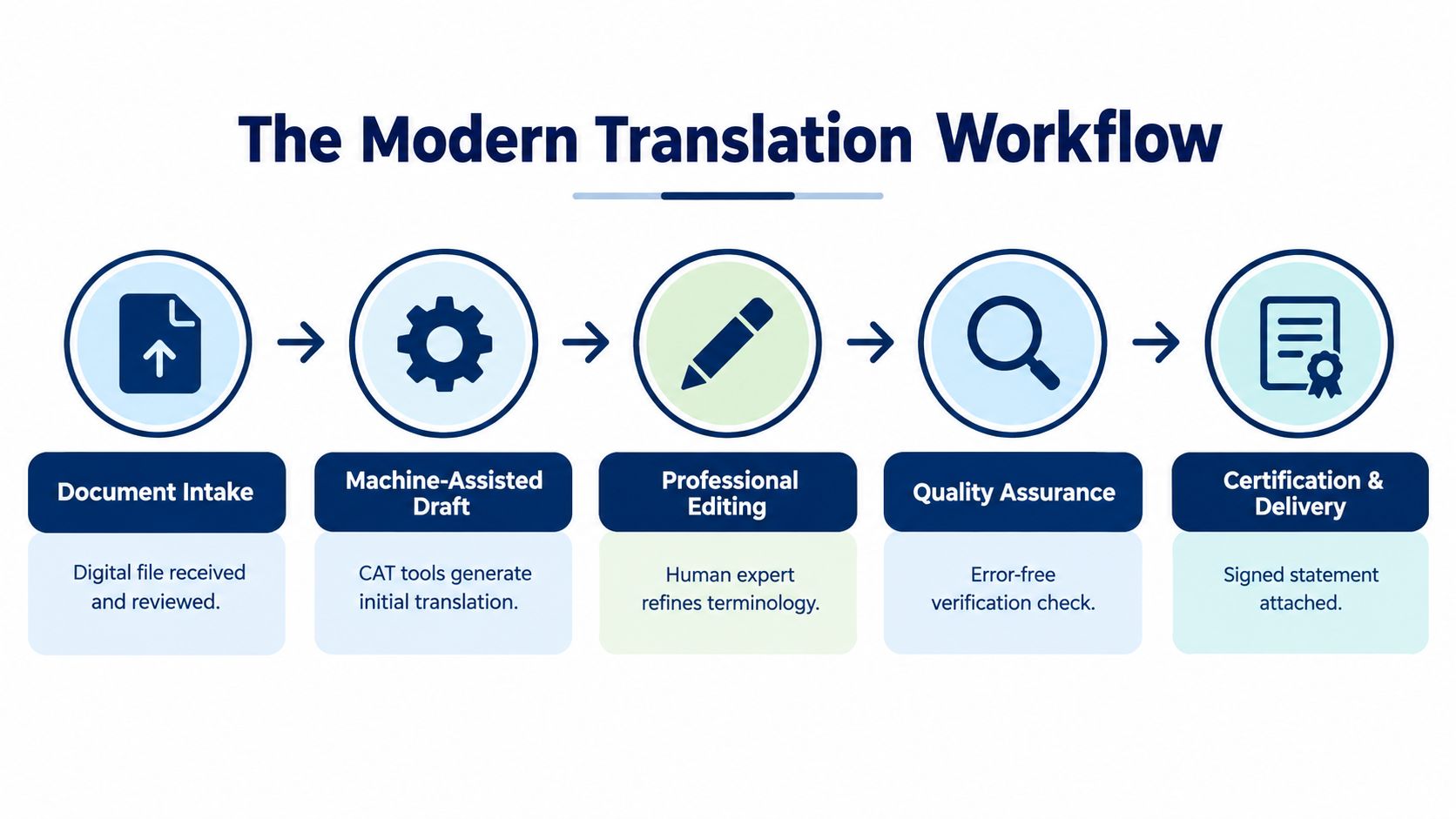
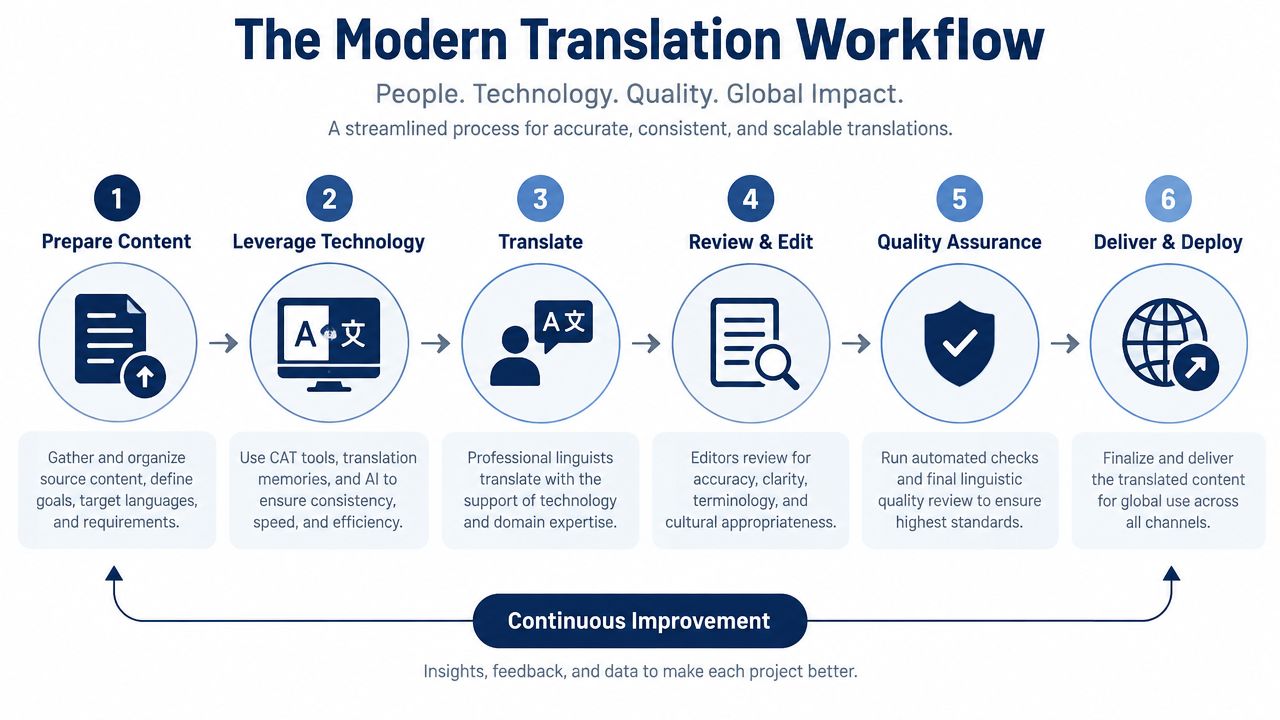
A modern certified translation workflow doesn't require a translator to retype every field manually. It can use optical character recognition, computer-assisted translation tools, terminology controls, and structured review. The important boundary is accountability. Technology may accelerate preparation, but a qualified human must verify the result before certification.
From licence image to reviewed document
The process usually starts with a clear scan or photograph. The provider identifies the document type, checks whether all fields are visible, and extracts information such as names, dates, licence categories, restrictions, and issuing details.
OCR can read text from many licence layouts, but it can misread characters, abbreviations, or low-quality images. That's why the reviewer must compare the translated document with the original rather than trusting extracted text.
A disciplined workflow includes:
- Document intake: The file is checked for legibility, completeness, and the requested language.
- Initial extraction or drafting: OCR and translation tools help prepare the working version.
- Terminology review: A human translator checks legal, administrative, and driving terms.
- Source comparison: Names, dates, categories, and identifying fields are matched against the original.
- Certification review: The statement, signature, date, and document references are checked.
- Secure delivery: The final files are supplied in a format the traveler can retrieve and present.
Right-to-left scripts and non-Latin alphabets require special attention. A literal translation that changes the appearance or ordering of identity fields can confuse the person checking the document. Native-script rendering and careful layout are practical compliance features, not decoration.
Security belongs in the workflow
Driving licences contain identity information. Ask how uploads are encrypted, who can access them, how long files remain available, and whether deletion is automatic. A provider that can't answer those questions clearly isn't ready to handle your document.
Digital delivery can be useful when a trip is close, but it creates another requirement: you must be able to retrieve the file without relying on one device or one email inbox. Save the document securely, keep a backup, and learn how digital delivery works before leaving.
Speed is valuable only when review remains visible. A provider promising instant output but refusing to explain human verification is offering convenience without a defensible process.
Real-World Application for Driving Licences
A driving licence may be perfectly valid in its issuing country and still be difficult for a foreign reader to interpret. At a rental counter, staff may need to identify the driver's name, date of birth, expiry date, vehicle categories, and restrictions quickly. If those details appear in an unfamiliar script, the problem isn't necessarily the licence. It's readability.
A certified translation can place those fields into the local or requested language and attach a statement of accuracy. That gives the counter agent a document they can read alongside the original. It doesn't alter the licence, expand your driving entitlement, or create a new legal category.
Translation versus International Driving Permit
Travelers often make the most expensive mistake here. A certified translation explains the contents of your national licence. An International Driving Permit is an official companion document issued through an authorized national or motoring authority under the applicable international framework.
You may need one, the other, or both. The answer depends on the destination, the rental company, the type of vehicle, your licence language, and local enforcement practice. Use the comparison of an IDP and a translated licence before ordering anything.
A translation is particularly useful when a staff member can't read the licence fields. An IDP may be required where local law or a rental agreement specifically demands it. Neither document replaces your original, unexpired driving licence.
What to carry at the counter
Keep the documents together rather than storing the translation separately:
- Original licence: This is the underlying authorization to drive.
- Certified translation: This makes the licence's information readable to the recipient.
- Official IDP, if required: Carry it when the destination or rental provider demands an authorized permit.
- Passport or identity document: Use it to resolve identity matching questions.
- Rental confirmation: Check whether the company lists additional document conditions.
Show the original first, then provide the translation as its companion. If the agent questions the translation, point to the signed statement and any verification reference. If they ask for an IDP, don't argue that a translation is equivalent. Confirm the requirement and obtain the correct document through an authorized issuer.
The same approach applies at a police checkpoint. Stay factual, present the original and companion documents together, and avoid claiming that a translation is a government permit when it isn't.
A short visual guide can help travelers understand how the documents fit together:
Choosing the Right Delivery and Verification Format
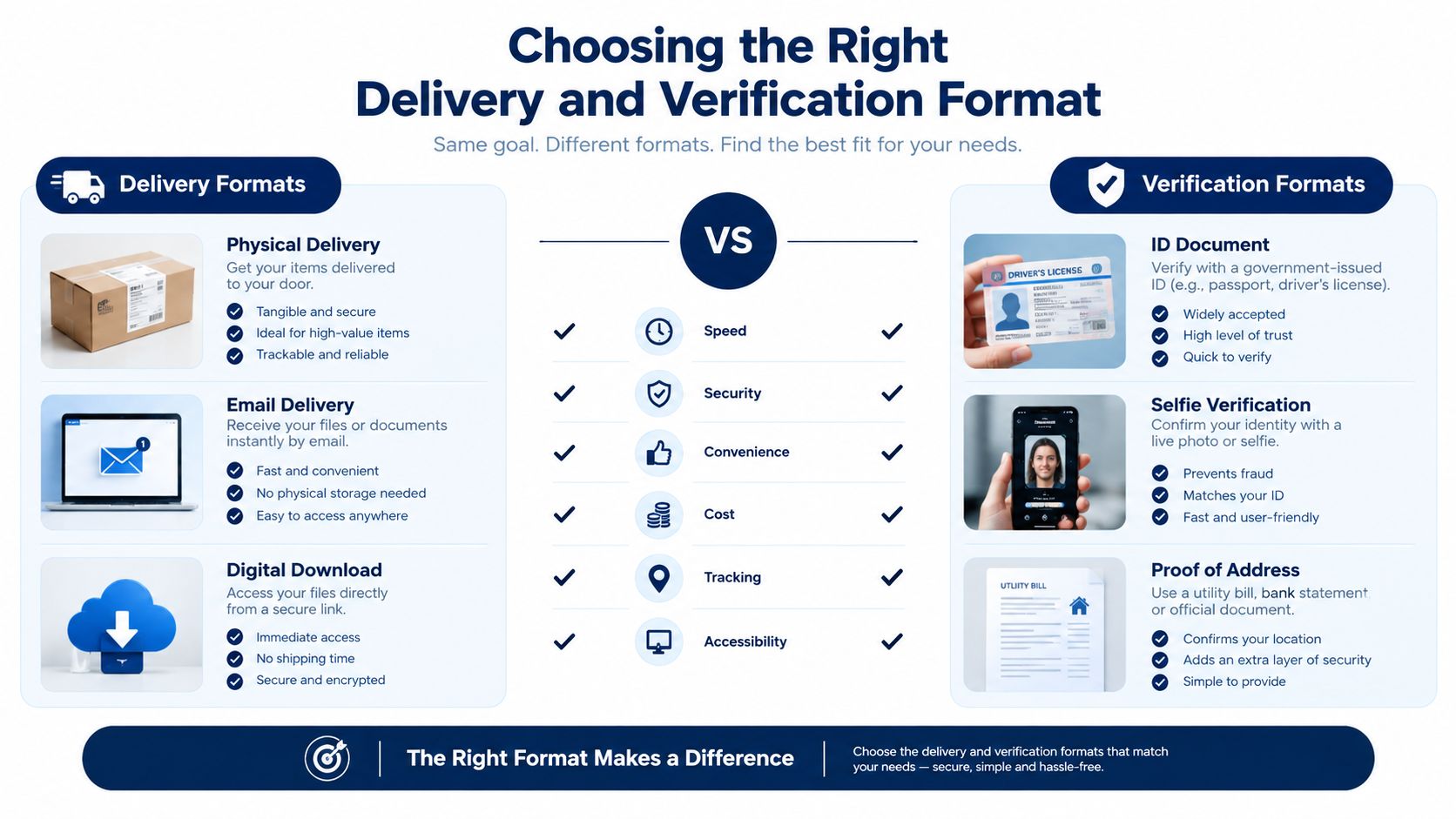
The translation's format affects how easily someone can inspect it. A digital PDF works well when the recipient can open files and the traveler has dependable access to a phone or cloud account. A printed booklet is more practical when a counter agent expects paper or internet access is uncertain.
Choose the format based on the journey, not on habit.
Digital delivery
A digital pack can be stored on your phone, backed up to secure storage, and forwarded when a rental company requests documents before arrival. A QR reference linked to a verification portal may help an agent confirm that the file corresponds to an issued record.
That convenience has limits. QR verification isn't a substitute for the receiving authority's own rules, and a phone with no battery is not a reliable document system. Keep an offline copy and make sure the file is readable without a specialist application.
Printed delivery
A printed, passport-format booklet gives you a physical document to place beside the original licence. It's useful when a rental desk works primarily with paper, when you're traveling through places with unreliable connectivity, or when several people need to inspect the document at once.
The trade-off is physical loss or damage. Keep it with your travel documents, not loose in a vehicle, and retain the digital version as a backup.
Match the pack to your itinerary
A single-language translation may be enough for a one-country trip. A multi-country itinerary can create a language problem at each border or rental desk. Families and couples should also check whether each driver needs an individual translation rather than assuming one document covers everyone.
Ask four questions before choosing:
| Travel situation | Sensible format |
|---|---|
| Short trip with dependable connectivity | Digital PDF with an offline backup |
| Remote route or paper-focused rental desk | Digital file plus printed booklet |
| Several countries with different language needs | A suitable multilingual document pack |
| Multiple drivers | Separate documents or a family option, as applicable |
For broader planning, review this guide to travel document translation. The correct format is the one that remains available, legible, and explainable when a person needs to check it quickly.
How to Vet a Translation Provider
Price should be near the end of your evaluation, not the beginning. A cheap document that a rental company or authority rejects costs more than a properly prepared translation because it creates delay at the exact moment you have the least flexibility.
Start with the provider's description of scope. It should state whether the service supplies a translation companion, a certified statement, an official permit, or some combination. If the wording blurs these categories, move on.
Use this provider checklist
- Read the acceptance caveats: A responsible provider won't promise universal acceptance. Local authorities and rental companies make their own decisions.
- Inspect a sample: Confirm that the sample shows the source fields, translated fields, certification wording, translator identity, signature, and date.
- Ask about human review: Find out who checks OCR output, dates, names, vehicle categories, and formatting.
- Review security controls: Look for encryption, limited access, retention rules, and deletion procedures.
- Test verification: Open the verification portal and check whether the reference leads to a public, understandable record.
- Check correction terms: A clear fix or refund policy shows that the provider accepts responsibility for production errors.
- Confirm delivery options: Decide whether you need a digital file, printed booklet, or both.
Cloudflare-hosted infrastructure may support a reliable public verification portal, but hosting alone doesn't prove legal acceptance. Treat it as a technical trust signal, not a legal guarantee.
Be cautious with providers that issue a polished PDF but don't identify the certifying person. Also avoid any service that presents a translation as an IDP, promises acceptance everywhere, or tells you that the original licence is unnecessary.
For a driving licence translation, a useful provider should ask for the actual licence image, identify the requested language, preserve the document's fields, and explain what the result can and can't do. A generic “instant certified” label isn't enough.
Navigating Legal Acceptance and Common Questions
Does a certified translation work in every country? No. Acceptance is local. One authority may accept a signed translation, while another may require a sworn translator, a specific format, an apostille, or an official International Driving Permit. Check the destination's road authority, embassy, rental company, or other receiving body before departure.
Can a translation replace my driving licence? No. Carry the original, valid licence with the translation. The translated document explains the original. It doesn't grant driving rights or prove that your licence remains valid.
Is a certified translation the same as an IDP? No. The translation is a companion document prepared to make the licence readable. An IDP is an official permit obtained through an authorized issuing route. If local rules require an IDP, obtain that document as well.
What should I do if a rental agent questions the translation? Stay calm and show the original first. Then provide the translation, point to the signed certification statement, and offer the verification reference if one exists. If the agent says the rental company requires an IDP, ask for the requirement in writing or check your booking terms, but don't misrepresent the translation as an official permit.
What if a police officer or authority rejects it? Don't rely on an argument about the word “certified.” Ask which document or issuing body they require, and follow that requirement. For future trips, contact the destination authority before traveling and keep written confirmation with your booking records.
The safest document strategy is simple: use a professional translation when language creates a readability problem, use an official IDP when the destination requires one, and carry both with the original licence when uncertainty remains. A signed statement supports credibility, but it can't override local law.
World Driving Permit offers certified, word-for-word driving licence translations in 28 languages, with digital delivery and an optional printed booklet for presentation alongside the original licence. If you need a readable companion document for rental desks or checkpoints, visit World Driving Permit and check the destination guidance before you travel.