
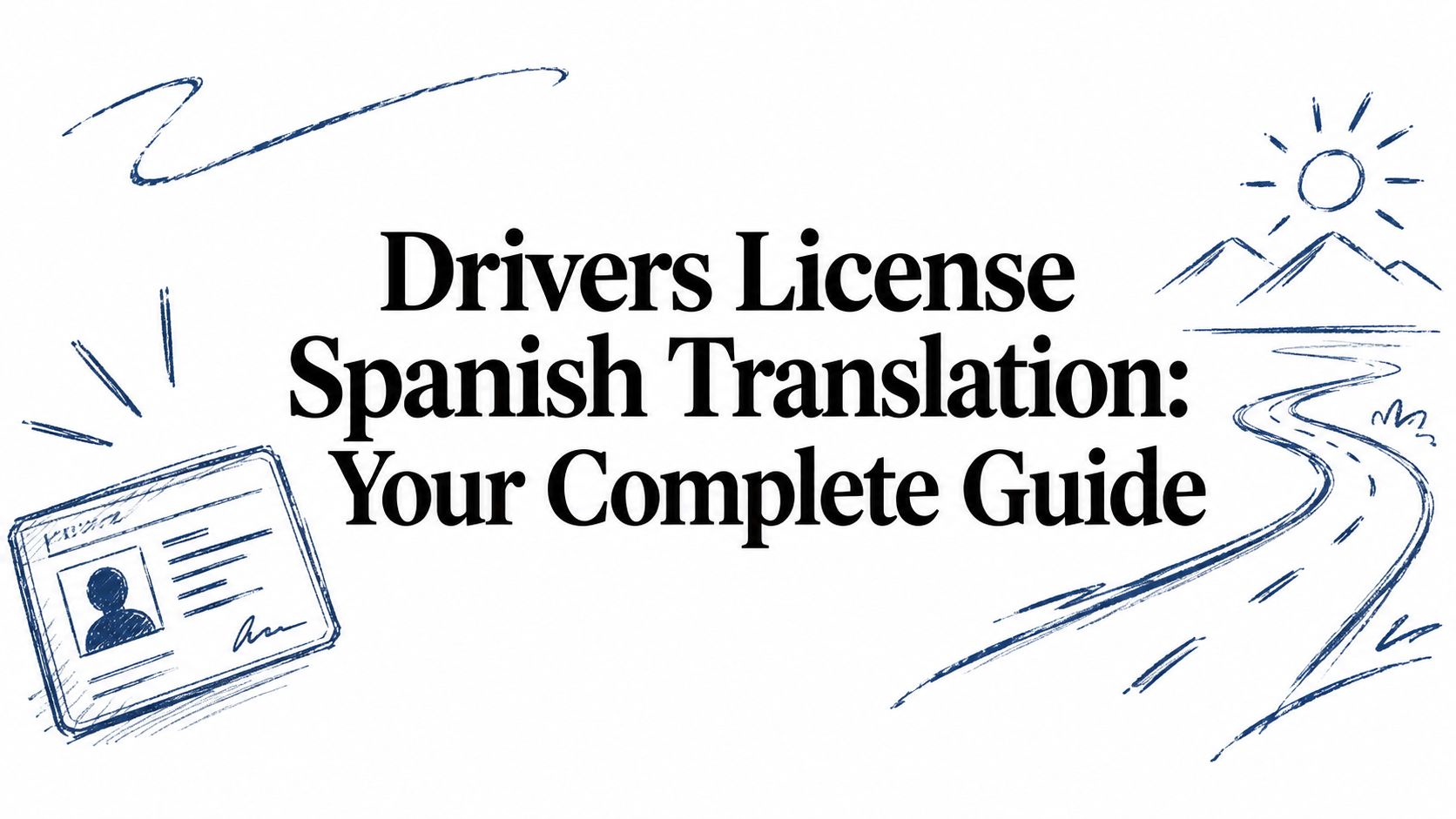
Drivers License Spanish Translation: Your Complete Guide
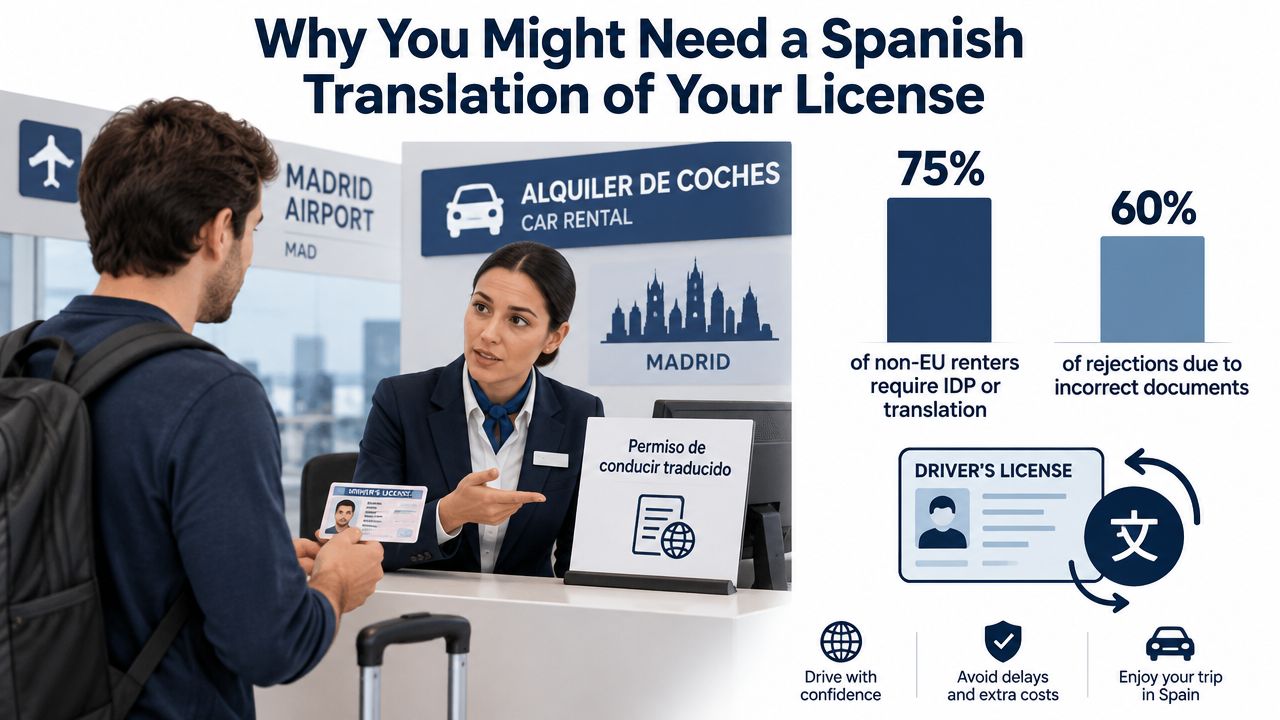
You're at a rental counter in Madrid with your passport, booking confirmation, and perfectly valid home-country licence. The agent studies the card, looks at the unfamiliar wording, and asks for a permiso de conducir traducido, or a translated driving licence. Your problem isn't necessarily whether you can drive. It's whether the person in front of you can quickly verify what your licence says, and whether the document you brought is legally sufficient for this particular use.
That distinction matters. A readable Spanish translation helps a clerk or officer understand your identity, vehicle categories, dates, and restrictions. An International Driving Permit, or IDP, acts as a recognised translation companion under applicable international arrangements, but it isn't a standalone driving entitlement. A sworn translation, or traducción jurada, carries a different level of formal authority and may be required for Spanish administrative or legal procedures.
The right choice depends on the destination, the rental company, your status as a tourist or resident, and the script used on your original licence. This guide separates those choices so you can order the document that matches the checkpoint you're likely to face.
Table of Contents
- Why You Might Need a Spanish Translation of Your License
- Understanding What a Spanish Translation Means
- Preparing the Right Documents Before You Order
- Choosing the Right Translation Format for Your Trip
- Matching the Translation to Where You're Going
- Avoiding the Most Common Rejection Scenarios
- Your Decision Framework Before You Travel
Why You Might Need a Spanish Translation of Your License
Your real challenge is whether the rental agent can verify your licence quickly. At a Madrid counter, the agent checks that the person named on the card is you, that the licence covers the vehicle you plan to rent, and that it remains valid. An English-only card may contain all that information while still causing delays if its categories, restrictions, or layout are unfamiliar.
A Spanish translation addresses three practical needs. Rental staff can compare your name and licence class with your passport and booking. Police can identify the relevant categories and dates during a roadside check. Insurers and claims staff can understand the document if they review your driving eligibility after an incident. The translation improves readability. It does not give you a new right to drive.
The question behind the request
Foreign driving licences are commonly accepted in Spain when written in Spanish or accompanied by an official translation. Travel and rental guidance also commonly directs holders of non-Spanish licences toward an IDP as a translation companion, particularly when the original uses a script local staff cannot easily read. The key issue is language and script, alongside the country that issued the card. Spain driving guidance on translated licences and IDPs reflects that distinction.
Latin-script licences are generally easier for a counter agent to inspect. Arabic, Cyrillic, and Chinese scripts are more likely to prompt a request for an accompanying translation or permit because staff cannot confidently verify the original fields at a glance. A Latin-script licence still may not be accepted alone. Rental policies and enforcement practices can impose additional requirements.
Practical rule: Use a translation to make the licence readable. Treat an IDP as a possible required companion for driving and rental use, and obtain a sworn translation when Spanish authorities require formal legal documentation. A readable document is not automatically legally sufficient.
The distinction matters even more if a holiday becomes a residence or licensing matter. A tourist collecting a rental car may need a readable companion document accepted by that company. A resident dealing with Spanish authorities may need a sworn translation, including every annotation and the reverse side of the licence. The phrase “drivers license Spanish translation” can therefore refer to documents with very different practical value, from a convenience at the counter to a formal requirement for an administrative procedure.
Understanding What a Spanish Translation Means
The standard Spanish renderings of “driver's license” are permiso de conducir and carnet de conducir. Both are widely understood. Spanish-speaking countries also use terms such as licencia de manejo, licencia de conducción, carné de conducir, and brevete. A professional translation should preserve the original document's meaning and structure, rather than replacing its terminology with a regional phrase that could alter its legal sense.
A Spanish translation renders your existing licence into readable Spanish. It should reproduce the holder's name, licence number, vehicle categories, issue and expiry dates, restrictions, issuing authority, and relevant annotations. It makes the document understandable, but it does not create a new entitlement to drive or establish authorization on its own.
Readability, certification, and sworn status: three different levels of authority
A readable translation helps a person understand the original licence. It may work at a rental desk or during informal verification, provided local rules and the company's policy allow it. Treat this format as a readability aid, not as proof that every authority must accept your driving credentials.
A certified translation includes a formal statement or certification from the translator or service provider. That document may satisfy an organization requesting certified paperwork. The label “certified” does not give it the same status as a Spanish sworn translation.
A traducción jurada is prepared by a translator authorized to produce sworn translations in Spain. Investigate this format when a Spanish government office, court, notary, licensing authority, or registration procedure specifically requires sworn work. A general translation provider cannot give an ordinary PDF equivalent legal status by calling it sworn.
Your licence's original script also affects the work. A Latin-script card may require direct translation of labels and categories. A licence printed in Arabic, Chinese, Japanese, Korean, Thai, or Cyrillic may require both transliteration of names and translation of fields, while preserving the original data exactly.
| Translation type | Who accepts it | Typical use |
|---|---|---|
| Readable translation | Rental staff, insurers, or officials where local rules allow it | Understanding an original licence during travel |
| Certified translation | Organisations that request a certified document | Formal verification and selected administrative uses |
| Traducción jurada | Spanish authorities, courts, notaries, or offices that require sworn work | Residency, licensing, registration, or legal proceedings |
Before ordering, ask the provider three direct questions: Must you present the original licence? Does the document include both sides and every annotation? Will the inspecting organization accept that certification? Those answers matter more than the product title.
Preparing the Right Documents Before You Order
Start with the licence itself, not a cropped photograph of its front. Send a clear colour scan or photograph of both sides, including the edges, holograms where visible, restriction codes, endorsements, issue details, and expiry information. A translator can interpret what's shown. They can't reconstruct a field hidden outside the frame.
A damaged card deserves attention before translation begins. Peeling laminate, glare across the licence number, an outdated photograph, or a blurred category code can create a second problem after the translation is issued. If the original is difficult to read, ask the issuing authority whether you need a replacement rather than paying for a document that repeats an unclear source.
Build a clean source file
Your passport bio page helps the translator match the licence holder's name and spelling. If you're a resident or applying for a local procedure, a residency card or other status document may establish which authority's rules apply. A previous translation can help maintain terminology consistency, but it shouldn't be treated as authoritative if it omitted the reverse side or contains a mismatch.
Use one complete upload rather than scattered screenshots. The provider should be able to compare the original licence with every translated field and flag an inconsistency before issuance.
- Front and back: Include every side of the physical card, not only the side with the photograph.
- Legibility: Retake images affected by glare, shadows, compression, or reflections.
- Identity matching: Check that the name format agrees with the passport and travel booking.
- Annotations: Show restrictions, endorsements, category codes, and issuing details.
- Purpose: Tell the translator whether the document is for a rental counter, police inspection, residency file, exchange, or registration.
Order for the strictest foreseeable use
A translation intended for a rental desk may not satisfy a government office. If you're travelling as a tourist, confirm the rental company's physical-document policy before selecting a format. If you're preparing a residence, exchange, or registration application, ask the receiving authority whether it requires a traducción jurada and whether additional legalisation applies.
Don't leave this until the airport. You need time to correct a missing back side, inconsistent name, or rejected format. Keep the original licence with the translation at all times, because the companion document doesn't replace it.
Choosing the Right Translation Format for Your Trip
The right format depends on who will inspect the document and what that person is authorised to accept. A digital PDF supports advance review and backup use. A printed certified booklet suits many rental counters and physical checks. A sworn translation serves authorities that require formal certification. These formats improve readability, but readability alone does not establish driving permission.
Digital PDF
Use a PDF to check the translated name, licence categories, dates, restrictions, and issuing details before departure. It also works as a backup when a rental company or authority accepts electronic documents. Confirm that policy in advance, because a PDF may be rejected where staff require an original paper translation.
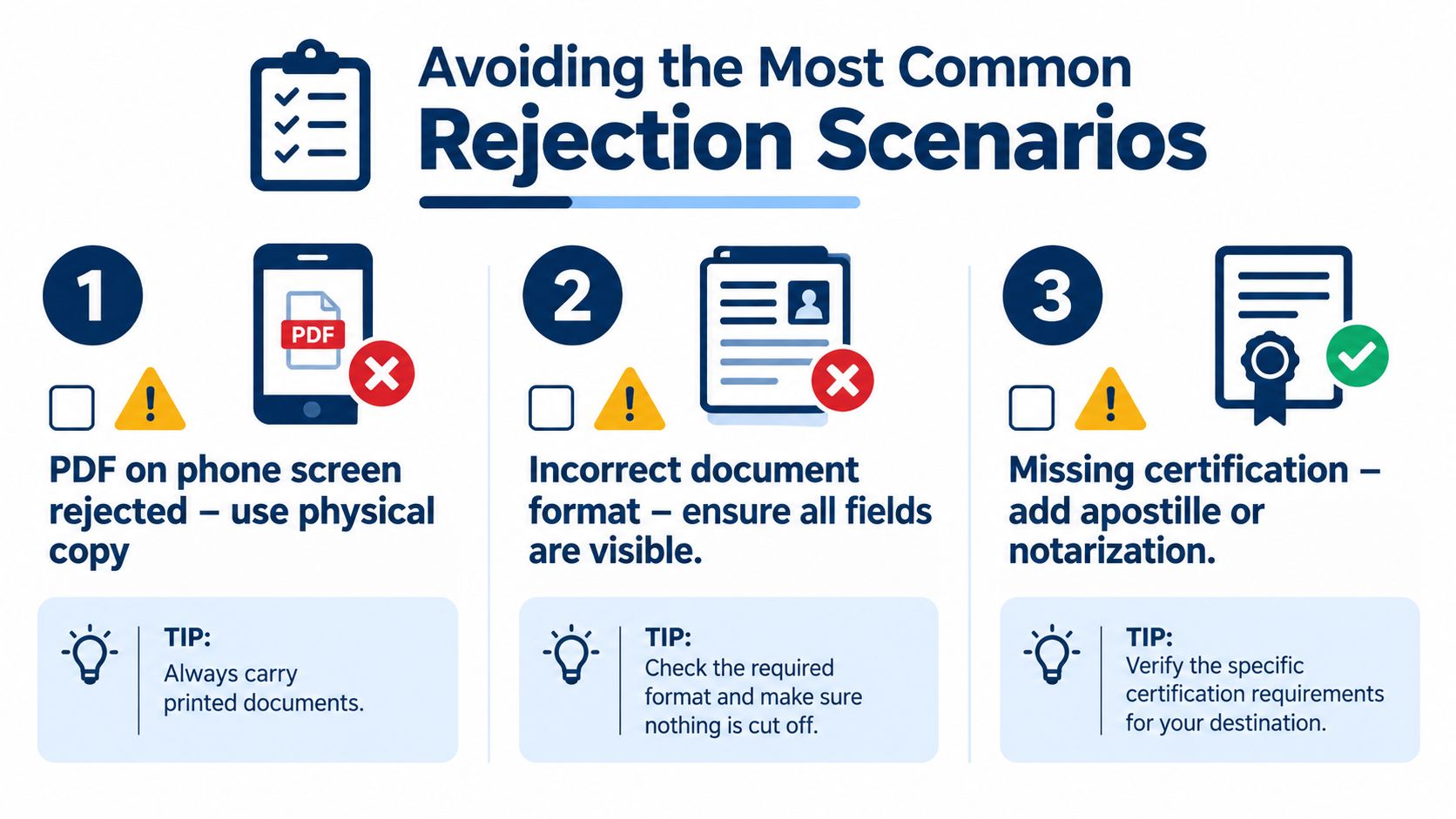
A phone image is a weak primary document for a Spanish licence translation. Staff need to read category codes, restrictions, and translated fields without glare or scrolling between separate images. A low battery, poor connection, locked file, or unreadable screen can stop the inspection even when the translation itself is accurate. Store the PDF securely and print it if the document will be checked in person.
Printed certified booklet
A printed booklet gives rental staff a stable page to compare with the original licence. It keeps front and back details together, presents the translated fields consistently, and is easier to inspect at a counter or checkpoint. Some rental policies require original paper translations and reject digital or PDF versions at pickup, as described in Europcar's rental document terms.
A printed booklet helps staff read your licence at the counter, but it carries no more legal weight than a certified PDF and never substitutes for an official IDP. An IDP is an authorised translation companion issued under the applicable convention. Carry the underlying national licence with it. For a clear comparison of readable translations and travel-document requirements, see this explanation of travel-document translation.
Sworn translation
Order a sworn translation when a Spanish authority, court, notary, registration office, or licensing process specifically requires one. This is the appropriate route for formal acceptance, including cases where an ordinary certified translation or IDP will not satisfy the receiving office. A short tourist rental usually does not need this format if the company accepts an IDP or another specified companion document.
| Format | Best use | Legal weight | Typical cost |
|---|---|---|---|
| Digital PDF | Backup and accepted electronic review | Depends on recipient | Provider-dependent |
| Printed certified booklet | Rental desks and physical inspections | Certified companion, not automatically an IDP | Provider-dependent |
| Sworn translation | Government, legal, residency, or licensing procedures | Formal status where specifically required | Provider and procedure-dependent |
Choose the document required by the strictest person who may inspect it. Keep the original licence with every translation or IDP, because no companion document replaces the licence itself.
Matching the Translation to Where You're Going
Your destination determines the document that will work. A readable Spanish translation can help a rental agent understand your licence, while an IDP may be required for driving or rental acceptance. A sworn translation belongs to formal government, legal, or licensing procedures. Choose according to who will inspect the document, not just the language printed on your licence.
Spain
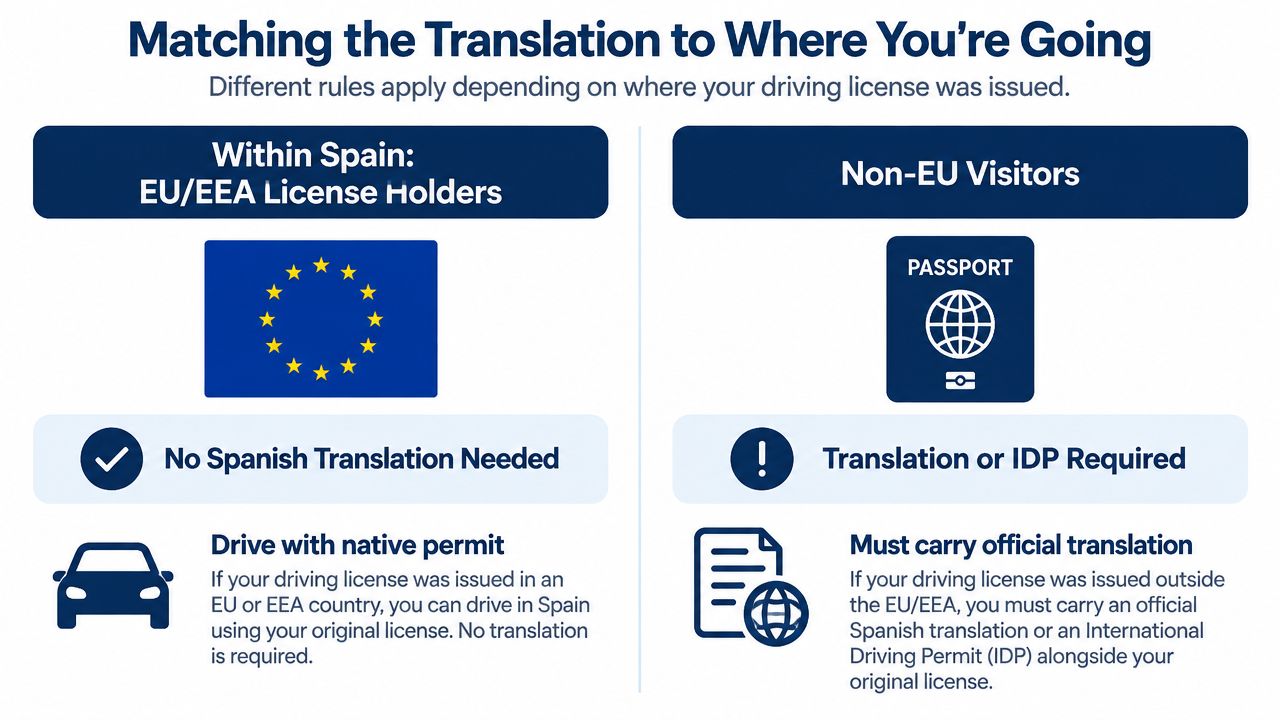
EU and EEA licence holders generally drive in Spain with their national permits. Non-EU visitors need a more deliberate plan. Spanish authorities may expect the licence to be in Spanish or accompanied by an accepted translation, and rental companies frequently recommend an IDP for non-Spanish licences. The practical details for U.S. visitors are outlined in this guide to driving in Spain with a U.S. licence.
The IDP works as a translation companion that must always be carried alongside your underlying national licence. It can support short-term driving and rental checks, but the receiving organisation decides whether it satisfies its own process. Residents face a different requirement: exchange, recognition, or licensing applications may call for a sworn translation. Missing reverse-side information or licence annotations can also prevent acceptance.
Use a sworn translation when a Spanish authority specifically requests formal certification. For a short tourist rental, an accepted IDP or readable translation may be enough, but confirm the rental company's policy before departure.
Latin America
Mexico, Argentina, Chile, and Colombia commonly separate short-term tourist driving from resident licensing obligations. A rental desk may accept a valid home-country licence with a readable translation, yet another company or a police officer may request an IDP. Legal permission and counter acceptance can therefore produce different document requirements.
Argentina shows why checking before booking matters. A foreign licence can be usable during a short visit, while an IDP becomes particularly useful when the licence is not in Spanish. A rental company or police officer may request it. Guidance for foreigners driving in Argentina recommends confirming the agency's requirements and carrying the original licence with the relevant travel documents.
U.S. and Canadian rental situations
Licences written in English or Latin characters are often easier for staff to review in the United States and Canada. Non-Latin scripts are more likely to prompt a request for an IDP or a professional typed translation. Some rental policies accept a typewritten translation when an IDP cannot be obtained, but the original licence remains required. International rental guidance on IDP and translation requirements explains why the two documents serve different acceptance needs.
Non-Latin scripts
Arabic, Chinese, Japanese, Korean, Thai, and Cyrillic licences call for a conservative choice. Carry the original licence with an IDP or professional translation in the format the destination and rental company accept. Use a sworn translation when a government office, court, notary, residency application, vehicle registration, or licence exchange requires formal legal recognition.
Avoiding the Most Common Rejection Scenarios
The most frequent rejections at rental counters trace back to incomplete documents rather than translation quality. Common problems include missing the back side, omitting annotations, or presenting a phone screenshot instead of paper. A readable translation still fails if the agent cannot verify every licence detail.
Run a counter-ready audit
Print the translation before departure and keep it beside the original licence. If the rental company requires paper, a digital file will not help at pickup. Use a physical copy as your default, with a secure scan available only as a backup.
Check the translation against the source line by line:
- Complete coverage: Confirm that the front, back, annotations, categories, dates, and licence number all appear.
- Terminology: Check that the Spanish wording is clear for the destination, including recognised terms such as permiso de conducir or carnet de conducir.
- Certification: Review signatures, stamps, statements, and verification details. Confirm that the receiving organisation accepts that form of certification.
- Original pairing: Carry the national licence with the translation. A translation supports the original and does not replace it.
- Backup access: Store a scan securely so you can retrieve it if the paper copy is lost. Do not rely on the phone version as your only document.
A translation that leaves out the reverse side may omit a restriction an officer needs to interpret. A polished PDF with the wrong scope remains insufficient authorization. For a rental desk, a clear translation may be enough. If the destination or company requires an IDP, carry one with the original licence. A government office, court, notary, residency application, vehicle registration, or licence exchange may require a sworn translation instead. Readability and legal acceptance are separate tests.
For a concise visual reminder before departure, use the following preparation video:
Your Decision Framework Before You Travel
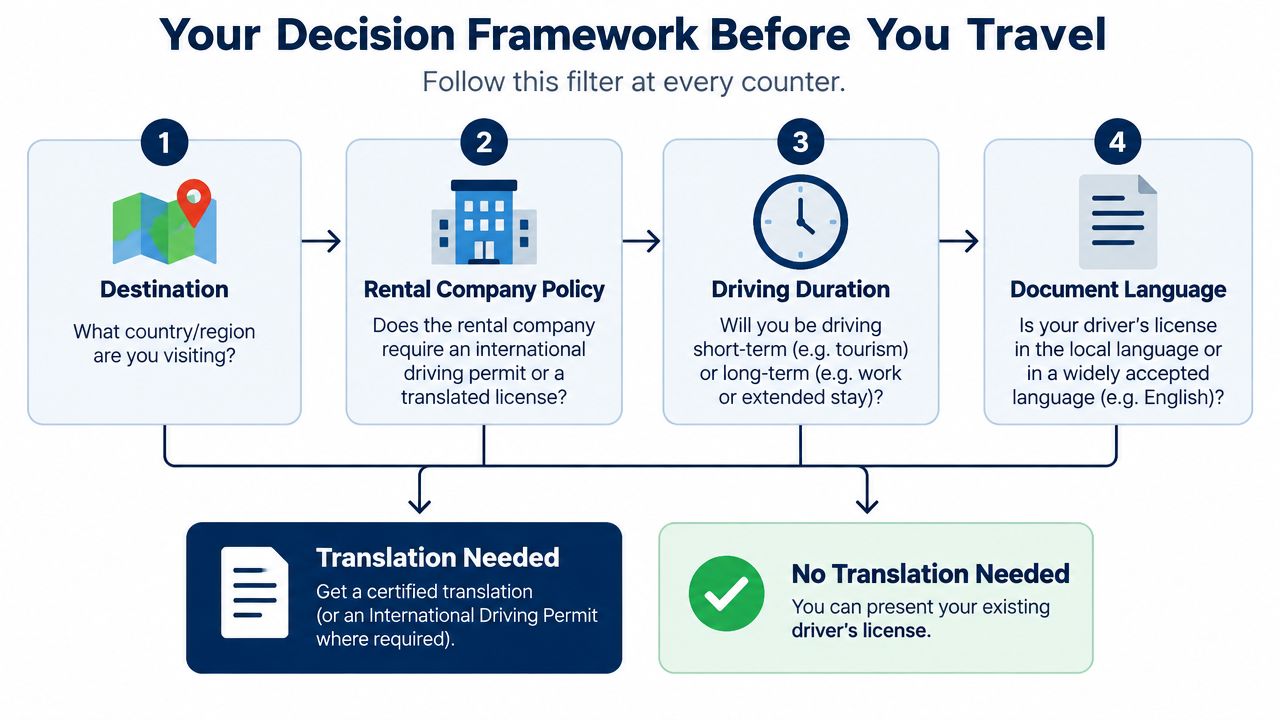
Use four filters in order. First, identify the destination's rule. Second, check the rental company's written policy. Third, decide whether you're visiting briefly or dealing with residence and licensing obligations. Fourth, assess the language and script of the original licence.
That sequence separates convenience from legal sufficiency. A Latin-script licence may be readable without a formal translation, while a non-Latin licence needs a stronger companion document. A rental company may accept a printed translation where an authority requires an IDP. A government office may require a sworn translation even though the rental desk was satisfied with a booklet.
At the counter, carry the document the strictest rule requires, not the document the most casual rule permits.
For most tourist rentals, my practical recommendation is to carry the original licence, a printed certified translation, and a digital backup. Add an IDP whenever the destination or rental company requires one. Reserve a sworn translation for a government, legal, residency, exchange, or registration procedure that specifically demands it. The comparison in IDP versus translated licence guidance helps keep those documents separate.
If you're travelling soon, verify the rental policy, photograph both sides of your licence, and order the format your strictest checkpoint accepts. World Driving Permit provides certified Spanish licence translations as digital documents with an optional printed booklet, while its requirement guidance can direct travellers toward an authorised IDP issuer when a genuine IDP is required. Visit World Driving Permit to prepare the translation companion that matches your trip.