
Driving in Spain with US License: Rules You Need
You've just landed at Madrid-Barajas, walked past the taxi rank, and reached the rental counter with a U.S. license showing a state name the agent can't immediately verify. Your trip may be perfectly legal, but the documents in your wallet will decide whether you leave in a car or return to the taxi line.
The phrase driving in Spain with a U.S. license covers two very different situations. A short-stay visitor and a person who has established normal residence aren't operating under the same rule, even if both still hold a valid American license. The essential legal window is six months, or 180 days, from the date normal residence begins, after which Spain requires a Spanish license, as explained by the Spanish government's driving-licence guidance.
Table of Contents
- Who This Guide Is For
- Visitor vs Resident Driving Rules
- Documents You Must Carry
- Spanish Road Rules That Catch Americans Off Guard
- Rentals, Checkpoints, and What to Do When Stopped
- Fines, Accidents, and Crossing the Six-Month Line
Who This Guide Is For
This guide is for Americans planning to drive a car, van, or motorcycle in Spain using a valid U.S. state license. That includes a visitor collecting a rental in Madrid, a family touring Andalusia, a student attending a short program, a retiree staying with relatives, and a new arrival who hasn't yet completed the practical steps of settling in.
The passport you carry matters for entry, but it isn't the main factor determining whether your American license remains usable. Residency status and elapsed time control the important transition. A tourist using a rental car for a short trip is in a different legal position from someone who has established normal residence and continues driving months later.
Put yourself in the right category
Use these questions before you reserve a vehicle:
- Are you visiting temporarily? Visitor rules generally apply while you're in Spain for a short stay and haven't become a normal resident.
- Have you established normal residence? Once residency begins, the six-month clock becomes the deadline for moving to a Spanish license.
- Are you staying for an extended period without a clear plan? Don't assume that entering as a tourist gives you unlimited driving rights. The Spanish government guidance identifies six months for foreign students and other non-EU residents, while Spain-focused explanations sometimes describe shorter visitor periods. That conflict is exactly why you should establish your status and dates before driving long-term.
A digital nomad who hasn't crossed into normal residence should still treat the timeline seriously. A student should do the same, even if the academic program feels temporary. The issue isn't whether your U.S. license remains unexpired in your home state. The issue is whether Spanish law still recognizes you as a visitor for driving purposes.
This article doesn't cover professional licensing for buses, heavy commercial vehicles, or other specialized driving work. It also doesn't cover drivers who already hold a Spanish or another EU license. Those credentials follow a different framework.
Practical rule: Write down the date your normal Spanish residence begins. Don't rely on the date printed on your U.S. license or the date your rental contract ends.
Visitor vs Resident Driving Rules
The cleanest way to understand the rule is to separate temporary visitor driving from resident driving. Spain generally allows visitors to drive with a valid U.S. license for a short stay, but a U.S. license by itself may not satisfy rental desks or roadside document checks. Many Spain-focused compliance guides recommend carrying an International Driving Permit alongside the original license, particularly when the license isn't written in Spanish or a widely recognized EU language, as outlined in this Spain driving requirements guide.
The legal position changes after normal residence begins. A resident may use the U.S. license during the first six months, or 180 days, from the residency date. After that window, the American license is no longer valid for continued driving in Spain, and the driver must follow the Spanish licensing process. Spain doesn't provide Americans with a simple automatic U.S.-to-Spain exchange, so planning for testing and paperwork matters.
| Requirement | Visitor, under 6 months | Resident, over 6 months |
|---|---|---|
| Basic credential | Valid physical U.S. state license | Spanish license required after the resident window |
| Companion document | IDP or an accepted official translation is strongly recommended, and may be demanded by a rental company | Companion documents don't replace the required Spanish license |
| Residency trigger | Temporary visit without normal residence | Establishing normal residence starts the relevant clock |
| Rental acceptance | Rental companies may impose stricter document rules than a roadside check | A rental desk may refuse a resident who can no longer lawfully drive on the U.S. license |
| Long-term solution | Temporary visitor documentation | Spanish licensing through the Directorate-General for Traffic, the DGT |
| Main risk | Arriving without the physical license or companion document | Continuing to drive after the six-month resident period |
The important distinction is that passport nationality doesn't create the deadline. Residency status does. A U.S. license can remain perfectly valid in New York, Texas, or another state while no longer authorizing you to drive in Spain as a resident beyond the permitted period.
If your plans are changing from a holiday to a move, stop treating the rental counter's acceptance as proof of legal validity. A clerk may approve a rental based on internal policy, but that approval doesn't extend Spanish driving rights.
Documents You Must Carry
For a trouble-free trip, carry the physical documents that let an agent, police officer, or insurer identify both you and your driving entitlement. The core package is straightforward:
- Original U.S. license: It must be physical, valid, unexpired, and show your photograph. A phone image isn't a substitute for the card.
- Passport: Carry the passport used for entry. It establishes identity and can help clarify your travel status if questions arise.
- International Driving Permit: Treat the IDP as a translation companion, never as a standalone license. You must present it together with the original U.S. license.
- Rental agreement: Keep the contract accessible in the vehicle. It connects you to the car and identifies the company responsible for its insurance arrangements.
- Insurance documentation: For a rental, retain the coverage information supplied by the company. For a borrowed or imported vehicle, carry the relevant insurance certificate or green card.
The Spanish driving licence translation resource is useful for understanding the difference between a translation and an official permit. A translation can make license fields readable, but it doesn't become a government-issued IDP. If a Spanish authority or rental company specifically asks for an IDP, a commercial translation won't automatically satisfy that request.
Get the companion document before departure
An IDP is generally obtained from an authorized issuer in the United States before travel. That timing matters. You can't assume a rental desk in Spain will produce one for you, and same-day arrival compliance isn't a realistic plan.
Carry the booklet with the original license in the same wallet or document pouch. Don't leave the IDP in your luggage while the U.S. license stays in your pocket. The two documents work together, and separating them creates an avoidable explanation at the counter or during a roadside check.
A translation may be appropriate where the relevant authority accepts it, but the practical choice for a visitor is to confirm the requirement with the rental company and use the document it will recognize. Rental agencies often apply a stricter standard than travelers expect. That's why an American who believes the U.S. license is sufficient can still be refused a vehicle.
Prepare for rental-counter problems
Third-party booking platforms sell the reservation, not necessarily a guarantee that the counter will accept every license format or payment method. Read the rental company's license policy directly and confirm that the named driver's U.S. license, IDP, and vehicle category are acceptable.
Payment creates another failure point. Bring a physical credit card in the main driver's name, with enough available credit for the company's security authorization. A debit card, a virtual card, or a card held by a passenger may not satisfy the desk's conditions.
Your phone is useful for storing copies and booking details, but it shouldn't hold the only version of anything important. Keep the originals with you, and store backup scans separately in a secure account.
Spanish Road Rules That Catch Americans Off Guard
Spain drives on the right, so the basic road position feels familiar to Americans. The difficult part comes in the details, especially when a U.S. driver enters a narrow historic district, approaches a multilane roundabout, or reads a speed sign in kilometers rather than miles.
In cities, a 30 km/h urban limit is a critical figure to recognize where posted or applicable. On secondary roads, expect 90 km/h, while 120 km/h applies on autopistas where that limit is posted, as summarized in the Spain driving guide for Americans. Don't convert the signs mentally while moving. Read the number as kilometers per hour and follow the posted limit for that road.
| Road type | Cars, km/h | Common sign |
|---|---|---|
| Urban streets | 30 km/h where applicable | Red-bordered circular speed sign |
| Secondary roads | 90 km/h | Red-bordered national speed sign |
| Autopistas | 120 km/h where posted | Speed sign on a motorway route |
The rules that cause immediate mistakes
- Roundabouts: Yield to vehicles already circulating unless signs indicate otherwise. Entering traffic doesn't automatically have priority.
- Red lights: Don't turn right on red unless a permitted arrow specifically authorizes the movement.
- Phones: Don't hold a phone while driving, including while waiting at a red light. Use a mounted device and hands-free operation.
- Alcohol: Spain applies a 0.05% blood-alcohol limit for most drivers, according to the Spain driving guide. The safest decision is not to drink before driving.
- Headlights: Follow local requirements for low beams, tunnels, and poor visibility, and use them when conditions make your vehicle harder to see.
- Horn use: Reserve the horn for warnings. Repeated honking in a city can create trouble rather than clear it.
Historic centers deserve special caution. A navigation app may send you down a street that technically fits a small car but leaves no room for confident correction. Bus and taxi lanes can look like ordinary lanes until a sign or road marking reveals the restriction. Park outside a medieval center and walk when the street layout becomes uncertain.
Rentals, Checkpoints, and What to Do When Stopped
The rental desk is where many Americans discover that “accepted by law” and “accepted by this branch” aren't identical. An agent may ask for an IDP because the license is from outside the EU, may reject a digital image, or may require a credit card authorization that makes the available balance a deciding factor. The reservation confirmation alone won't solve a documentation gap.
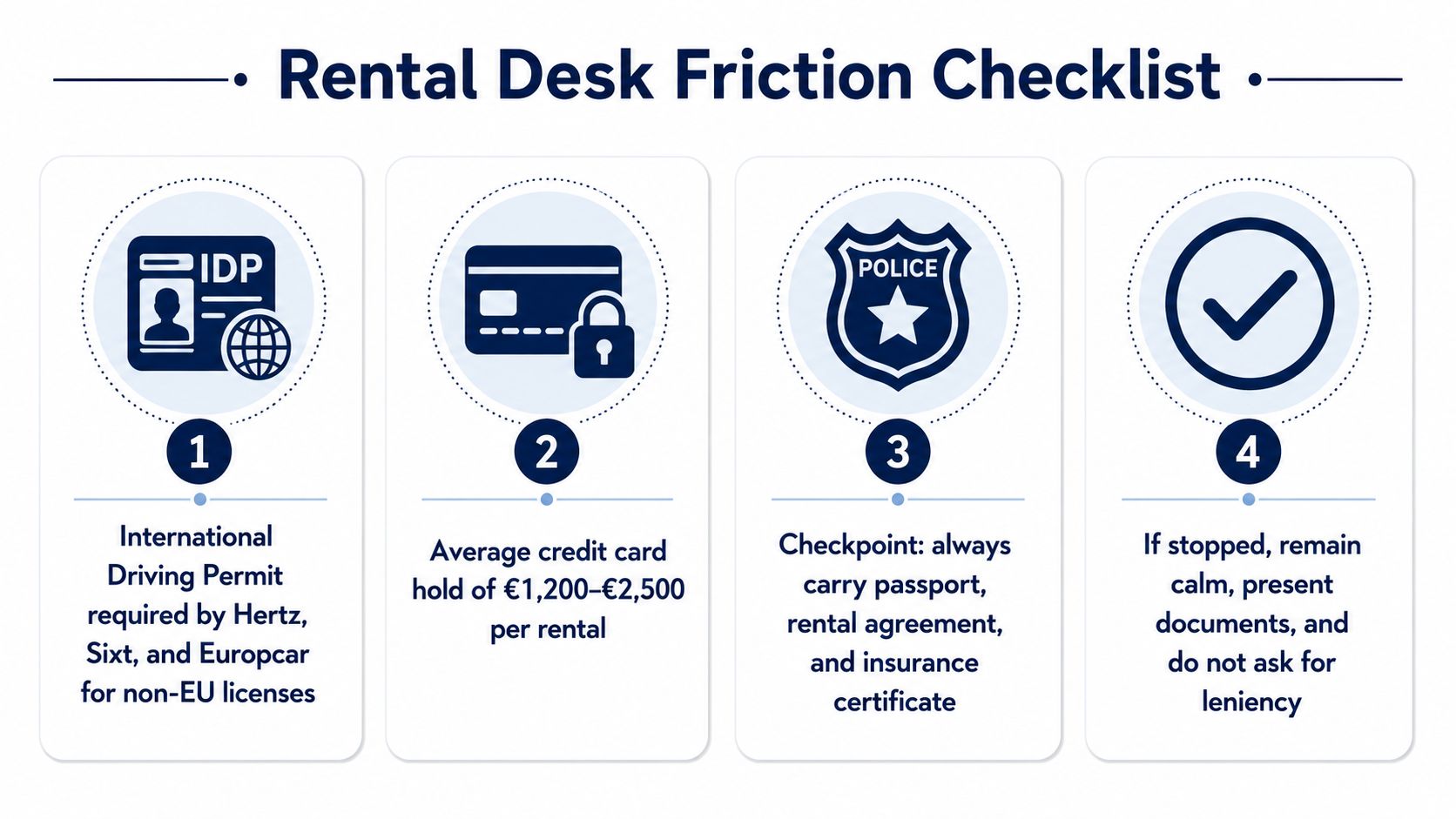
At pickup, put the documents on the counter together: passport, original U.S. license, IDP or accepted translation, booking confirmation, and payment card. Ask the agent to confirm the named driver, authorized vehicle class, insurance excess, and any cross-border or one-way restrictions before you sign.
The foreign-country rental guidance from World Driving Permit is worth checking before departure because rental conditions can be more demanding than a traveler's assumptions.
A routine checkpoint
On a highway, a Guardia Civil officer may signal you to pull over. Slow down, stop safely, turn off the engine if instructed, and keep your hands visible. You don't need to give a speech. Present the documents in a calm order:
- Passport or other requested identity document.
- Physical U.S. license.
- IDP, kept beside the license.
- Rental agreement.
- Insurance documentation.
Use simple Spanish if you can: “Buenos días,” “Aquí tiene,” and “¿Habla inglés?” are enough to begin respectfully. If communication fails, ask for an English-speaking supervisor or an interpreter. Don't argue about the legality of the IDP at the roadside, don't offer money, and don't ask the officer to overlook a missing document.
If you receive a citation, read the instructions and keep every paper. A missing permit can lead to a fine and may prevent you from continuing to drive. The applicable consequence depends on the circumstances, the authority, and the offense, so don't rely on a travel blog's fixed penalty figure.
Stay courteous, provide the requested documents, and solve the paperwork issue through the official process. A roadside argument rarely improves the outcome.
Fines, Accidents, and Crossing the Six-Month Line
An accident demands procedure before debate. Stop, make the scene safe, and contact 112 when people may be injured. Photograph the vehicles, damage, plates, signs, lane positions, and surrounding road conditions before anything gets moved, when it's safe to do so.
Exchange information with the other driver and contact the rental company promptly. Complete the insurer's accident declaration, often called a Parte Amistoso, while the details are still clear. Don't sign a document you can't understand. Ask for an explanation or an interpreter before accepting responsibility.
Handling a traffic fine
A rental company may receive the notice first and then charge your payment method for the ticket or an administrative handling fee under the rental contract. Check the notice carefully, because the payment route and any reduced-payment option will be printed there. Never ignore a fine because the car has already been returned.
Keep these actions in order:
- At the scene: Follow the officer's instructions and request a written citation.
- After returning the car: Watch your email, rental account, and card statements for company notices.
- Before paying: Confirm the vehicle, date, location, and alleged offense.
- For a dispute: Use the official appeal or payment channel listed on the notice.
Prepare for the resident transition early
Once normal residence begins, mark the end of the six-month window immediately. The DGT, Spain's Directorate-General for Traffic, issues Spanish licenses, and Americans should expect to prepare for the Spanish licensing pathway rather than assume an automatic exchange.
Gather proof of identity, evidence of legal residence, and the documents requested by the relevant traffic office. Check the current procedure with the DGT before booking an appointment, because your application route can depend on your residence category and the license class you need.
Do not wait until the final week. If you can't complete the Spanish process before the resident driving window ends, stop driving and arrange another form of transport. A valid U.S. card doesn't restore Spanish driving authority after the applicable resident period.
If you're renting a car in Spain, arrange the original U.S. license and the correct companion document before departure, then verify the rental company's counter policy. For help preparing a readable license translation and checking whether an IDP or translation fits your trip, visit World Driving Permit.