
International Driving Permit for Car Rental
You've landed, collected your luggage, and reached the rental counter with a reservation confirmation on your phone. You hand over your home licence, expecting the keys. Instead, the agent asks for an International Driving Permit, then points to a policy saying a phone image, photocopy, or digital file won't work. Your itinerary hasn't changed, but your road trip has stopped before it starts.
That situation is avoidable if you separate the three documents travelers routinely confuse: the original driving licence, the International Driving Permit, and a certified translation. International law defines what an IDP is, but the rental company decides what it will accept at pickup. The safest approach is to check the brand's written policy, obtain the strictest document your itinerary requires, and carry the physical originals.
Table of Contents
- What an International Driving Permit Actually Is
- The 1949 and 1968 Conventions Explained
- IDP Versus Certified Translation of Your Licence
- How to Get the Right Document Before Your Trip
- Country-Specific Rules at the Rental Counter
- Rental-Desk Checklist You Can Print and Pack
- Choosing the Right Document for Your Itinerary
- Common Questions and Persistent Misconceptions
What an International Driving Permit Actually Is
An International Driving Permit, or IDP, is a multilingual translation of a valid domestic driving licence. It isn't a new licence, a replacement for your home document, or permission to drive a vehicle category you aren't already licensed to drive. The permit exists to make information such as your identity, licence categories, and validity details easier for foreign officials and rental staff to understand.
The booklet normally includes your photograph, translated personal information, translated vehicle categories, and validity fields. You qualify because you already hold a valid licence issued by your home country. An issuing automobile association or other authorized national body produces the permit under the relevant domestic authority. The IDP has no useful standalone value. You must carry it with the original national licence.
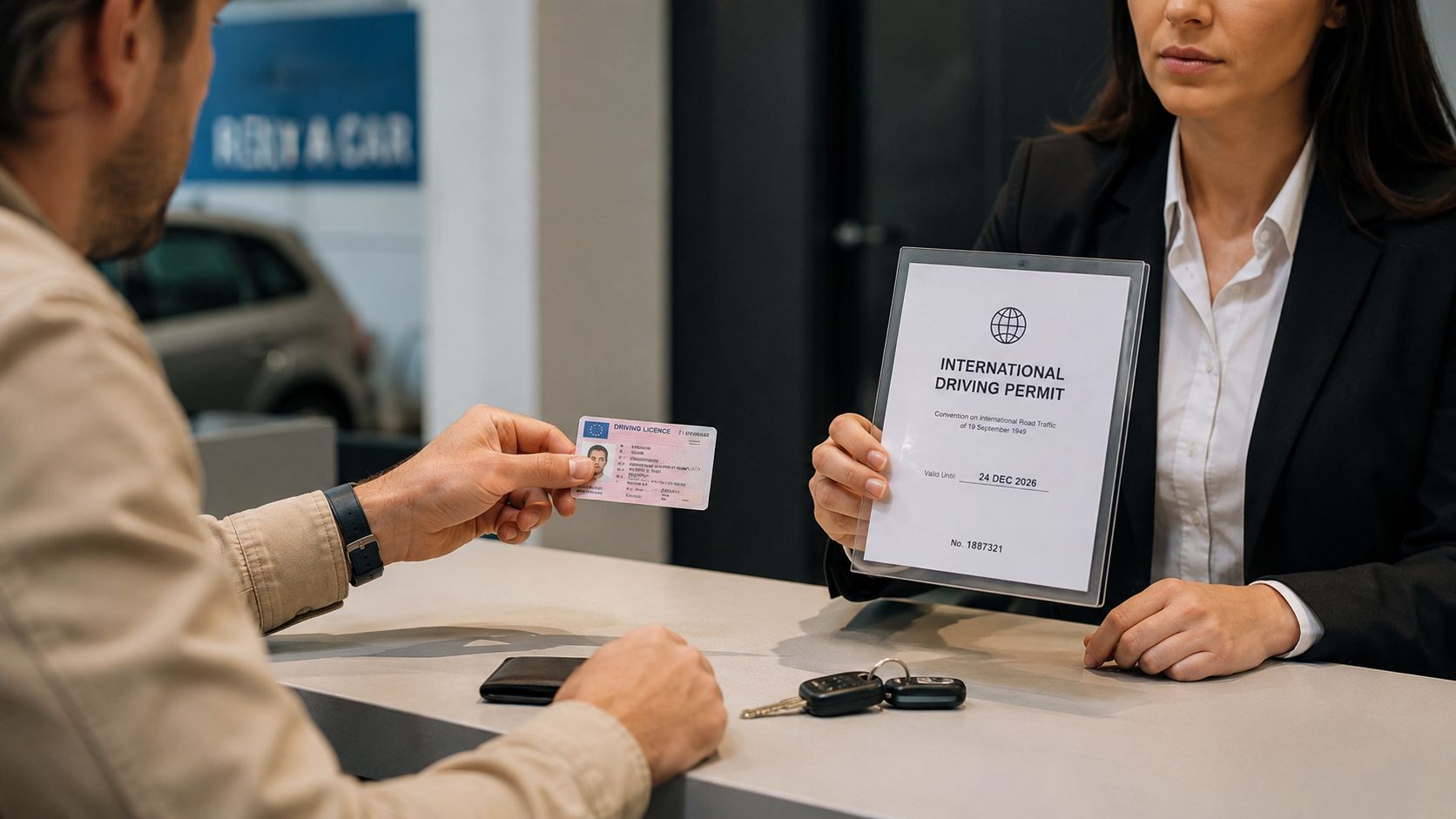
The three documents at the desk
Think of the paperwork as a chain, not a choice between substitutes:
- Original licence: This proves that you're licensed to drive in your home country. The IDP cannot replace it.
- International Driving Permit: This translates and standardizes the information on that licence. It works only alongside the original.
- Certified translation: This renders the licence into a requested language or format through a sworn, accredited, or otherwise accepted translation process. It may be accepted where an IDP isn't required, but it isn't automatically interchangeable with one.
That distinction explains many failed pickups. A traveler may have a perfectly valid licence and a translation, yet the rental brand's policy may specifically demand an IDP booklet. Another traveler may carry an IDP, but the agent still refuses the rental because the original licence is missing.
Practical rule: Pack the original licence first. Add the document the rental company explicitly names, and keep both in physical form.
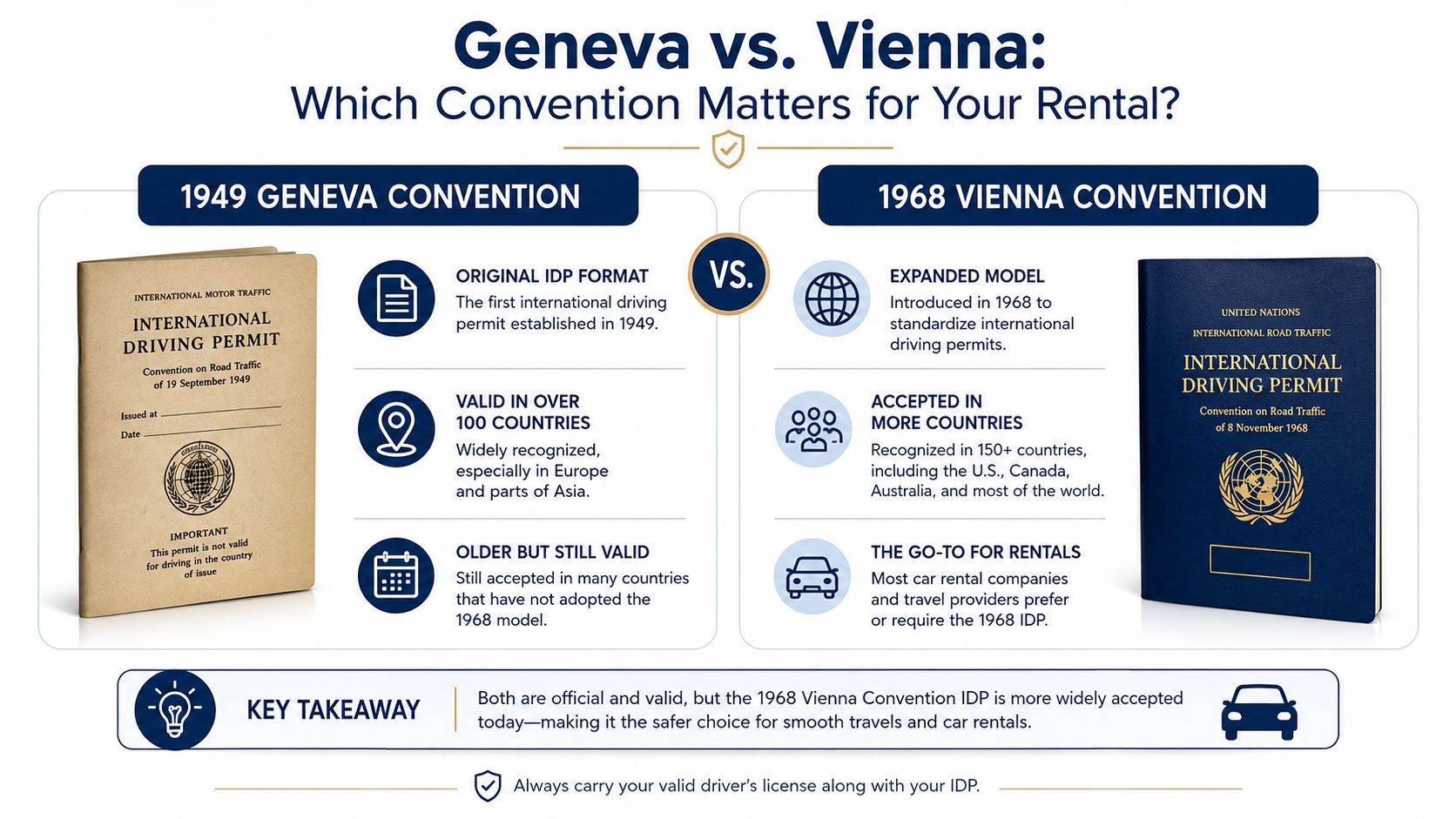
The modern permit system is rooted in the 1949 Geneva Convention on Road Traffic and the 1968 Vienna Convention on Road Traffic. Both frameworks treat the permit as a multilingual companion to a domestic licence, not as an independent driving entitlement. That legal design matters, but the counter agent still follows the company's document checklist.
The 1949 and 1968 Conventions Explained
The 1949 Geneva Convention on Road Traffic established the original international permit framework. The 1968 Vienna Convention on Road Traffic developed the modern model used in many current driving arrangements. Both conventions define the IDP as a translation of a valid national licence, not as a separate authorization to drive.
That distinction matters at the rental counter. An IDP does not create driving rights by itself, and it must accompany the underlying domestic licence. Under the Vienna framework, the permit is valid only when carried with the original national licence. UK implementing rules also recognize that the Vienna form can run for up to five years from the convention's entry into force, as described in this International Driving Permit conventions overview.
What the conventions mean for renters
The conventions provide countries with a shared document model. They do not override local driving rules or a rental company's contract. An IDP still depends on a valid domestic licence, and its usefulness depends on whether the destination recognizes the applicable framework.
Convention membership is background information, not the final answer to a reservation. Drivers from countries outside a particular convention may still obtain an IDP from an authorized issuing body. The permit supports driving and rental requirements abroad, but it is not a domestic licence in the driver's home country.
Rental companies can apply a stricter operational standard than the minimum rule in a government summary. One major international operator requires U.S., Canadian, or Australian licence holders to present both their domestic licence and an IDP in Austria, Bulgaria, the Czech Republic, Estonia, Greece, Hungary, Italy, Luxembourg, Poland, Romania, Slovenia, Slovakia, and Spain. Its policy also rejects photocopies, phone images, and digital or PDF-only permits, requiring original paper or laminated documents at the counter.
Use this 1949 Geneva and 1968 Vienna comparison guide to identify the applicable convention, then check the rental brand's pickup policy for the exact documents it requires.
IDP Versus Certified Translation of Your Licence
An IDP and a certified translation solve related problems, but they aren't the same document. The IDP follows an international permit format and comes from an authorized issuing organization in the driver's home country. A certified translation comes from a translator or service whose credentials and format satisfy the destination authority or rental company.
The IDP is usually the stronger choice when the destination or rental brand names it directly. A certified translation can be the better route where the company accepts a translated licence instead, particularly when the traveller cannot obtain an official permit before departure. Neither option works without the original licence.
Compare the documents before ordering
| Factor | International Driving Permit | Certified Translation |
|---|---|---|
| Purpose | Translates a valid domestic licence into the recognized permit format. | Translates licence fields into a requested language or readable format. |
| Issuer | Authorized automobile association or national issuing body. | Sworn, accredited, notarized, or otherwise accepted translator. |
| Physical form | Normally an original paper or laminated booklet. | May be a certified paper document, and some companies may accept a verified digital copy. |
| Best use | Destinations and rental brands that explicitly require an IDP. | Destinations and brands that confirm a translation is sufficient. |
| Main limitation | It never replaces the domestic licence and won't satisfy every local translation rule. | It may be rejected where the rental policy specifically demands an IDP booklet. |
| Counter risk | A valid permit can still fail if it is digital-only, copied, or carried without the original licence. | A professionally prepared translation can still fail if the company doesn't recognize that translator or format. |
A certified translation isn't a loophole around an IDP requirement. If the rental desk in Italy demands the booklet, showing a translation won't settle the dispute. Conversely, an IDP doesn't automatically solve every language or jurisdiction problem. The document must match both the destination's rules and the company's pickup policy.
The original licence remains the anchor in every scenario. If it expires, is suspended, or is left in your hotel, neither companion document gives you a valid substitute. This is especially important for licences issued in non-Roman characters, where the desk agent may need a formal translation or IDP to verify names, categories, and dates.
For a practical side-by-side explanation of the two formats, see this guide to IDPs and translated licences. Then check your reservation brand directly. The rental company, not international law alone, decides what the agent will accept.
How to Get the Right Document Before Your Trip
Start with the pickup policy, not the application form. Enter the exact country, pickup location, vehicle type, licence-issuing country, and rental brand into your research. A policy for an airport branch may be more specific than a general destination page, and the counter team will apply the local reservation terms.
Path one, apply for an official IDP
Use the authorized automobile association or national body in your home country. Depending on where you live, that may be an organization such as AAA, AA, CAA, or ADAC. Prepare the items the issuing body requests, which commonly include:
- Valid domestic licence: The permit translates this document and cannot stand in for it.
- Passport photograph: Follow the issuer's size and signature requirements.
- Completed application: Make sure your name matches the licence and passport.
- Issuance fee: Pay through the authorized channel, not an unverified intermediary.
In the United States, a major rental brand states that an IDP is valid for one year from issuance, and travel reporting cited in the verified rental guidance says obtaining one by mail can take about two weeks, with a $20 fee and in-person issuance available through authorized offices. See the official application guidance for an international driving permit before submitting anything.
Avoid websites that sell an “international driver's licence” without clearly identifying the authorized issuing organization. A polished online form doesn't turn a private document into a government-recognized IDP.
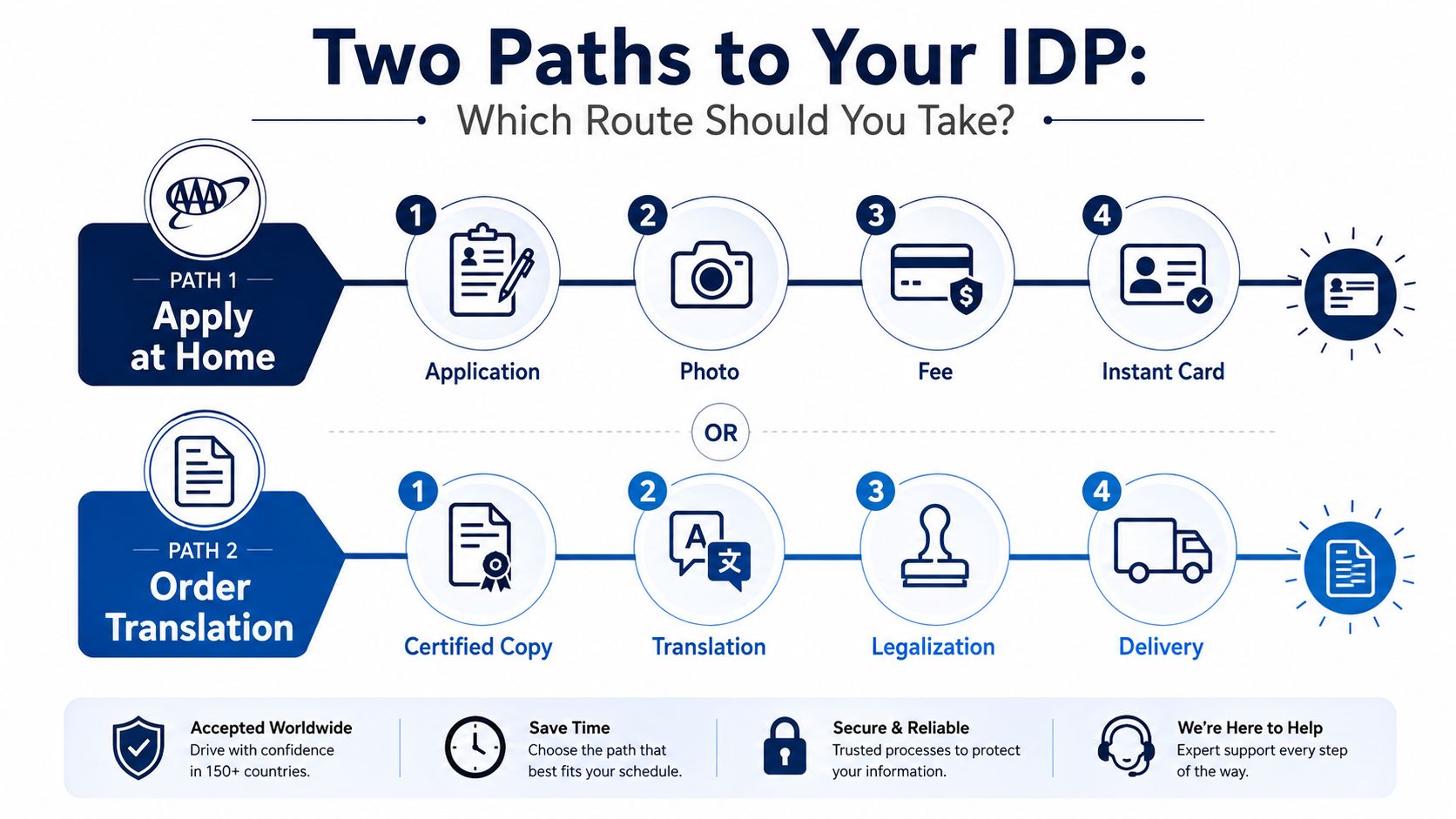
Path two, arrange a certified translation
If the rental company confirms that a certified translation is acceptable, use a provider that identifies the translator, certification method, language, and delivery format. Ask whether the desk requires a printed original, a notarized version, a QR-verifiable file, or another specific format. Do this before paying, because “translated” and “accepted at pickup” are different claims.
If your departure is close, a certified translation may be logistically easier than a mailed booklet. It still won't override a policy that expressly requires an IDP. Carry the translation with the original licence and keep a secure backup of the order record, but don't mistake a backup for the required physical document.
The timing rule is blunt. If you leave in less than two weeks, confirm whether an authorized in-person IDP is available immediately. If it isn't, ask the rental brand whether it will accept a certified translation before relying on one.
Country-Specific Rules at the Rental Counter
Country research gives you a starting point. The practical check is narrower: match the destination, issuing country, licence script, rental brand, and exact pickup branch before you pay or travel.
Start with the reservation page. Open the terms for the selected vehicle and branch, then search for “international driving permit,” “translation,” “licence,” and “rental requirements.” Record whether the wording requires the original licence plus an IDP, permits a certified translation, or gives no clear answer. If the policy is vague, contact that branch directly and ask for written confirmation in the booking record or by email.
A major European operator, for example, requires U.S., Canadian, and Australian licence holders to show both their home licence and an IDP in Italy, Spain, Greece, Austria, Bulgaria, and the Czech Republic. Its policy also states that UK licence holders need an IDP in Italy and that digital or copied permits are rejected. Check the rental company's international licence policy, then verify that the rule applies to your issuing country and pickup branch.
Verify the destination and branch together
| Country or market | Check before booking | Question for the rental branch |
|---|---|---|
| Italy | Confirm the rule for your licence origin. | Will this branch require the original licence and an IDP? |
| Spain | Check the issuing-country and licence-format conditions. | Does the selected brand list an IDP for your licence? |
| Greece | Review the applicable local and convention rules. | Which companion document must you show at collection? |
| Austria and the Czech Republic | Check whether the relevant Vienna framework applies. | Does this operator still require an IDP for your licence? |
| Germany, France, and the Netherlands | Confirm whether your licence can be used under the applicable arrangements. | Will the brand request an IDP or certified translation anyway? |
| Japan | Check the licence language and translation rules. | Is an IDP enough, or does the branch require an approved translation? |
| Australia | Confirm the collection document list before arrival. | Will the desk refuse collection without an IDP? |
| United Kingdom, Canada, and Ireland | Check whether the licence is directly readable to staff. | Does the brand impose an additional document condition? |
Use the branch's answer, not a generic country summary, to make the final choice. Save the policy page, the branch's written reply, and the reservation terms together. If the answer changes between the booking page and the email, ask the company to resolve the conflict before pickup.
AAA Australia's International Driving Permit guidance warns that most car rentals require an IDP before collection and may refuse the rental without one. Treat that as a booking-stage question, especially when your licence is not in a commonly read script.
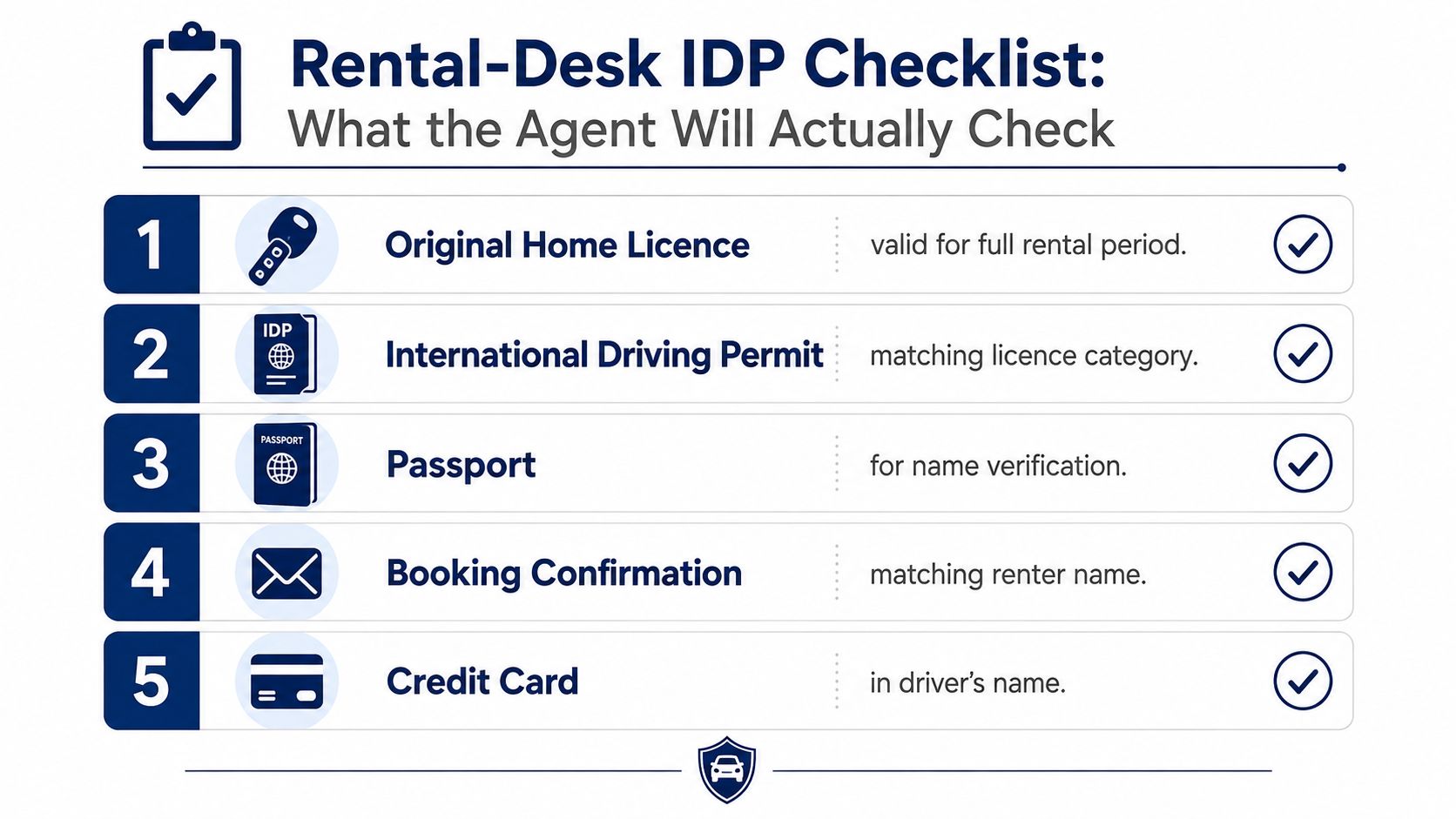
Rental-Desk Checklist You Can Print and Pack
Use this list for the actual handover, not just for immigration or trip planning. Put the documents in one accessible folder, and check the names before leaving for the branch.
- Original home licence: Confirm it remains valid for the complete rental period.
- IDP booklet or certified translation: Bring the physical format the rental company approved.
- Passport: Use it for identity and name verification, especially for international pickups.
- Second photo ID: Carry another government-issued photo document if the branch requests it.
- Booking confirmation: Make sure the renter's name matches the licence and passport.
- International payment card: Bring a card in the main driver's name for the rental hold or payment.
- Additional-driver documents: Every additional driver should bring their own licence and any required companion document.
- Address details: Check whether the licence address and reservation information meet the branch's requirements.
- Cross-border paperwork: Ask about permission before taking the vehicle across a national border.
- Age conditions: Confirm any age-related surcharge or vehicle restriction that applies to the driver.
Contact the rental brand 72 hours before pickup and ask for a written confirmation of the required documents. Policies can change, and a general booking email may not reflect the branch's document screen.
Choosing the Right Document for Your Itinerary
A trip through Italy, Spain, and Greece can fail at the first counter if one country or branch applies a stricter document rule. Use an International Driving Permit for the entire itinerary when any required rental desk specifies one. Carry it with your original licence. A certified translation is not an equivalent substitute when the company requests an IDP.
For a multi-country route, match the document to the strictest confirmed requirement:
- Italy: If the booked branch requires an IDP, bring the physical permit and original licence.
- Spain: Use the format the rental company confirms, whether an IDP or certified translation.
- Greece: If the branch lists an IDP, keep that permit available at pickup.
The final choice is made at the rental counter by the company's document policy, not by assuming that one country's rule applies everywhere. Sixt, Hertz, Europcar, Avis, and local operators can set different requirements in the same destination. Ask the specific branch to state whether it accepts an IDP, a certified translation, or both.
Licences written in non-Roman characters need extra preparation. The agent must read the driver's name, vehicle categories, and licence dates. Keep the original licence beside whichever companion document the branch approved. Neither an IDP nor a certified translation gives you independent driving authority.
If the company cannot confirm the format in writing, choose the physical IDP where available and carry the original licence. That combination is the safer choice for an itinerary crossing multiple countries.
Common Questions and Persistent Misconceptions
Is a digital IDP or phone screenshot enough?
No, not where the rental policy requires an original physical document. The published policy discussed earlier rejects phone images, photocopies, and digital or PDF-only permits. Bring the paper or laminated document named by the company.
Is an International Driver's License the same as an IDP?
No. International Driving Permit is the recognized document concept. “International driver's licence” is often used casually online, and private sellers may use it to market documents that aren't official permits. Check the issuer before paying.
Does AAA still issue IDPs?
Authorized issuing organizations continue to be the relevant route in countries where they hold that authority. In the United States, the verified rental guidance specifically refers to in-person issuance through authorized offices. Don't rely on an online intermediary unless the national issuing authority confirms it.
Do European Union licences need an IDP everywhere in Europe?
Not automatically. The answer depends on the licence, destination, rental company, and document format. A company may request an IDP for operational verification even when a traveler believes local law permits the licence.
Are photocopies valid?
Treat them as backup records only. They won't satisfy a counter policy that requires the original licence or permit.
Is there an overnight solution?
Sometimes an authorized in-person issuer can process an application quickly, but there is no universal overnight route. If the brand accepts a certified translation, ask about the exact paper or digital format before ordering.
What happens if the original licence is lost abroad?
An IDP or translation cannot replace it. Contact your licensing authority, police, insurer, and rental company immediately, and ask what temporary evidence the branch and local authorities will recognize.
Email the rental company 48 hours before pickup and ask one direct question: “Which physical driving documents must the main driver present at this branch?” Save the reply with your travel papers.
World Driving Permit provides certified, word-for-word driving-licence translations in 28 languages, delivered digitally with an optional printed booklet, but it isn't an official IDP. Visit World Driving Permit to check whether a certified translation fits your rental company's stated requirements, or to find guidance for an authorized permit issuer when an IDP is required.