
Driving in Portugal with US License: A 2026 Guide
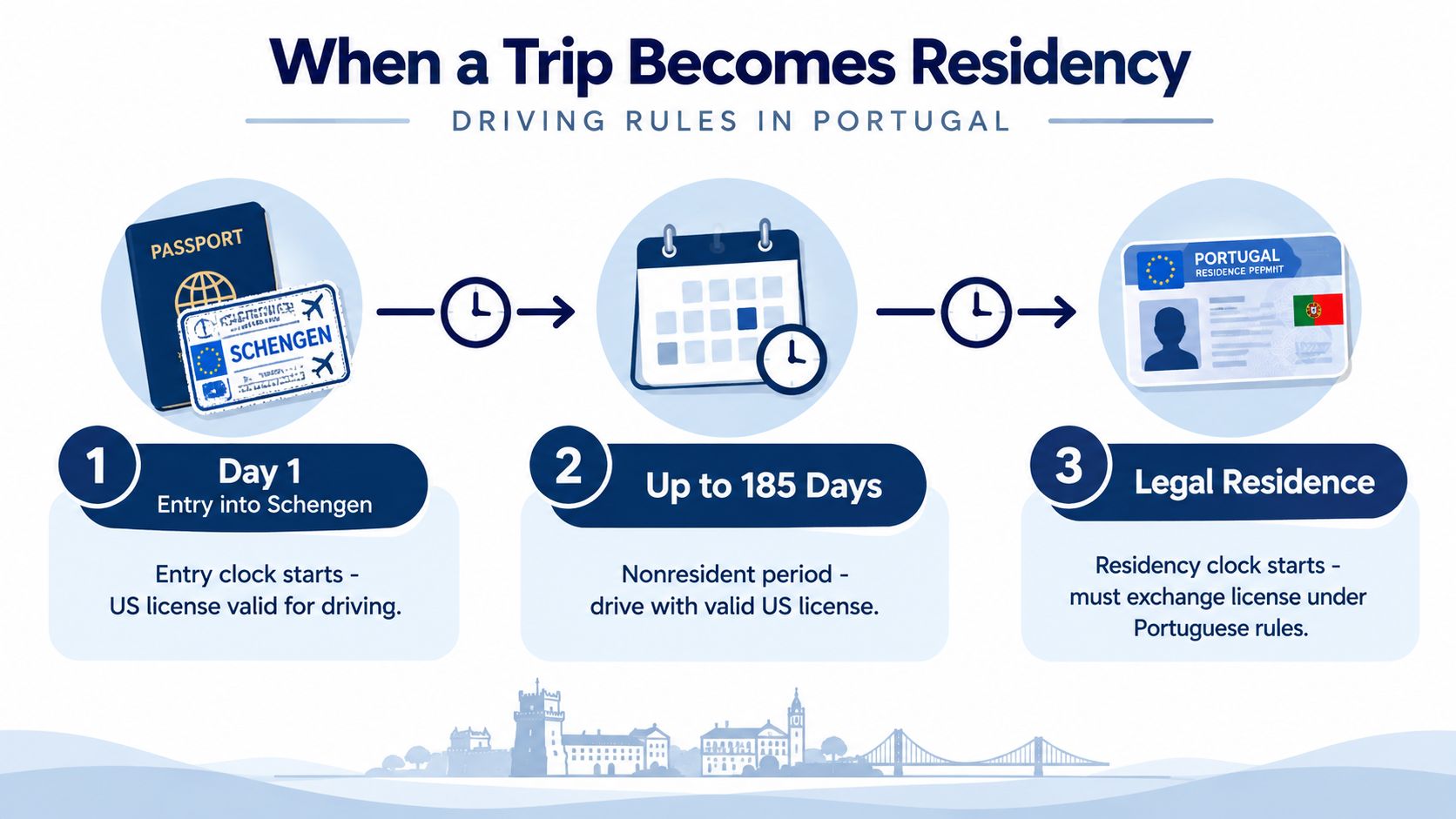
Yes, you can drive in Portugal with a valid U.S. state license for up to 185 days from your first entry into the Schengen Area. If you become a Portuguese resident, a separate rule applies: notify IMT within 60 days and start the licence exchange process within 90 days.
You're at the Lisbon rental counter, jet-lagged, holding your passport, credit card, and perfectly valid American licence. The agent asks for an extra driving document, and suddenly a simple road trip feels like an administrative problem. The confusion comes from treating tourist driving and resident driving as the same question. They aren't.
For a holiday, Portugal generally recognizes your valid state-issued licence within the visitor window. For a move, your residency status changes the legal track, the deadlines, and the paperwork. This guide separates those two situations so you know which clock applies before you take the keys.
Table of Contents
- What Your US License Actually Gets You in Portugal
- IDP Versus Certified Translation Versus State License
- Renting a Car and Buying Insurance
- When a Trip Becomes Residency
- Tolls, Highways and the Real Cost of Driving
- Speed Limits, Alcohol, and Other Rules That Bite
- What to Do If Something Goes Wrong
- Pre-Flight Checklist and Final Reminders
What Your US License Actually Gets You in Portugal
For a normal visit, a valid U.S. state driving licence can be used in Portugal for up to 185 days after you enter the Schengen Area, not merely after you land in Portugal. Time spent in Spain, France, Germany, or another Schengen country counts toward the same window. The rule matters immediately if your itinerary includes a multi-country drive before reaching Portugal. Portugal driving guidance for U.S. visitors explains why the Schengen entry date is the practical starting point.
Your licence remains the foundation. An International Driving Permit or translation can help with communication, but neither replaces the original state licence. Your licence must be current, and the vehicle category you drive must match the privileges shown on it. A standard U.S. passenger-car licence generally serves the same practical purpose as a Portuguese category B entitlement for an ordinary rental car. Motorcycle riding is different. A motorcycle endorsement needs to be present if you plan to rent or ride a motorcycle, rather than assuming a passenger-car licence covers it.
Decide which traveler you are
The answer changes according to your status:
- Short holiday visitor: Drive with your valid U.S. licence, and carry an IDP or readable translation to reduce friction at rental desks and checkpoints.
- Long tourist stay: Track the Schengen entry date carefully. Don't calculate the period from your Portuguese hotel check-in.
- Digital nomad with a D8 visa: Don't automatically use the tourist answer. Your residence documentation and legal status may place you on the resident track.
- D7 retiree or relocating family: Treat the move as a residency matter from the beginning, even if you plan to drive only occasionally.
A fiscal number, a long lease, or a residence permit can signal that your circumstances no longer resemble a brief tourist visit. The decisive issue is your legal status, not the fact that you're American.
Practical rule: If you're renting for a holiday, prepare for the rental desk. If you're moving, contact IMT before relying on the tourist window.
Before booking a car, compare your licence, passport, travel dates, and Schengen entry record. This Portugal driving document guide is useful for checking what to carry, but it shouldn't replace confirmation from IMT when your residence status is changing.
IDP Versus Certified Translation Versus State License
U.S. drivers usually encounter three documents, and they serve different purposes. Your state licence is the legal base document. An International Driving Permit is a standardized translation companion, while a certified Portuguese translation is an alternative companion for situations where a translated record is needed.
The 1949 Geneva-format IDP is the practical choice for many tourists. It presents licence information in multiple languages and can make an interaction with a rental employee, police officer, or insurer easier. Carry it with the original licence, never instead of it. A certified translation can perform the same communication role, but it must be prepared by an appropriate sworn translator and may need apostille treatment for official use.
The key distinction is simple. An IDP doesn't grant driving privileges by itself, and a translation doesn't cure an expired or invalid licence.
| Document | Who Actually Needs It | Where It Counts | Watch Out For |
|---|---|---|---|
| Valid U.S. state licence | Every U.S. driver | Establishes your driving entitlement | It must remain valid and match the vehicle category |
| 1949 Geneva IDP | Tourists who want a widely recognizable translation companion | Rental desks, roadside checks, and cross-border travel | Carry the original licence with it |
| Certified Portuguese translation | Drivers who need an official readable version or whose document format creates language problems | Administrative, insurance, or official interactions | Use a sworn translator and confirm apostille requirements |
My recommendation by traveler type
For a tourist staying under a month, I'd carry the state licence and a 1949 IDP. The IDP is usually the least awkward way to prevent a rental employee from questioning an unfamiliar U.S. document.
For a longer tourist stay, use the same combination and keep evidence of your Schengen entry date. The longer you drive and the more countries you cross, the more valuable clear documentation becomes.
For a resident in mid-conversion, don't treat an IDP as a substitute for the IMT process. Assemble the authenticated driving record and any required translation instead. This comparison of an IDP and a licence helps clarify what the translation document can and can't do.
Renting a Car and Buying Insurance
At the Lisbon counter, hand over your original U.S. licence and 1949 IDP together. Put the rental agreement and credit card in the same driver's name whenever possible. The employee may also check the licence's validity and the driver's age, so don't arrive with only a phone photograph of the document.
Ask three questions before signing:
- Is the car fitted with a Via Verde transponder?
- How are tolls and service charges billed?
- What is the excess for collision damage, theft, glass, tires, wheels, roof, and underbody damage?
Separate legal cover from useful cover
Portuguese rentals include mandatory third-party liability cover because vehicles must be insured for damage caused to others. That protection doesn't pay to repair the rental car itself.
Collision damage protection with a zero excess is the coverage I'd consider most carefully. Portuguese streets can combine narrow lanes, stone walls, tight garage entrances, steep ramps, and rough surfaces. A small scrape can become expensive when the contract leaves you responsible for the excess.
The other products deserve individual scrutiny:
- Theft protection: Check the excess and exclusions before accepting it.
- Personal accident insurance: Skip duplicate cover if your U.S. health policy already handles the medical risks you care about, including evacuation.
- Credit-card CDW: Read the card's terms. Many policies exclude tires, windscreens, the roof, or underbody damage, precisely the areas that can suffer on cobbled streets and uneven access roads.
A third-party-only rental may be legally adequate, but it leaves you carrying the financial risk for the vehicle. That's a poor trade for a driver unfamiliar with Portuguese road design.
Before you decline an insurance option, find the excess clause and read the exclusions. The headline coverage is less important than the damage you still pay for.
Rental companies can impose their own age and experience conditions, and those terms can vary by supplier and vehicle. Don't assume the cheapest online quote includes every driver, every licence category, or the protection you expect. This foreign-car-rental guide is a useful preparation reference before you compare rental contracts.
When a Trip Becomes Residency
A visitor's driving permission and a resident's obligations sit on separate tracks. Portugal's government guidance states that, from 1 August 2022, eligible licences issued by OECD and CPLP countries, including the United States, can remain recognized for eligible residents without the usual exchange requirement. The conditions include being under 60, holding a valid licence, having no more than 15 years since issue or last renewal, and having no seizure, suspension, expiry, or revocation. Portugal's official IMT document sets out those conditions.
That flexibility doesn't mean you can ignore IMT. Official guidance says residents must notify IMT within 60 days of taking up residence, while U.S. residents also face a 90-day period after residency issuance to start the exchange process. Those are different obligations. Don't collapse them into one deadline.
Assemble the file before you need it
Start with IMT and confirm the route for your specific state licence and residence status. Then prepare:
- Identity documents: Passport and residence documentation.
- Residence evidence: Proof that your legal residence has been established.
- Tax identification: Your Portuguese fiscal identification details.
- Current licence: The physical U.S. licence, not merely a scan.
- Driving record: An authenticated DMV abstract showing validity, issue and expiration dates, vehicle classes, and suspensions or revocations.
- Authentication: The U.S. driving record must carry an apostille where required, with any certified translation requested by IMT.
The authenticated abstract is where many movers lose time. A basic DMV printout or photocopy may not satisfy the authority asking for a verified record. Request the document from the state licensing authority early, check that your name matches your residence documents, and confirm whether medical information is required for your category.
The U.S. tourist answer doesn't protect you indefinitely after residence begins. Use the permitted procedure, meet the notification and exchange deadlines, and keep proof that you started the process.
Tolls, Highways and the Real Cost of Driving
The drive from Lisbon toward the Algarve looks simple on a map. You leave the city, join the A2, pass through motorway toll infrastructure, and eventually connect with older IP or IC roads or regional routes near your destination. The surprise is that Portugal uses both staffed toll plazas and electronic-only toll collection, including on former SCUT roads.
A rental car commonly has a Via Verde transponder. That convenience doesn't make tolls free. The rental company bills the tolls recorded by the device and may add a service charge under the rental contract.
What happens in sequence
At pickup, ask the agent to show you the transponder and explain whether it's active. Ask how electronic-only roads are recorded and what happens if you drive onto one before activation. Don't assume you can stop at a booth and pay cash when there isn't a booth.
If you're driving a vehicle without an activated transponder, follow the official payment method available for that road, such as EasyToll or TollCard, and observe the applicable payment instructions. Save confirmation details. Toll administration is much easier when you know the vehicle registration and payment method before joining the motorway.
Parking creates a second layer of exposure. Yellow curb markings generally signal restrictions, blue areas usually require payment, and a white space isn't automatically free. Read the meter, place the ticket as instructed, and photograph nearby signs when the restriction isn't obvious.
Treat the advertised rental price as only the starting line. Budget for fuel, tolls, parking, transponder charges, and possible administration fees.
A toll or parking notice may reach the rental company before it reaches you. The company can then charge your card under the contract, including an administration charge. Photograph the car, registration, transponder, and rental paperwork at collection so you can identify a disputed charge later.
Speed Limits, Alcohol, and Other Rules That Bite
Portuguese signs control the road in front of you, and the national limits are only the baseline. For passenger cars, the standard limits are 50 km/h in built-up areas, 90 km/h on ordinary roads, and 120 km/h on motorways, unless signs or vehicle conditions require a lower speed. Portugal's foreign-driver guidance also emphasizes that local road rules differ from those many non-European drivers expect.
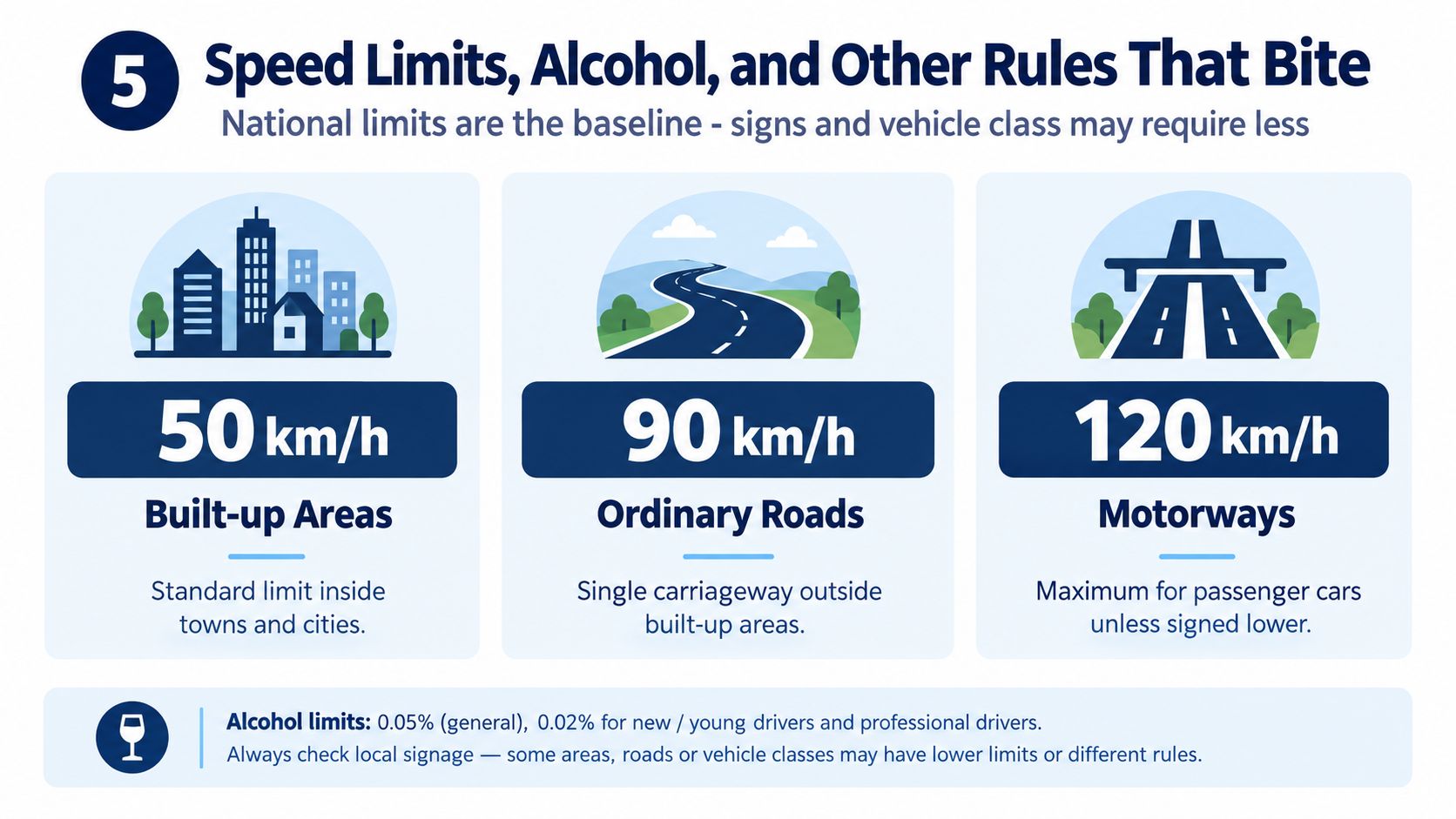
The general blood-alcohol limit is 0.5 g/L. A lower threshold of 0.2 g/L applies to probationary drivers and certain professional or emergency-service categories. If you're unsure whether a special category applies, don't drink before driving. The safest interpretation for a visitor is no alcohol at all.
Rules Americans commonly misread
Headlights or daytime running lights are mandatory on public roads, and phone use while driving is prohibited. A phone-use violation can cost roughly €250 to €1,250, depending on the conduct and offence circumstances. Portugal's road-driving guidance is the right official starting point for checking current obligations.
- Roundabouts: Follow the lane arrows and priority signs, rather than applying a U.S. four-way-stop instinct.
- Cameras: Expect fixed and mobile enforcement, as well as section-based speed control.
- Warnings: Flashing roadside signs mean slow down and assess the traffic environment.
- Phones: Mount navigation before moving and keep the device out of your hand.
Before leaving the rental lot, set the route, identify the speed shown on the nearest sign, and locate the vehicle's lights. Your American licence gives you permission to drive when the applicable conditions are met. It doesn't exempt you from Portuguese rules.
What to Do If Something Goes Wrong
You're on the EN125 outside Faro when another car clips your rental vehicle. Nobody appears seriously hurt, but both cars are blocking part of the road. The correct response is not an argument about fault. It's a controlled sequence: protect people, document the scene, complete the accident declaration, and notify the right parties.
Turn on the hazard lights and move to a safe position if the vehicles can be moved without creating another danger. Use the reflective triangle as required, and photograph the vehicles, registration plates, road position, signs, lane markings, visible damage, and the surrounding approach before the scene changes.
Complete the joint declaration
The Declaração Amigável de Acidente de Automóvel, often called the Participatory Report, lets both drivers record the circumstances in a standardized form. Each driver completes their part, checks the vehicle and incident details, signs only after reviewing the information, and keeps a copy.
Call the police when there are injuries, the drivers disagree about what happened, impairment is suspected, or a vehicle may be uninsured. Police attendance also makes sense when the road is unsafe or the parties can't exchange reliable details.
| Scenario | Required Action | Who to Contact |
|---|---|---|
| Minor collision, no dispute | Secure the scene, photograph damage, and complete the joint declaration | The insurers and rental company |
| Injury or immediate danger | Give first aid only within your ability and request emergency assistance | 112, then police |
| Disagreement about events | Don't sign an inaccurate declaration; preserve evidence | PSP or GNR |
| Suspected impairment or no insurance | Keep distance, avoid confrontation, and wait for authorities | PSP or GNR |
| Rental vehicle involved | Follow the rental contract and report the incident promptly | Rental company and its insurer |
Ask for the police report, or participação, at the nearest PSP or GNR post if officers attend or you need a formal record. Notify the rental company and insurer within the time required by the contract, record the temporary claim number, and keep every document.
The right order is safety, evidence, declaration or police report, then notification.
Don't admit fault casually, don't repair the vehicle without authorization, and don't leave without the other driver's details. A clean paper trail matters more than winning the conversation beside the road.
Pre-Flight Checklist and Final Reminders
Save this list to your phone and check each item before boarding. Driving in Portugal with a US license is straightforward when your documents, insurance, and status match the trip you're taking.
Documents and timing
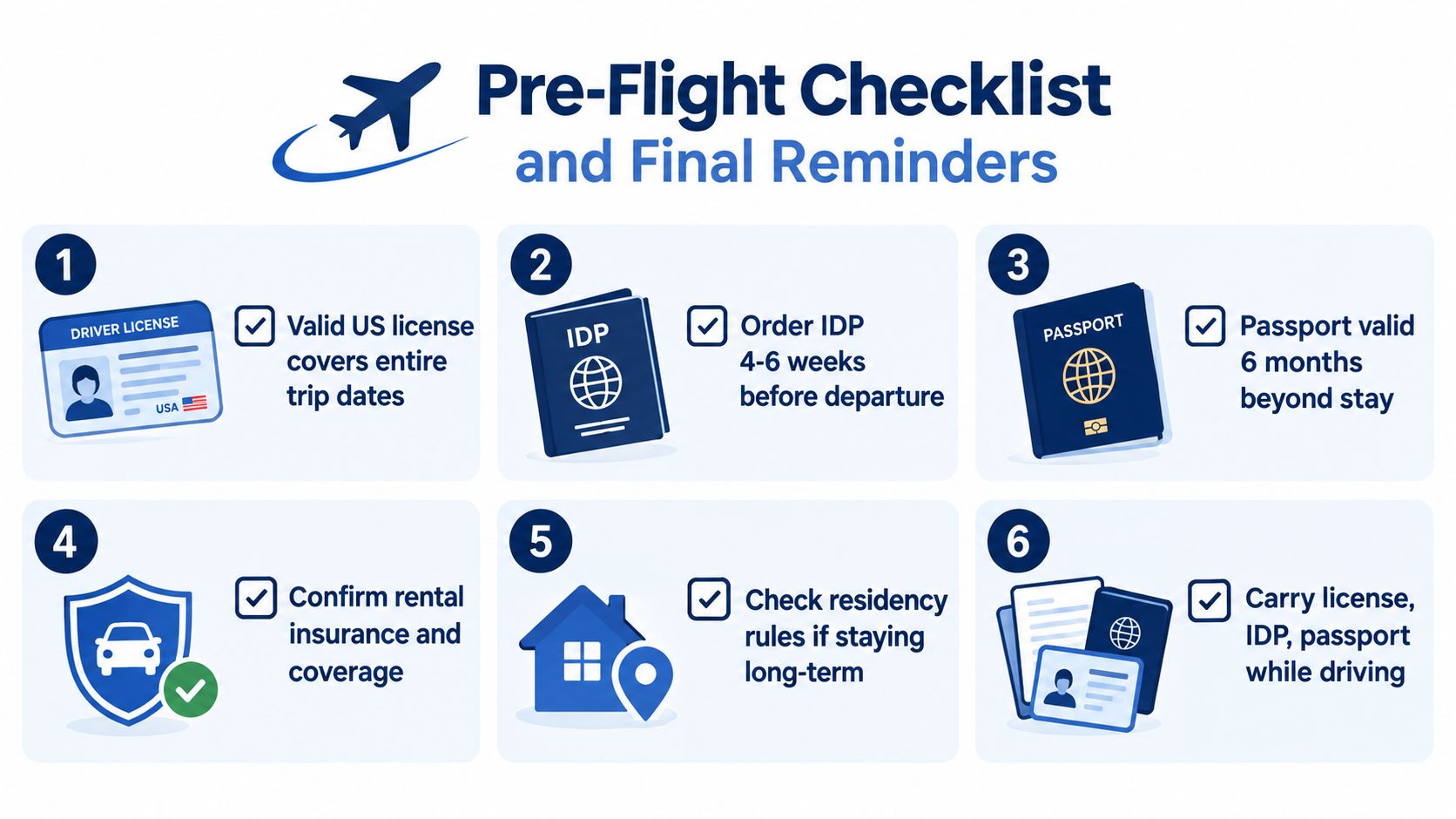
- License validity: Confirm that your physical U.S. licence stays valid for the entire driving period.
- Schengen entry: Record where and when you first entered the Schengen Area, because that date controls the visitor calculation.
- IDP or translation: Order the 1949 IDP before departure, or arrange a certified translation if your circumstances call for one.
- Resident paperwork: If you're moving, check the IMT notification and exchange requirements before you collect a car.
- Rental payment: Bring a credit card in the principal driver's name and verify the deposit terms.
- Emergency contact: Save 112 for emergencies and keep the U.S. embassy contact details accessible.
Car, road, and payment checks
At the counter, photograph the vehicle from every side, note existing damage, and confirm the fuel and mileage entries. Ask how the Via Verde transponder works, how electronic tolls are billed, and whether your chosen insurance covers glass, tires, wheels, roof, and underbody damage.
Keep the reflective triangle in the vehicle, set navigation before moving, and confirm the headlights or daytime running lights. Install or prepare the official toll payment method if the rental company doesn't provide a transponder. In cities, read every parking sign instead of assuming a white space is free.
The rules are stable enough to plan around, but enforcement conditions can change. Treat any claim about future camera deployment, alcohol checkpoints, or toll-road changes as something to verify with current Portuguese authorities and your rental company, not as a promise about the road you'll encounter.
Your final decision is the most important one: determine whether you're visiting or becoming resident before you calculate how long your U.S. licence remains usable. Tourists should document their Schengen entry and prepare a translation companion. Movers should contact IMT, request the authenticated DMV abstract, and start the resident process on time.
World Driving Permit provides certified, word-for-word translations of national driving licences into 28 languages, with digital delivery and an optional printed booklet for presentation alongside the original licence. If you want a readable companion for a Portuguese rental desk or roadside interaction, visit World Driving Permit and choose the document format that fits your trip.