
International Driving Permit vs License: Which Do You Need
You're standing at the rental desk, your bag is open, and the agent is looking at three things you thought were interchangeable, your domestic licence, an “international licence” printout, and a passport. That's where trips get delayed, cars get denied, and people get charged for avoidable extras. The problem isn't driving skill, it's document type, because an International Driving Permit is not the same thing as a driving licence, and a certified translation isn't the same thing as either.
Here's the blunt answer. Your domestic licence is the authority to drive. An International Driving Permit, or IDP, is a treaty-based companion document, not a standalone right to drive, and it must be carried with the original licence to mean anything in jurisdictions that recognize it, as set out under the 1949 Geneva Convention framework. A certified licence translation solves a different problem, language readability, and may be accepted where an IDP isn't required or doesn't fit local rules, but it doesn't magically replace your home licence either.
| Criteria | National Driving License | International Driving Permit (IDP) | Certified License Translation |
|---|---|---|---|
| Legal status | Main legal proof you're licensed | Supplementary, treaty-based companion | Supplementary language aid |
| Issued by | Home country authority | Authorized body in your home country | Certified translation provider |
| Must be carried with original licence | Already the original | Yes | Yes, in practical use |
| Best use | Driving in your home country | Cross-border driving where IDPs are recognized | Places that want a readable licence without IDP rules |
| Rental desk use | Sometimes enough, depending on destination | Often requested by agents | Helpful when staff need a local-language document |
| Police checkpoint use | Strongest proof of domestic authorization | Makes licence details easier to interpret | Helps with language access, where accepted |
Table of Contents
- Why Travelers Confuse Permits and Licenses Abroad
- Legal Definitions and Treaty Origins
- Side by Side Comparison of Driving Documents
- Country Rules and Common Exemptions
- How to Obtain Each Document Before Your Trip
- Choosing the Right Option for Your Itinerary
- Presenting Documents at Rental Desks and Checkpoints
Why Travelers Confuse Permits and Licenses Abroad
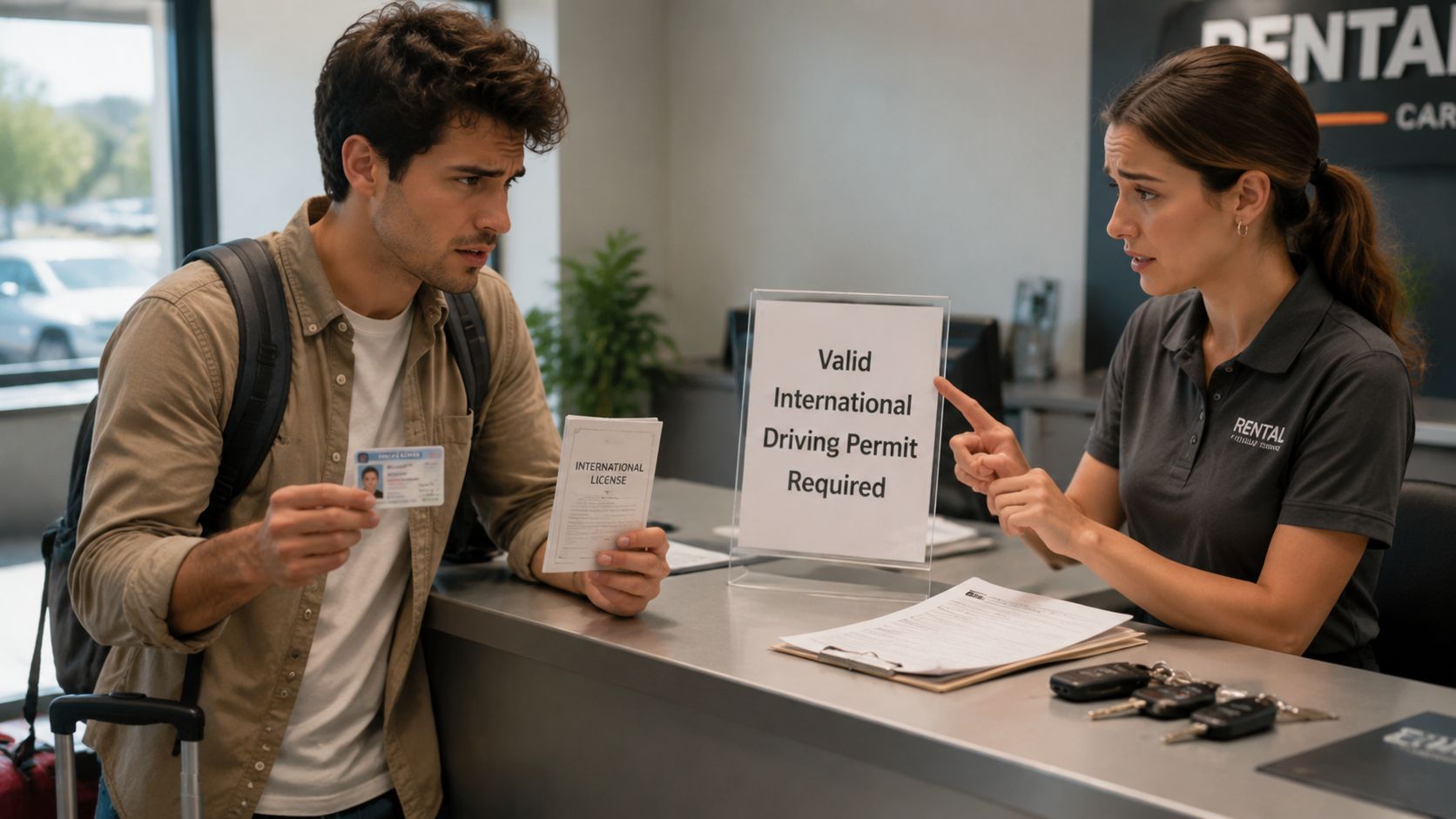
The confusion starts at the counter. A traveler hands over a domestic licence, adds a glossy “international licence” printout bought online, and the agent rejects it because the paper is not the correct document. Sometimes the desk asks for more paperwork. Sometimes it stops the rental outright.
That gap catches people because the labels sound interchangeable. International driving permit, international driving licence, and certified translation get mixed together online, but rental staff and police do not treat them the same way. What matters is whether the document set fits the destination's rules and survives a real inspection, not whether a sales page used the right wording. The official UK guidance on international driving permits tells travelers to check the destination before they drive, and that is the right habit.
What the rental desk checks
Rental agents do not care about forum theory. They check the booking name, the passport, whether the licence is readable, and whether the document set fits the destination's rules. If staff cannot read the licence, they may ask for an IDP or a certified translation. If the destination does not accept what you brought, they can refuse the car on the spot.
The same pattern shows up at checkpoints. A local officer wants documents that can be read quickly and tied back to the original authority to drive. A random printout from the internet does not help. A document that looks official but does not match what the country expects does not help either.
If you still treat an IDP and a translation as interchangeable, this guide on whether an IDP is a translation clears up the difference.
The problem is not the paperwork itself. It is the gap between what a traveler thinks should work and what a non-local agent will accept under pressure. At the rental counter, that gap is where trips get delayed or denied.
Legal Definitions and Treaty Origins
A national driving licence is the core document. Your home country issues it, and it proves that you are legally allowed to drive. If that licence is weak, expired, or not valid for the trip, nothing else can rescue it at the counter or roadside.
An International Driving Permit is something else entirely. It is a treaty-based document tied to the 1949 Geneva Convention on Road Traffic, defined in Annex 10 and issued as a standardized translation of the domestic licence. The permit is valid for one year from the date of issue, and it only carries weight when presented with the original licence. That treaty structure is what gives it recognition across borders, unlike a local handout or a self-made translation.
Why treaty history matters
A non-local agent does not care about legal theory. They look for documents they can verify fast. A permit issued under a recognized framework is easier to process because the format is familiar, the categories are standardized, and the reference points line up with what rental staff and police expect to see.
A certified translation sits in a different lane. It is a language-access document, not a treaty document. That matters at a roadside stop where an officer needs to read the licence name, class, and restrictions immediately. A translation can still fail there if the local officer wants the treaty format instead, or if the document does not help them match the licence to the driving category on the spot.
Countries also do not treat these documents the same way. Some work under the 1949 framework, others use different arrangements, and the country's own rules decide what a counter agent or checkpoint officer will accept. The worlddrivingpermit.com guide on IDP versus translated licence is useful here, because it reflects the practical split travelers run into once someone local checks the papers.
A licence proves you are allowed to drive. An IDP helps strangers read that licence. A translation helps with language, but it does not automatically solve the legal question.
Side by Side Comparison of Driving Documents
The cleanest way to choose is to compare what each document does. If you're driving at home, the domestic licence is enough. If you're crossing borders and the destination recognizes IDPs, the permit is the more portable companion. If the main issue is that staff can't read your licence, a certified translation may be the better fit.
| Criteria | National Driving License | International Driving Permit (IDP) | Certified License Translation |
|---|---|---|---|
| Legal role | Primary proof of driving authority | Companion to the domestic licence | Companion for readability |
| Issuing body | Government authority in your home country | Authorized issuer in your home country | Certified translation provider |
| Treaty status | None | Treaty-based, standardized format | None by itself |
| Validity | Set by your home licence rules | One year from issue under the 1949 framework | Depends on provider and local acceptance |
| Best use case | Domestic driving, or foreign driving where no extra document is needed | Places where an IDP is required or strongly preferred | Countries or counters that need a legible local-language version |
| At rental desks | Often accepted if local rules are simple | Commonly requested where the destination expects it | Useful when the agent wants readable fields |
| At checkpoints | Strongest proof of authorization | Helps officers interpret the domestic licence | Helps with language access where accepted |
How the three documents behave in the real world
A domestic licence alone works only in limited situations, usually where local rules are simple or where the destination specifically allows it. That's why government guidance tells travelers to check ahead, rather than guessing. The USA government guidance on international drivers also makes one thing clear, some neighboring-country trips don't need an IDP, but that doesn't make the permit optional everywhere else.
An IDP is the safest choice when the destination expects treaty-style documentation. It's also the one rental desks are most likely to recognize quickly, because it follows a standard format. A certified translation is more flexible in places where the law or the rental company cares about readability more than treaty formality, and that's exactly why it exists.
If you want the shortest decision rule, use this. License proves authority, IDP proves portable interpretability, translation proves language access. Don't treat them as substitutes for each other.
Country Rules and Common Exemptions
Travelers get burned. One country treats the IDP as essential, another only recommends it, and a third lets some visitors drive on the domestic licence alone for a limited time. That's why a route that looks simple on paper can still fail at the desk if you don't match the local rule set.
Japan is the classic hard-stop example in travel advice because rental desks and police there often expect the right document combination, while many European destinations are more willing to work with a certified translation or a domestic licence depending on the driver's nationality and the exact rules in force. The important part isn't the continent, it's the destination-specific rule. The country-by-country IDP guide is the kind of check travelers should be doing before booking a car, not after landing.
What to verify before you leave
Use this order every time, and don't skip steps.
- Check the destination's official government guidance. Embassy pages and transport authorities tell you what's required, not what a forum assumes.
- Check the rental company's policy. Some agencies are stricter than local law and will ask for an IDP even when the statute is looser.
- Check whether your route crosses multiple jurisdictions. A document accepted in one country may be useless in the next.
- Check whether a translation is accepted instead of an IDP. That answer changes depending on where you're going.
- Check whether you're entering on a short stay or moving toward residency. Long-term stays often trigger local licence conversion rules.
Regional exemptions matter too. EU and EEA drivers are often exempt within the EU, but that doesn't help a traveler from elsewhere. Some neighbouring-country trips don't need extra paperwork, and official guidance in the US points out that not every nearby border crossing requires an IDP. The same is true in other regions, local law decides, not internet habit.
When the rule is stricter than you expected
Short-term visitors, diplomats, and military personnel can sometimes fall under special arrangements. That doesn't mean you should assume an exception applies to you. If police or a rental desk asks for the document set they expect, the burden is on you to show it, not on them to guess your status.
If you cross borders often, build a habit of checking the destination before you book the vehicle. That one habit prevents more rejected rentals than any brochure ever will.
How to Obtain Each Document Before Your Trip
Get the paperwork done before you leave home. That sounds obvious, but it's the step people skip when they assume a foreign desk will “work it out.” An IDP has to be issued through the proper home-country channel, and a certified translation should be arranged early enough that you can review the wording before you travel.
Getting an IDP the proper way
Start with a valid domestic licence. If that licence is expired or close to expiring, fix that first because the permit is only useful when the original is valid. Then apply through your country's authorized issuer. In the US, official guidance points to approved organizations rather than random online sellers, and that's the right place to start if you need the treaty-backed booklet, as outlined in the World Driving Permit IDP setup guide.
The usual application packet is simple, a completed form, identity proof, passport-style photos, and payment. Get the booklet in hand, then keep it with the original licence, not in a separate suitcase pocket. If you can't carry both together, the permit loses its value at the place it matters most.
Ordering a certified translation digitally
A certified translation solves a different job. It's for travelers who need a readable licence document fast, especially when local rules don't call for an IDP. Digital services like World Driving Permit provide a certified translation of the domestic licence as a companion document, and the point is readability plus verification, not replacement of the original licence.
Keep the original licence, the translation, and your passport together. If one is missing, staff start doubting all three.
Watch out for the easy mistakes. Expired documents get rejected. Uncertified photocopies get ignored. And “international licences” sold online by unverified sellers are not the same thing as an IDP, no matter how polished the sales page looks. If you need a treaty document, buy the treaty document. If you need a translation, buy a translation.
Choosing the Right Option for Your Itinerary
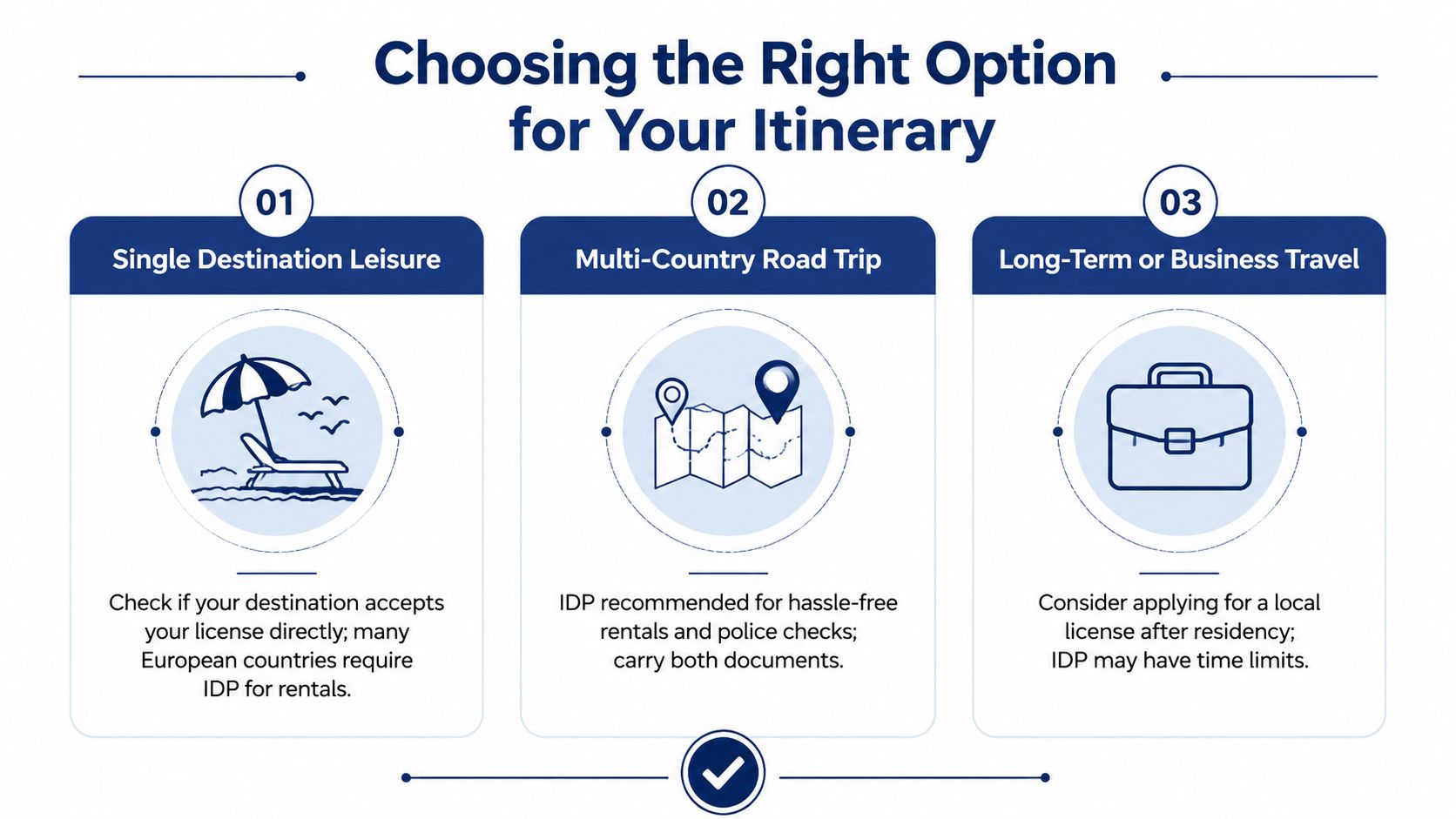
Your itinerary decides the document stack, not your preference. A weekend in one country is a different problem from a six-country road trip, and a business traveler shuttling between borders needs a stronger default than a tourist staying put. The safest rule is to choose the document that matches the most demanding point in the trip, not the least demanding one.
Match the document to the trip shape
| Trip type | Best default choice | Why it works |
|---|---|---|
| Single destination leisure | Licence, IDP, or translation depending on local rules | You only need the document set the destination actually accepts |
| Multi-country road trip | IDP plus domestic licence | Broader acceptance across checkpoints and rentals |
| Long-term business or relocation | Local licence conversion plan | Residency usually changes the document requirement |
| Language-barrier destination | Certified translation or IDP, depending on law | The staff need to read what your licence says |
A Europe road trip usually rewards over-preparing. Carry both the domestic licence and the IDP if the route crosses borders or if the rental desk is known to ask for it. For Southeast Asia, don't rely on what one country accepts to carry you through the next, because border-by-border variability is the rule, not the exception.
North American cross-border travel can be simpler on some routes, but simplicity doesn't equal universality. The right approach is still to check the destination and the rental company before you go. If you're a frequent traveler and your routes change often, a certified translation can be useful when a local-language document is the only thing stopping an otherwise valid rental from being released.
The cost question is straightforward. Don't overbuy a document you won't need, but don't cheap out on the one that prevents a refusal at the counter. If a destination treats the IDP as the cleanest answer, get the IDP. If the issue is readability and local acceptance, a certified translation can be the smarter play.
Presenting Documents at Rental Desks and Checkpoints
Hand over the documents in the right order. Start with the domestic licence, then add the IDP or certified translation as the supporting document. That order makes sense to agents and officers because the original proves authorization and the companion document makes the details readable.
Keep everything together. A single sleeve or folder prevents the awkward shuffle where you're digging for a second paper while the agent waits. It also reduces the chance of handing over the wrong document first, which is how travelers accidentally create suspicion around otherwise valid paperwork.
What to say if staff look uncertain
Stay calm and be specific. If the agent doesn't recognize the format, point to the original licence and explain that the companion document is there for translation or treaty recognition. If you carry an IDP, it helps to know that it comes from the treaty framework discussed earlier, because the issue is usually unfamiliarity, not hostility.
Practical rule: don't argue about online advice at the counter. Present the original licence, the companion document, and your passport. Keep the conversation short.
Check the names before you leave home. The name on your licence, IDP, and passport should match exactly. If your legal name has changed and the documents don't line up, carry a secondary ID that explains the difference. Expired papers, uncertified photocopies, and half-finished translations are the fastest way to lose time.
If you travel often or don't want to guess at destination rules, use a service that helps you sort the document type before you book. World Driving Permit provides certified licence translations and points travelers toward the official IDP issuer when an IDP is the document the destination requires.
If you want the cleanest route through rental desks and checkpoints, get your document set sorted before you fly. Visit World Driving Permit to prepare a certified licence translation and check whether your itinerary calls for an IDP instead, so you show up with the right papers the first time.