
Driving in Japan with Us License

A US license alone isn't enough for driving in Japan. You need a valid US driver's license plus a 1949 Geneva Convention International Driving Permit, and that combination lets you drive for up to 12 months from the date you enter Japan.
You discover this at the worst possible moment: after a long flight, standing at a rental counter with luggage beside you and a road trip already planned. The agent examines your Colorado, California, or New York license, then asks for the booklet you assumed was optional. A phone photo, an online “international license,” or a translation app won't solve the problem.
For driving in Japan with a US license, prepare the documents before you leave the United States. Japan's rule is unusually specific, and the difference between a valid Geneva IDP and an invalid Vienna IDP matters at the rental desk, during a police check, and if you need to make an insurance claim. The country's enforcement has also become more consequential. Japan recorded 7,286 traffic accidents involving vehicles and motorcycles operated by foreign nationals in 2024, up by more than 1,800 from five years earlier, according to reporting based on National Police Agency data and the government's traffic white paper (NHK World).
Table of Contents
- What a US Driver Actually Needs at the Rental Counter in Japan
- Why Japan Is Different, the 1949 Geneva Convention Rule
- How to Get Your IDP in the United States Before You Fly
- IDP vs JAF Translation vs Private Translation, Which Is Accepted Where
- Living in Japan, How Residents Convert a US License to a Japanese License
- Rental Desks, Insurance, and What Counter Agents Actually Check
- Common Pitfalls That Get US Drivers Turned Away
- Pre-Trip Checklist and Where to Verify the Rules Yourself
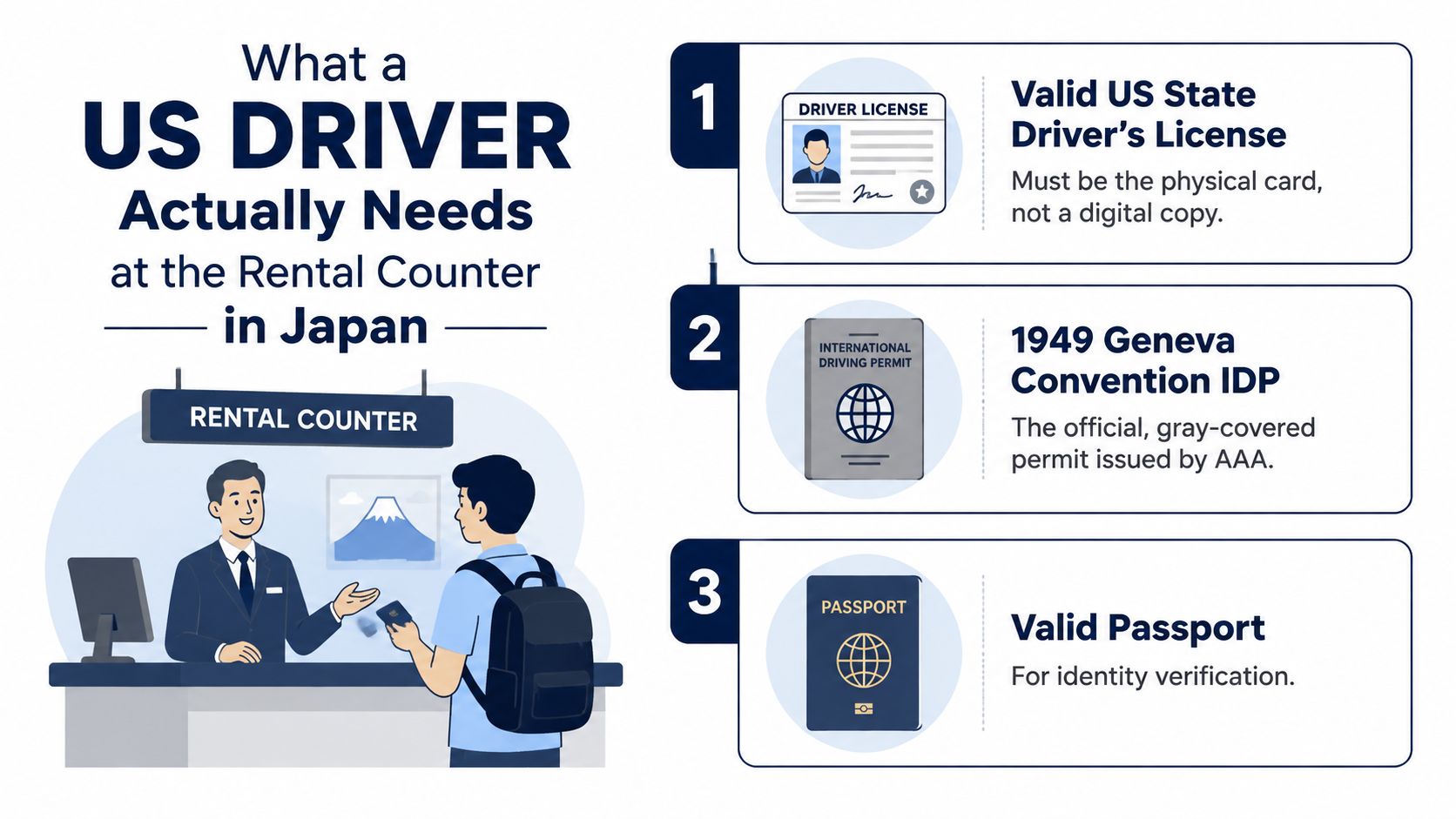
What a US Driver Actually Needs at the Rental Counter in Japan
A US tourist arrives at a Toyota Rent a Car counter at Narita and places a Colorado driver's license on the desk. The license is valid, physical, and clearly shows the driver's name and photo. It still isn't enough.
The correct document set is:
- A valid physical US driver's license
- A 1949 Geneva Convention International Driving Permit
- A valid passport
Present all three together. The IDP isn't a standalone license, and it doesn't replace the state-issued license. It serves as a standardized translation and validation document that must be carried with the underlying US permit.
Pack the originals, not substitutes
Bring the original license card, the original IDP booklet, and your passport. Don't rely on a digital license, a scan, or a photocopy. Rental staff need to verify the documents themselves and compare the identity details across them.
The practical planning fact is the 12-month driving window from your entry date into Japan. The US Embassy in Japan says Americans must carry a valid US license together with an IDP, and foreigners may drive on an international driving license for up to 12 months (US Embassy in Japan). Residents face additional rules when leaving and re-entering Japan, including an overseas stay requirement before the driving period can be treated as renewed.
Age rules can also affect the reservation. You must be at least 18 for regular cars, while certain vehicle categories require drivers to be 20 or older. Rental companies can impose stricter policies, especially for younger drivers or specialized vehicles, so check the agency's conditions before paying.
Practical rule: Put the license, IDP, and passport in the same travel wallet. If one is missing, the other two may not get you behind the wheel.
Why Japan Is Different, the 1949 Geneva Convention Rule
Japan doesn't accept every document marketed as an “international license.” Its system is tied to the 1949 Geneva Convention on Road Traffic, and Japanese authorities distinguish that framework from the 1968 Vienna Convention.
That distinction explains why a booklet that looks official in another country can be rejected in Japan. Tokyo police specify that Japan accepts IDPs issued under the 1949 Geneva Convention, while IDPs issued under the 1968 Vienna Convention are invalid in Japan, even when the issuing country is also connected to the Geneva framework. The US IDP issued through AAA follows the Geneva format Japan recognizes.
| Convention | Year | Issued in US | Accepted in Japan |
|---|---|---|---|
| Geneva Convention | 1949 | Yes, through the authorized US issuer | Yes, when paired with a valid US license |
| Vienna Convention | 1968 | Not the relevant US format for Japan | No |
The treaty isn't a technical footnote. It determines whether the document supports lawful driving. The IDP must be presented with the valid home-country license, because the permit translates and validates the authority of that original document rather than creating an independent driving entitlement.
For a concise explanation of the two treaty systems, use this comparison of the 1949 Geneva and 1968 Vienna conventions.
Why the counter check feels formal
Japanese rental agents and prefectural police operate in an environment where document validity matters. The Road Traffic Act provides the legal foundation, while prefectural police administer enforcement locally. That combination produces a consistent national expectation: staff inspect the physical booklet, confirm the convention format, and match it to the original US license and passport.
Japan's recent accident data helps explain the attention. The government reported that accidents involving foreign drivers rose from 5,441 in 2020 to 7,286 in 2024, and the Japan Times reported that foreign drivers caused 258 serious car accidents in the first half of 2025, representing 2.1% of serious car accidents during that period (NHK World). Those figures don't change the document rule, but they show why rental companies and authorities treat verification as an operational requirement rather than casual paperwork.
How to Get Your IDP in the United States Before You Fly
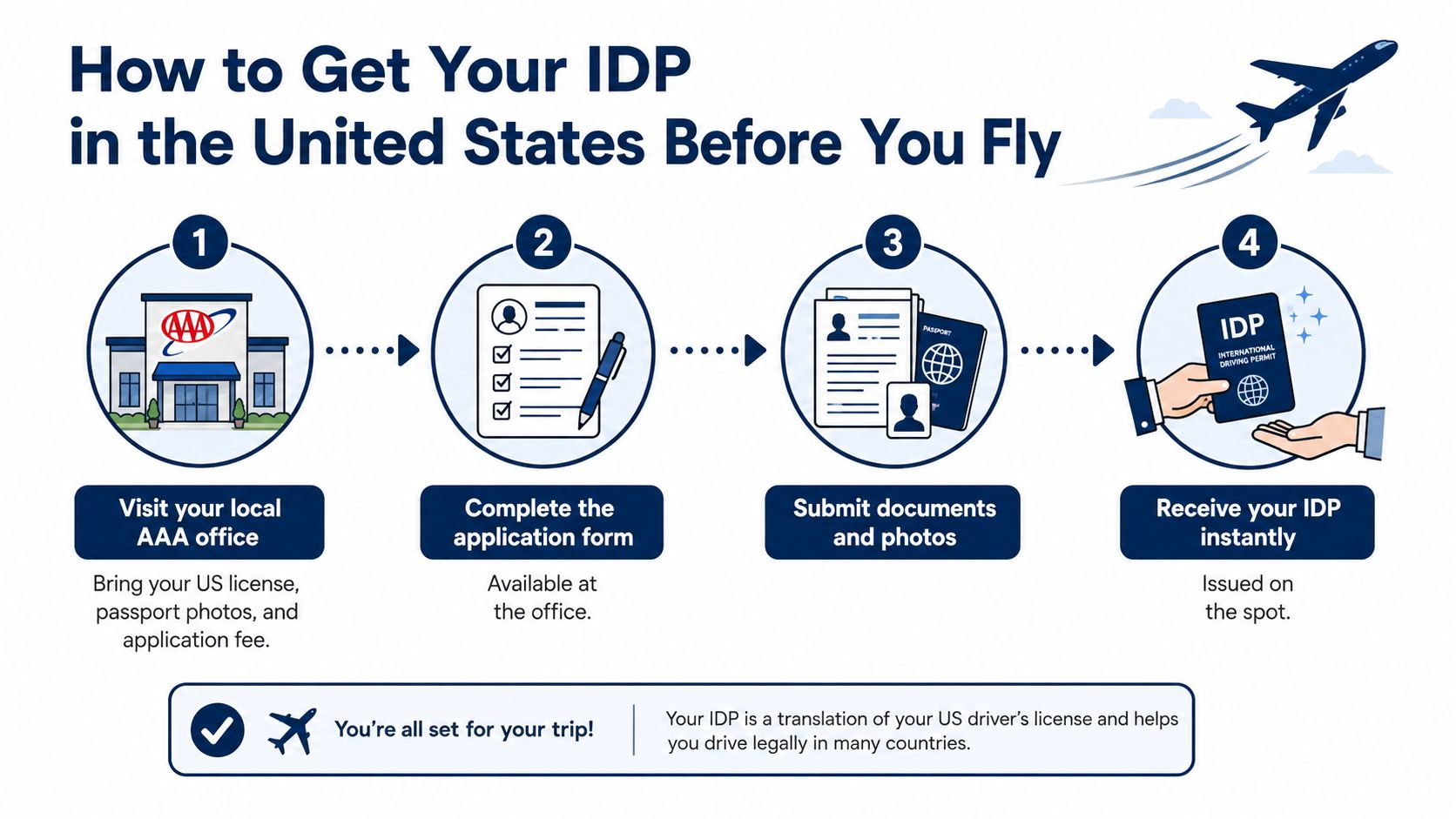
Get the IDP before your departure. You can't fix the problem reliably after landing, and an online-only document from an unrecognized reseller isn't a substitute for the authorized permit.
For US drivers, the normal route is through AAA. The application fee is $20, before any applicable member or non-member processing fees. AAA requires a completed application, two identical passport-style photos, a valid US driver's license, and proof of identity such as a passport. The photographs should be 2 by 2 inches, have a white background, and have been taken within the last six months.
Follow the application sequence
- Check the license first. AAA won't issue the IDP if your US license expires within six months of the trip. Renew the state license before applying if necessary.
- Prepare the photos. Bring two matching passport-style photographs that meet the required size and background specifications.
- Complete the AAA application. You can obtain the form through AAA and submit it with the other documents.
- Choose branch or mail processing. A branch office may process the application the same day. Mail applications can take 4 to 6 weeks, so build in a buffer (AAA International Driving Permit information).
Watch both validity dates
There are two separate clocks. Your US license must meet AAA's validity condition when you apply, and the IDP itself is valid for one year from its issue date, not automatically one year from your arrival in Japan.
That makes timing important. Applying too early can reduce the useful life of the permit by the time you travel, while applying by mail too late can leave you without the document. My recommendation is to apply 4 to 6 weeks before departure, using a branch office when available and confirming the exact issue date.
The IDP should be treated as a physical travel document. Keep it in your carry-on, not checked baggage, and don't separate it from the state license during the trip.
Here's a visual walkthrough of the process:
IDP vs JAF Translation vs Private Translation, Which Is Accepted Where
US travelers often hear three terms and assume they're interchangeable: International Driving Permit, JAF Japanese translation, and certified private translation. They aren't interchangeable.
For a short-term US visitor renting a normal car, the 1949 Geneva IDP is the document to obtain. A JAF translation is mainly an administrative document used by people who already have the relevant foreign license and are handling Japanese licensing matters. A private translation can make license details readable, but it doesn't automatically carry the legal effect of an IDP.
| Document | Issued by | Approximate cost | Turnaround | Accepted by rental agencies | Valid for driving | Valid for license conversion |
|---|---|---|---|---|---|---|
| 1949 Geneva IDP | AAA in the US | $20, plus applicable processing fees | Often same day in person, longer by mail | Generally required for US visitors | Yes, when carried with the valid US license and passport | No, it isn't a Japanese license |
| JAF Japanese translation | Japan Automobile Federation | About ¥4,000 | Varies by application method and location | Not the standard substitute for a US visitor's IDP | Mainly for qualifying license holders under Japanese rules | Yes, commonly used in the conversion process |
| Private certified translation | Private translation provider | Varies | Varies | Confirm directly before relying on it | Acceptance depends on the authority and rental company | May support an application, subject to licensing-center approval |
Choose by legal purpose
The IDP is for short-term visitor driving under the applicable treaty framework. It must travel with the original US license, and the passport remains important for identity and entry verification.
The JAF translation serves a different role. Residents converting a US license to a Japanese license may need a Japanese rendering of the license for the licensing center. That translation helps officials understand the license fields, but it doesn't turn a tourist's US license into an IDP.
A private certified translation can be useful when an authority or rental company specifically accepts it. Don't assume certification alone makes it universally valid. Ask the rental agency in writing if you're considering one, and ask the prefectural licensing center what it will accept if you're converting your license.
A readable translation and a legally recognized driving permit solve different problems. Buy or request the document that matches your status.
Living in Japan, How Residents Convert a US License to a Japanese License
Residents shouldn't plan to drive indefinitely on repeated IDPs. The more durable route is gaimen kirikae, the process of converting a valid foreign license into a Japanese license.
The first eligibility question is historical, not logistical. The US license must have been issued while you lived in the issuing US state for at least three consecutive months after age 18. Your passport entry and exit records, or other accepted evidence, may be used to prove that stay. An expired US license can't be converted.
Assemble the conversion file
Expect the licensing center to request documents such as:
- Current US license: It must be valid and unexpired.
- Japanese translation: A JAF translation is commonly used for the application.
- Stay evidence: Bring passport records, entry stamps, or other proof showing the required time in the issuing state.
- Japanese residency documents: Your residence card and proof of residence may be required.
- Photograph and application materials: Follow the local License Center's specifications.
Local procedures differ, so contact the prefectural License Center before visiting. The Japan license translation and conversion guide can help you organize the terminology and document list, but the licensing authority makes the final decision.
Pick the route that fits your schedule
The standard path runs through the prefectural License Center. It can include an eyesight check, a written knowledge test, and a practical driving test. For some applicants, the written test is a short English true-or-false format, but don't treat it as automatic or universal. Test language, exemptions, and appointment practices can vary by prefecture and by the issuing US state.
The alternative is a paid driving school program. Some schools prepare applicants for the Japanese test process and may offer a route that avoids taking the road test directly, depending on the school and local rules. A realistic school-based timeline can be 2 to 4 weeks, while a License Center appointment may take longer if testing slots are limited.
Conversion fees generally fall around ¥2,500 to ¥4,500, depending on the local process and license category. Confirm the current amount with your prefecture before budgeting.
Rental Desks, Insurance, and What Counter Agents Actually Check
At a Japanese rental counter, hand over the passport first, then the physical US license and the original IDP booklet. The agent typically compares the name, photograph, dates, and other identity information across the documents.
A photocopy won't carry the same weight as the original. Neither will a phone image. The staff member needs to inspect the booklet and confirm that it belongs to the person presenting the state license.
The counter sequence matters
Rental staff in Tokyo, Osaka, and Okinawa generally recognize the Geneva IDP format. They usually won't ask a US driver for a separate Japanese translation when the correct IDP is present, because the IDP is designed for this international verification purpose.
Before signing, ask the agent to explain the insurance package in plain language. Japanese rentals generally include basic liability and collision-related protection, but coverage limits, exclusions, and deductibles vary by company. US domestic auto insurance often doesn't extend automatically to Japan, so confirm with your insurer rather than assuming your policy follows you overseas.
Credit card rental coverage may apply in some situations, but the card issuer's conditions control. Keep the required license and IDP available at the time of rental, and check whether the card benefit excludes certain vehicle types, roads, or countries.
Budget for the operating details
Ask about ETC toll equipment, fuel, and roadside assistance before driving away. Some agencies may charge a 6-hour ETC card deposit, expressway use can involve ¥20 to ¥30 tolls, and a fuel service fee may range from ¥1,000 to ¥3,000 if you return the vehicle without refilling it. Confirm each amount with the rental company because these are operational charges, not universal national fees.
Inspect the car before leaving. Photograph existing scratches, check the fuel gauge, confirm the return location, and ask what happens if you use a toll road without an ETC card.
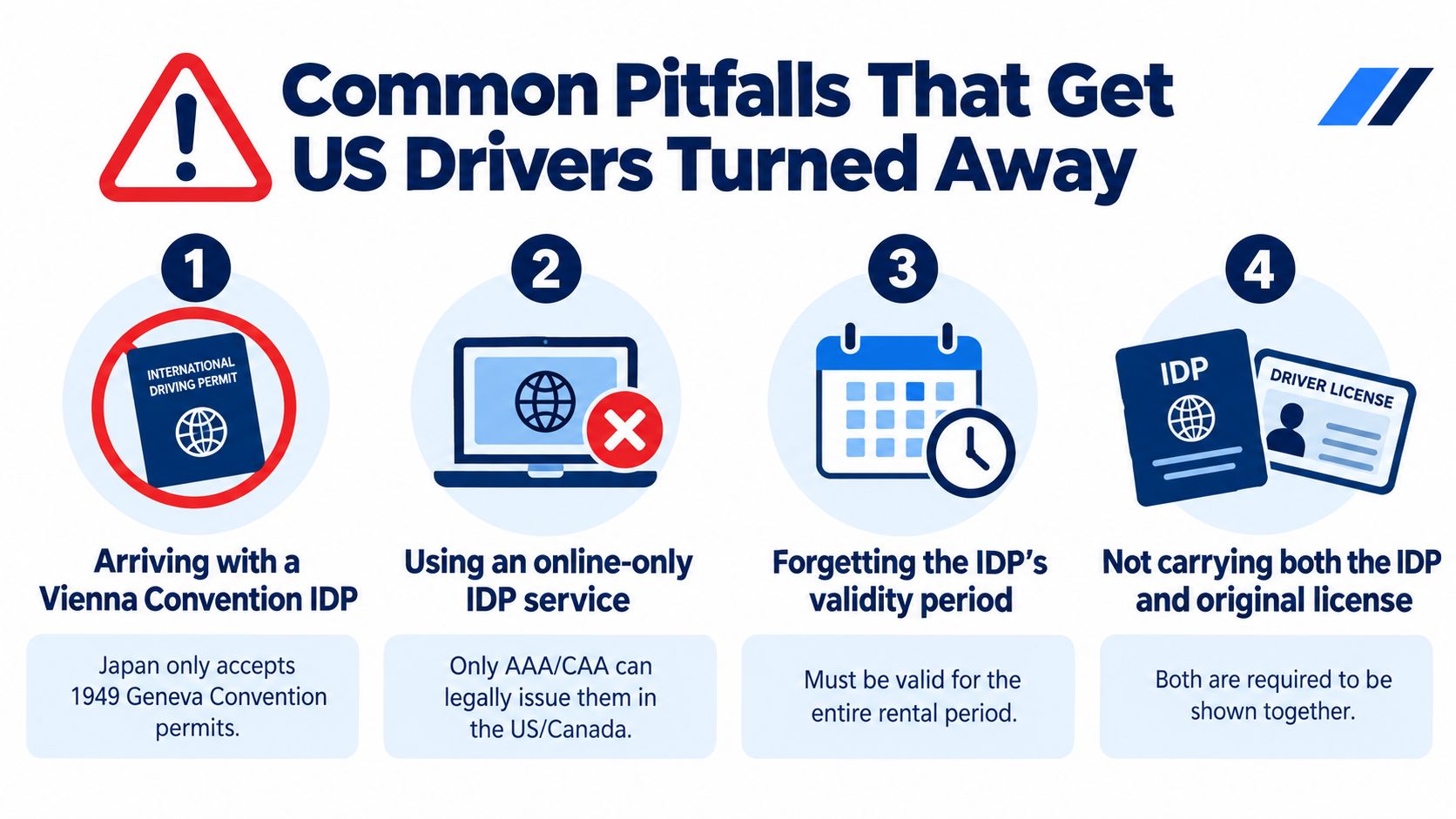
Common Pitfalls That Get US Drivers Turned Away
Most rejected rentals don't fail because the traveler lacks a driver's license. They fail because the traveler brings the wrong companion document or misunderstands what the IDP does.
Five mistakes to eliminate
- Arriving with a Vienna IDP. Japan accepts the 1949 Geneva Convention format, not a 1968 Vienna Convention permit. Check the convention stated in the booklet before departure.
- Treating the IDP as a replacement license. Carry the valid physical US license and the IDP together. The permit has no practical value as a standalone booklet.
- Ignoring the time limit. The relevant driving window is tied to entry into Japan and the applicable residency rules. Residents also need to consider the overseas stay requirement before re-entry.
- Assuming any translation will work. A private certified translation may help in a specific administrative setting, but it isn't automatically equivalent to the required IDP at every rental desk.
- Overlooking age and vehicle rules. Regular cars generally require drivers to be at least 18, while some categories require drivers to be 20 or older. Rental companies may set higher thresholds or restrict vehicle classes for younger drivers.
Don't trust digital paperwork
An online-only “international driver's license” is a common trap. A website can sell a translation or a decorative booklet, but that doesn't make it the treaty-based IDP required for US drivers in Japan. Use AAA for the US-issued permit, and treat translation services as supplementary unless the rental company or licensing authority confirms otherwise.
If your itinerary includes another country before or after Japan, check that country separately. Japan's permission to drive doesn't automatically authorize you to drive elsewhere, and a document accepted in one destination may be rejected in the next.
Counter-saving habit: Before flying, open the IDP and verify the convention, issue date, expiration, name, and vehicle category. Then place it beside the physical US license in your document wallet.
Pre-Trip Checklist and Where to Verify the Rules Yourself
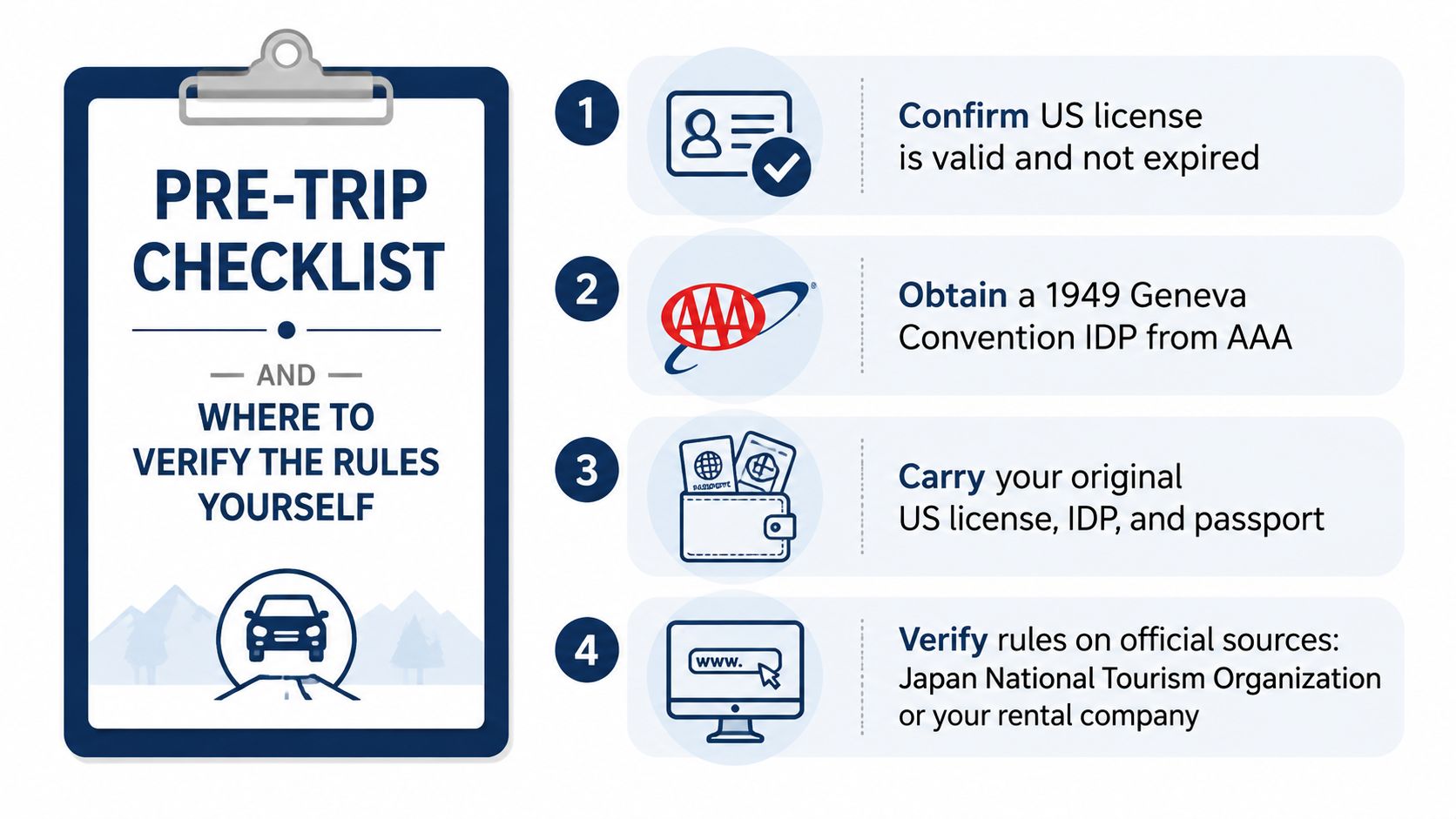
Don't build your plan around an old forum post or a friend's experience from a different US state. Complete a document check before departure, then confirm the rental company's own conditions.
Your document check
- Confirm the state license: Make sure the physical US license is valid for the full rental period.
- Obtain the correct permit: Get a 1949 Geneva Convention IDP from AAA before leaving the United States.
- Carry the originals: Keep the license, IDP, and passport together and accessible.
- Review your status: If you're a Japan resident, check whether the entry date, overseas stay, and residence status mean you need a Japanese license conversion.
- Ask the rental company: Verify age limits, vehicle restrictions, deposit rules, insurance exclusions, and fuel requirements.
- Inspect at pickup: Record existing damage and confirm roadside assistance and the return procedure.
Use primary authorities for unusual situations
Start with the US Embassy in Japan's driving guidance for the US traveler position. For enforcement and national police information, consult the National Police Agency reporting and traffic information, then contact the prefectural License Center handling your residence if you're converting a license.
JAF is the relevant organization to ask about Japanese translation services. AAA can explain US IDP issuance, while the rental company can confirm its counter policy. Those checks matter most for long stays, nonstandard licenses, younger drivers, and trips that follow a visa or residence-status change.
The Japan driving requirements guide can serve as a practical document checklist, but local authorities and the rental agency remain the final sources for acceptance.
World Driving Permit provides certified word-for-word translations of national driving licenses into 28 languages, with digital delivery and an optional printed booklet for presentation alongside the original license. For Japan, use its requirement checker to confirm that you still need the authorized 1949 Geneva IDP, then visit World Driving Permit if a readable translation companion will help with another country or rental counter.