
Driving in Greece with US License: A Practical Guide

Under Greek Law 4850/2021, reported in November 2021, a valid US driver's license is recognized for short-term visits to Greece. Rental companies and police checks may still ask for a readable companion, such as an International Driving Permit or certified translation.
You've booked the Athens flight, sketched out an island-hopping route, and perhaps reserved a car for Santorini or Milos. Then the practical question appears: will the license in your wallet get you past the rental counter? For Americans, driving in Greece with a US license is legally more straightforward than many older travel guides suggest, but the desk experience can still depend on the company, the location, and the agent handling your documents.
The safest approach is to separate two issues. Greek law provides the legal baseline, while rental companies and roadside officials decide what they need to read and verify quickly. The plan below helps you prepare the original license, choose a useful companion document, check the rental conditions, and avoid arriving at a Greek island office with paperwork that looks acceptable online but causes trouble in person.
Table of Contents
- Planning to Drive in Greece With a US License
- What Greek Law 4850/2021 Changed for US Visitors
- US License Alone, IDP, or Certified Translation
- Pre-Trip Documentation Checklist
- Rental Counter and Insurance Realities
- Key Greek Driving Rules and Road Signs
- Getting an IDP or Certified Translation Before You Fly
- Final Pre-Departure Checklist and Bottom Line
Planning to Drive in Greece With a US License
A valid US license is recognized for short-term visits under the post-2021 Greek framework. That means the old blanket instruction, “every American must have an International Driving Permit,” is no longer an accurate description of the legal starting point for many tourists. The original license remains the key document, not a translation or substitute.
The complication begins at the rental desk. An agent may need to understand the license categories, validity dates, and identifying details without being familiar with the format of your state-issued card. A police officer conducting a roadside check may face the same issue. An International Driving Permit, or a properly prepared certified translation, gives the reader a standardized companion while leaving your original license as the controlling document.
Practical rule: Treat your US license as the legal foundation, and treat a readable companion as friction protection.
Before departure, check the specific terms of the company you'll use. Some operators ask for a license held for at least one year, and some still request an IDP as an internal requirement even where the license is recognized. The Greece driving requirements guide can help you identify the documents to review before you finalize the booking.
Your preparation should answer four questions:
- Is the physical license valid for the full visit?
- Does the rental company explicitly require an IDP?
- Would an agent or officer be able to read the license details quickly?
- Can you present the passport, license, companion document, and payment card together?
If the answer to the third question is uncertain, obtain the companion document before flying. A small amount of preparation at home is preferable to negotiating document requirements beside a luggage carousel or ferry terminal.
What Greek Law 4850/2021 Changed for US Visitors
Greek Law 4850/2021 marked a significant change for Americans and other non-EU visitors. Reported in November 2021, the reform established recognition of qualifying foreign licenses for short-term visitors, including valid US licenses, without making an IDP the automatic legal requirement for every tourist journey. The reported explanation of the Greek recognition rule identifies this date as the point at which the practical guidance shifted away from an IDP-first assumption.
The important word is short-term. The rule is designed for visitors during a tourist stay, with summaries describing the allowance as applying to stays under six months. It isn't a general route for someone who has relocated to Greece, established residence, or remained beyond the visitor framework. A longer-term stay can trigger different licensing obligations, so don't treat a tourist rule as permission to drive indefinitely on a home-state credential.
What the law does and doesn't do
The reform recognizes the original foreign license. It doesn't transform a translation into a driving license, guarantee that every rental company will accept the card without additional paperwork, or remove the need to satisfy the rental agreement. The US license must be valid, legible, and presented with the other documents the operator requests.
The US Embassy guidance on driver's licenses adds an important practical limit. The embassy isn't authorized to renew or replace a state-issued license, administer driving tests, or provide a replacement when a traveler loses the card. Travelers therefore need to resolve expiration, renewal, and replacement concerns before departure.
The embassy also isn't the office to contact for an IDP, an apostille, or a consularly certified translation of your license. Those are separate matters handled through authorized issuers or private translation providers. Don't arrive in Athens expecting consular staff to convert an invalid or missing license into a usable rental document.
The legal baseline versus local discretion
The law answers whether your valid US license can serve as the basis for short-term driving. The rental desk answers whether its internal policy requires an additional document before releasing the vehicle. That distinction explains why travelers can receive different instructions from a national rental brand, a local island office, and a police checkpoint without the underlying legal rule changing.
US License Alone, IDP, or Certified Translation
There are three sensible documentation paths for an American visitor. Pick based on your itinerary and the rental company's written terms, not on a generic internet checklist.
| Option | What It Is | Where It Works Best | Typical Turnaround | Approximate Cost |
|---|---|---|---|---|
| US license alone | Your valid, physical state-issued license | Short tourist stays where the rental company confirms that no companion is required | Already available if valid | Existing document cost |
| US license plus IDP | The original license carried with an authorized international permit | First visits, multiple rental offices, roadside checks, and companies that list an IDP in their terms | Depends on the authorized issuer and delivery method | Issuer fee and any delivery cost |
| US license plus certified translation | The original license accompanied by a readable translation | When a rental office wants translated fields or an IDP isn't available | Depends on the provider and delivery option | Provider fee |
The license alone
This is the minimum legal path for many short visits under the 2021 framework. It works best when the rental company confirms acceptance in writing and your license clearly displays the information an agent needs. It leaves you exposed to avoidable confusion if the office has a strict internal policy or the staff can't quickly interpret your card.
Adding an IDP
An IDP is a standardized companion, not a replacement for the US license. It can help an agent or officer interpret the information on the original card, particularly when the rental office serves travelers from many countries. Some operators continue to request one as a risk-control measure, even when Greek law recognizes the underlying US license, as explained in the rental-company guidance on IDP requirements.
Adding a certified translation
A certified translation can make the license fields easier to understand without presenting itself as a government-issued permit. It may suit travelers who need a Greek-readable document and can't obtain an IDP through their usual route. Acceptance remains local, so confirm the rental company's policy before relying on translation alone.
My recommendation is simple. First-time visitors should carry the physical US license plus an IDP, unless the rental company gives clear written instructions that another arrangement is sufficient. The IDP isn't a substitute for checking the contract, but it closes a common communication gap at the counter.
Pre-Trip Documentation Checklist
Handle the paperwork in order. Don't wait until the airport to discover that the card you planned to use expired during the trip or that the rental company requires a companion document.
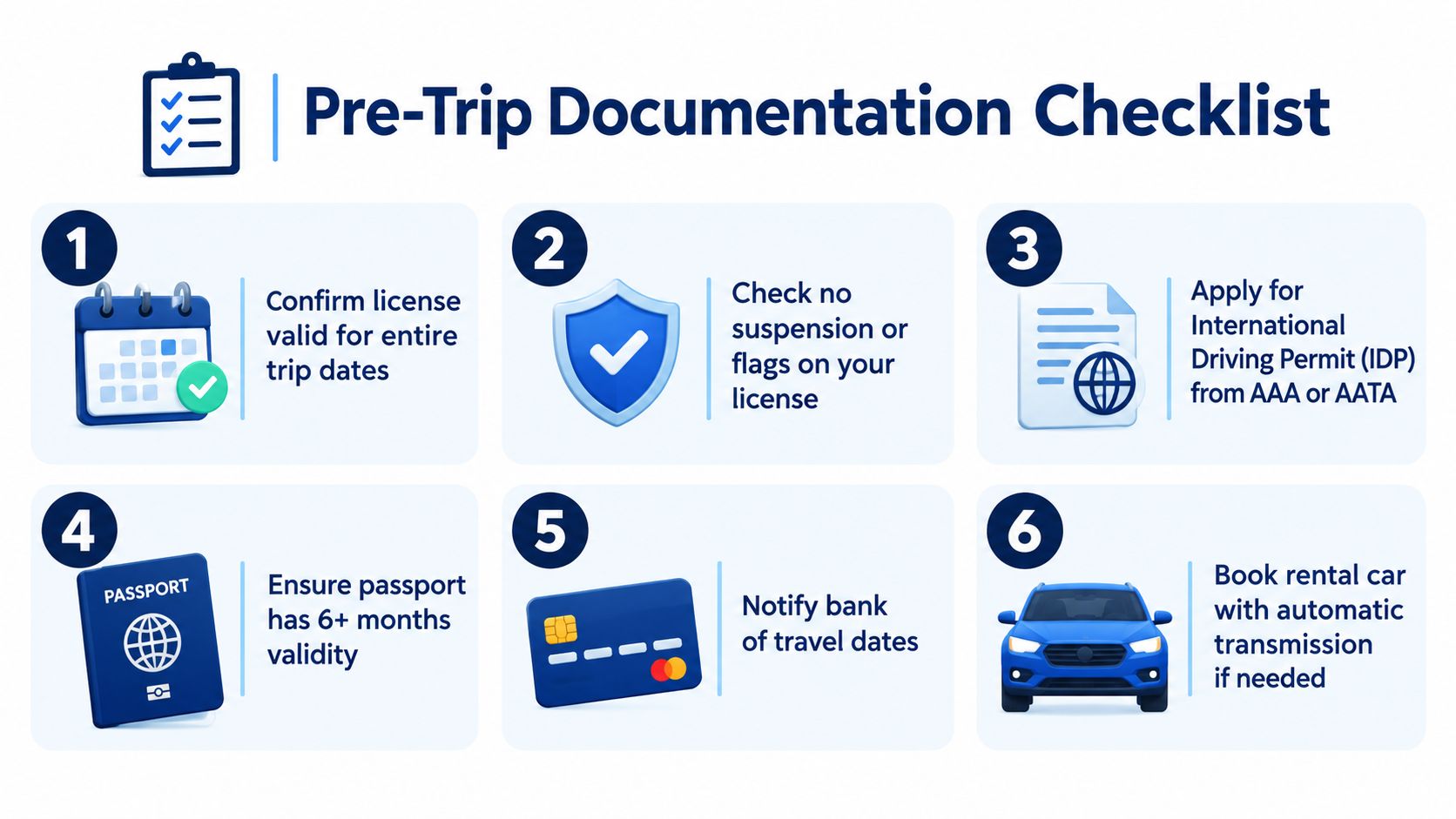
Confirm the license dates. Check the front and back of the state-issued license and verify that it remains valid for the entire trip. If renewal falls inside the travel window, fix that before leaving home.
Create secure copies. Scan both sides at clear resolution, save the files in secure cloud storage, and keep an offline copy on your phone. Copies won't replace the original at the counter, but they make a lost-wallet problem easier to manage.
Choose the companion document. Ask the rental company whether it wants an IDP, a certified translation, or only the original license. If the answer isn't clear, choose the document that gives the desk the most readable information.
Print the core papers. Carry printed copies of the passport bio page, license, companion document, rental voucher, and insurance confirmation. Keep the originals separate from the copies so one lost bag doesn't contain everything.
Match the payment details. Confirm that the lead driver's credit card is in the same name as the license and has enough available capacity for the rental hold. Add every additional driver during booking rather than trying to negotiate it at pickup.
Prepare for weak connectivity. Download offline maps for Greece and your islands, save ferry details, and screenshot the confirmation showing the driver name, dates, and vehicle class.
The video below can supplement your document preparation with practical travel context.
Rental Counter and Insurance Realities
The reservation confirmation isn't the same as a guaranteed handover. At pickup, the agent will compare the driver, license, passport, payment card, and booking details. Rental operators commonly want the license to have been held for at least one year, and they may impose stricter conditions for certain vehicle categories.
Expect the lead driver to present the physical license, passport, and credit card. A debit card may not satisfy the company's deposit policy, and a card belonging to a companion may not work if the reservation is in the lead driver's name. Additional drivers should appear on the booking or rental contract before anyone takes the wheel.
| Requirement | Typical Rule | Notes for US Visitors |
|---|---|---|
| Original license | Valid state-issued license | Bring the physical card, not only a digital copy |
| License history | Often held for at least one year | Check the company's terms before booking |
| Passport | Identity and travel document check | Name should match the booking and license |
| Credit card | Used for the rental hold | The lead driver should carry the card |
| IDP or translation | May appear in company terms | Company policy can be stricter than the legal baseline |
| Additional driver | Must be recorded by the operator | Add the person before pickup |
Some companies still list an IDP because their internal procedures prioritize a standardized, readable companion. That request doesn't necessarily mean the company disputes the Greek recognition rule. It means the agent is applying the company's risk policy, and arguing about the law at the counter won't get you the keys faster. Review the IDP and car-rental preparation guidance before you commit to a provider.
Read the insurance contract
Third-party liability cover may be included in the base rental arrangement, but that doesn't tell you what damage you could owe after an incident. Ask the agent to show the excess, exclusions, glass and tire treatment, underbody coverage, and any restrictions for ferries, gravel roads, or particular islands.
If you plan to use credit-card coverage or buy separate collision protection, confirm the conditions in writing before pickup. Don't rely on a verbal promise that “everything is covered.” The signed contract should state what the excess applies to and what evidence the company expects after damage.
Key Greek Driving Rules and Road Signs
The legal details that matter most are the ones Americans can miss while adjusting to Greek roads. Drive on the right, keep your pace conservative on narrow island routes, and expect conditions to change quickly between city streets, villages, mountain roads, and coastal approaches.
Use the following as a plane-ride briefing, then obey the posted sign whenever it sets a different limit:
- Built-up areas: The supplied guidance lists 50 km/h as the standard limit in urban areas.
- Open roads: The listed limit is 90 km/h on open rural roads.
- Motorways: The listed limit is 130 km/h on motorways.
- Villages and schools: Slow immediately when signs, flashing lights, or pedestrians indicate a lower limit. Don't assume the open-road limit continues through a settlement.
- Headlights: Dipped headlights are required outside cities. Set them before leaving an urban area rather than waiting for a reminder from another driver.
- Seatbelts: Wear a seatbelt in every occupied seat. Make this automatic before moving.
- Phones: Use a hands-free system. Mount navigation before departure and ask a passenger to handle route changes.
- Alcohol: The legal blood alcohol limit is 0.05 g/L, lower than the limit in many US jurisdictions. The practical recommendation is to avoid alcohol entirely when driving.
Roundabouts, signs, and tolls
Roundabouts demand attention because priority can be signposted differently from what an American driver expects. Follow the posted priority signs, yield as directed, and don't enter just because the lane appears open. Once inside, stay predictable and signal clearly when exiting.
Blue circular signs usually communicate mandatory instructions. Brown signs point toward tourist or archaeological destinations, while motorway signage helps identify major routes and toll-related approaches. Read the sign before committing to a turn, especially where Greek and Latin place names appear together.
Parking also requires local awareness. Markings and signs determine whether a space is available, restricted, or paid. Ask your hotel or rental office how the local system works before leaving the car, rather than assuming that an apparently open space is free.
Getting an IDP or Certified Translation Before You Fly
If you choose an IDP, use an authorized issuer and carry it with the original US license. The permit doesn't stand alone. A rental agent or officer may want both documents, and the original license remains the evidence of your actual driving authorization.
AAA is a familiar route for Americans who want an IDP before an international trip. Check the current application instructions directly with AAA, including whether your local branch handles applications in person or whether you need to use a mail process. Have the original license and required identification materials ready, and allow enough time for delivery if you aren't applying at a branch.
Don't confuse different international permit conventions. The document you obtain must be the one applicable to your destination and vehicle use, and you should verify the current Greek requirement with the rental company and authorized issuer. A permit from an unofficial website can create a second problem instead of solving the first.
A translation as a readable companion
A certified, multi-language translation can be useful when a rental desk wants the license details presented in a more familiar format or when an IDP isn't available in time. It isn't a government license or an automatic guarantee of acceptance. Keep it together with the physical US license and ask the rental company to confirm that it accepts this type of document.
The Greece license translation service is one private option that provides a certified translation of a national license as a readable companion. Check its stated scope, delivery format, and acceptance caveats before ordering, and don't use a translation as a substitute where an official IDP is specifically required.
Whichever route you choose, save a digital copy and pack the physical companion document. A PDF in your phone can help with reference, but it won't necessarily satisfy a desk that requires printed documentation.
Final Pre-Departure Checklist and Bottom Line
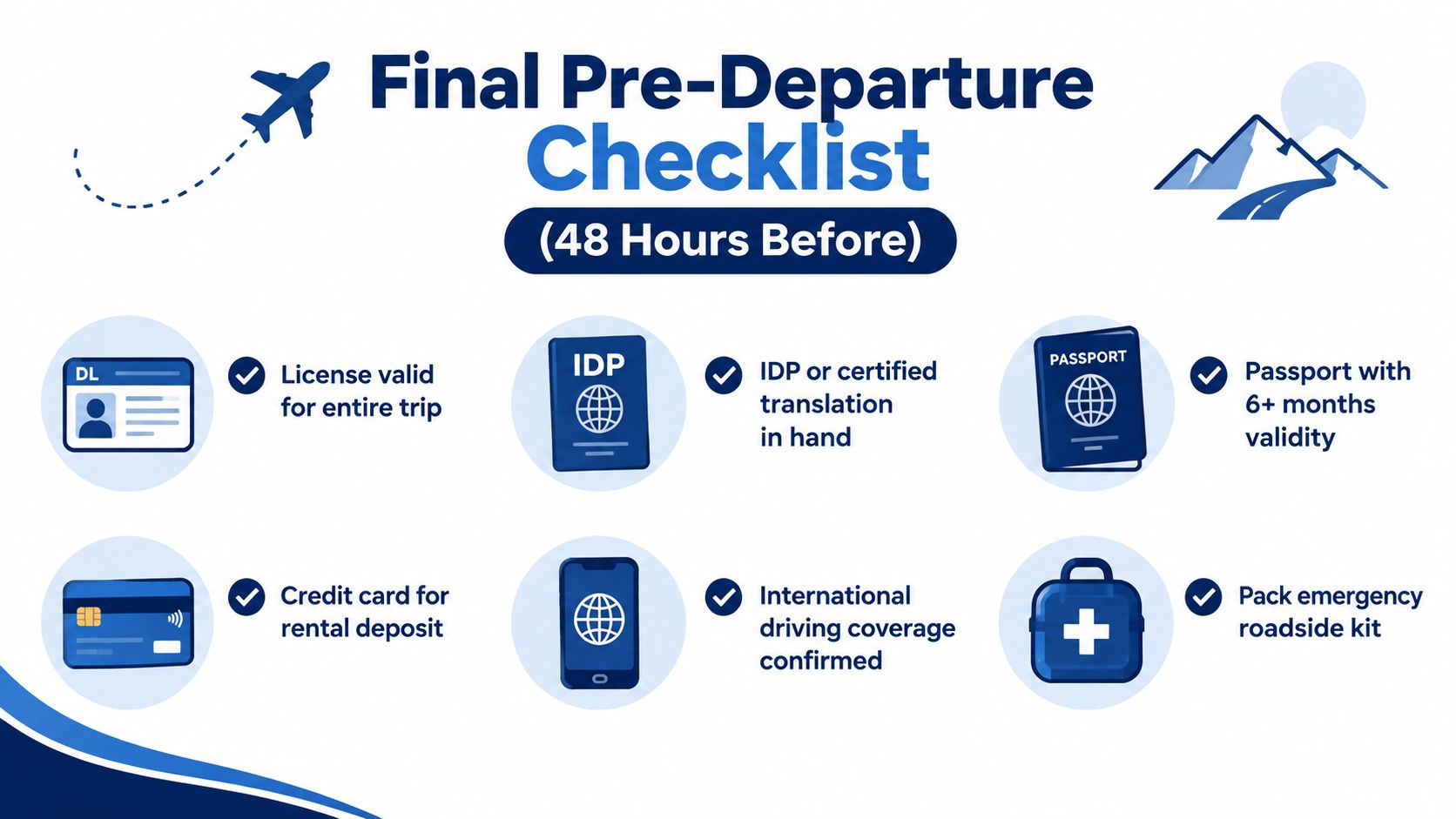
Use the final 48 hours to verify the items that can still derail pickup:
- License: Confirm the original state-issued card is valid for the full trip.
- Companion document: Put the IDP or certified translation beside the license.
- Passport: Check the passport's remaining validity and carry the original.
- Payment card: Confirm the lead driver has the required credit card for the rental hold.
- Rental paperwork: Print the voucher, driver details, vehicle class, and insurance confirmation.
- Offline access: Save embassy contact information, rental assistance details, maps, and ferry information without relying on mobile service.
The bottom line is clear. Under the framework created by Greek Law 4850/2021, a valid US license is recognized for short Greek visits. The rental counter still operates according to company policy, and roadside communication can be easier when the license has a readable companion. Carrying an IDP or certified translation doesn't replace the original license, but it can remove an unnecessary point of friction.
My recommendation is to spend the small amount required for the companion document and handle it before departure. One visit to an authorized issuer, or an appropriate translation order, is cheap insurance against losing a morning at the airport or ferry port because an agent can't process an unfamiliar license format.
World Driving Permit provides certified, word-for-word driving-license translations in 28 languages, with digital delivery and an optional printed booklet for presentation alongside the original license. If you want a readable companion for your Greek rental paperwork, review the options and destination guidance at World Driving Permit.