
Drivers License in Sweden
If you're visiting Sweden with a valid foreign licence, you can generally drive for up to one year, but whether you need a translation or an IDP depends on the licence's language and issuing country. At the rental counter or during a police stop, the original licence must be supported by the document that makes it readable and acceptable locally.
You've landed at Arlanda, collected your luggage, and reached the rental desk. Your licence is valid, but it's printed in Thai, Arabic, or another script the agent can't immediately verify. The agent calls a supervisor, checks the company's policy, and your supposedly quick pickup turns into a delay.
That situation is avoidable. Sweden's foreign-licence rules are manageable when you separate three decisions: how long you're entitled to drive, whether your licence can be read without assistance, and whether the rental company imposes stricter requirements than Swedish law. Residency changes the answer, too. A tourist's document strategy is different from a newly registered resident's.
Table of Contents
- The One-Year Rule for Driving in Sweden with a Foreign Licence
- Which Foreign Licences Sweden Recognises Automatically
- Carrying and Presenting Your Licence at Rental Desks and Police Stops
- Certified Translation Versus Official IDP
- Exchanging Your Licence After Swedish Residency
- 2026 Rule Changes That Affect Drivers in Sweden
- Practical Checklist and Common Mistakes to Avoid
The One-Year Rule for Driving in Sweden with a Foreign Licence
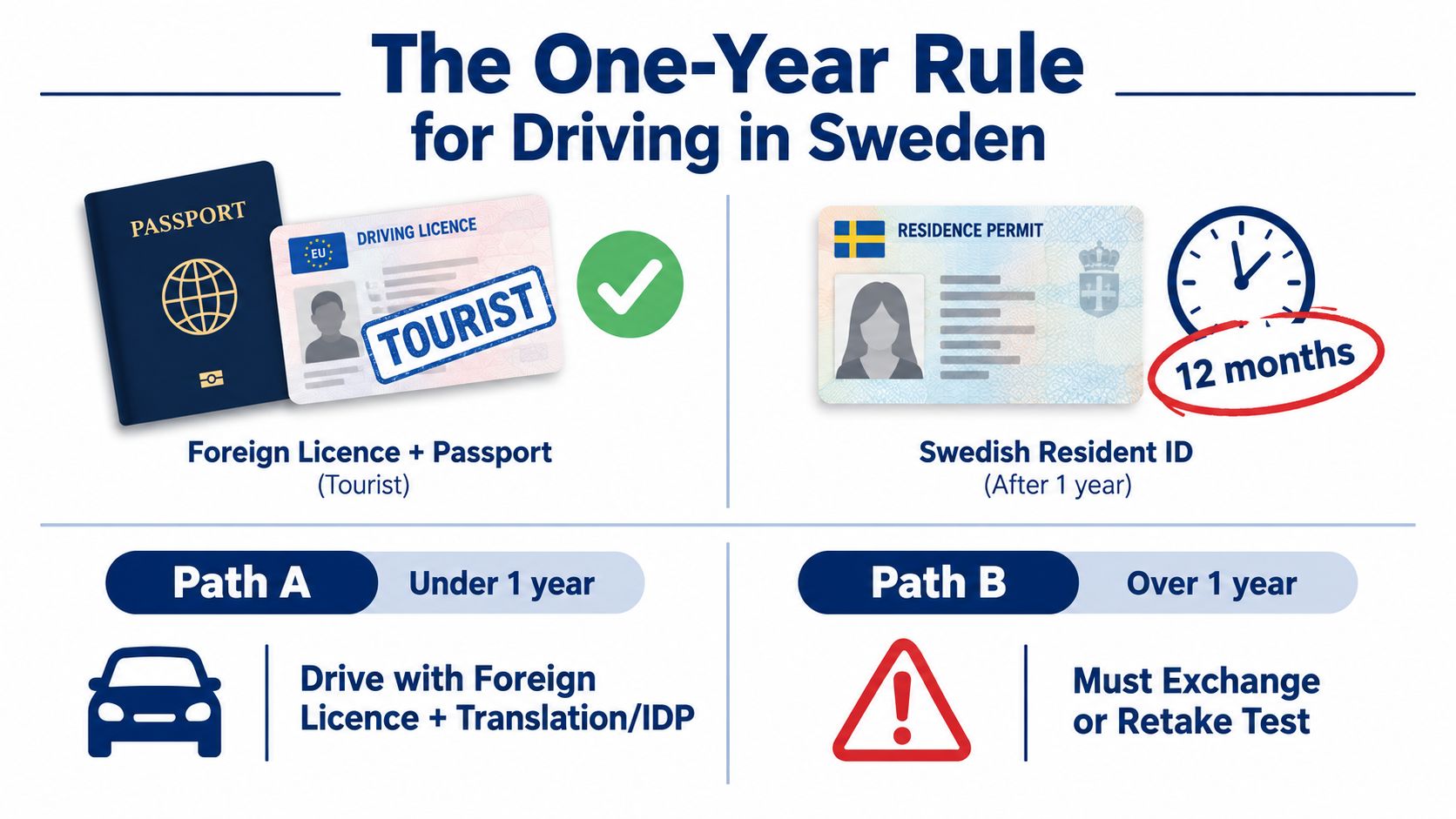
For a visitor, the central rule is straightforward. A valid foreign driving licence can generally be used in Sweden for up to one year after population registration or the relevant start of residence, depending on the driver's status and the applicable rule. Official Swedish guidance explains that non-EEA licences are generally valid for one year after Swedish population registration, with limited exceptions for stays that are restricted and present low road-safety risk. Swedish diplomatic guidance on foreign licences and translations sets out the exception and translation conditions.
Don't calculate the period from the date printed on your licence, the day you picked up the rental car, or the date you crossed a particular border. Your immigration and registration circumstances matter. Short trips outside Sweden also don't give a resident a fresh entitlement. Treat the period as a continuing window, not a timer you can reset with a weekend away.
Two questions decide whether you'll be delayed
First, what language or script is printed on the licence? Swedish guidance says a certified translation is required when the licence isn't in English, German, French, Swedish, Danish, or Norwegian and doesn't meet the relevant road-traffic convention requirements. A licence in a familiar Latin-script format may be easier for an agent or officer to read, but “probably readable” isn't a reliable rental strategy.
Second, which country issued it? Sweden distinguishes between licences that fit European recognition arrangements, licences issued under relevant international conventions, and documents that need supporting material before an authority or rental company can verify them. The country of issue also affects whether you can exchange the licence after becoming resident.
At the desk, these two factors determine whether the agent releases the keys immediately, asks for an IDP, requests a certified translation, or refuses the rental under company policy. Decide before travelling, then carry the original licence and its companion document together.
Which Foreign Licences Sweden Recognises Automatically
There isn't one universal “foreign licence” category. In practice, drivers encounter three recognition tiers, and rental companies may apply their own checklist even when the legal position is more flexible.
Licences from EU and EEA countries, plus Switzerland, are usually the least problematic when presented in their original format. A physical licence is the safest document to carry. A company may still ask for a passport, payment card, or additional identification, but translation and IDP questions are less likely when the card follows a familiar European model.
A second group includes licences that authorities and rental staff can often interpret under international or comparable licence formats. Japan, South Korea, Canada, and some US state licences are common examples in travel discussions, but the exact document design and the company's policy matter. A licence printed in a non-Roman script can trigger a translation request even if the issuing country is otherwise familiar.
The third group covers licences that don't present information in a form the Swedish authority or rental desk can confidently verify. In that situation, obtain an IDP through the authorised issuer in the country that issued your national licence. An IDP is a companion document, not a replacement.
| Country category | Examples | Accepted as-is? | Translation needed? | IDP needed? | Rental desk outcome |
|---|---|---|---|---|---|
| EU, EEA, and Switzerland | EU and EEA states, Switzerland | Often, if valid and legible | Usually not for a standard European-format licence | Usually not | Normally straightforward, subject to company policy |
| Convention or comparable formats | Japan, South Korea, Canada, some US states | Sometimes | Sensible when the layout or script isn't readily readable | May be requested by the company | Confirm before booking |
| Other non-recognised or difficult-to-read formats | Countries outside the familiar recognition arrangements | Not reliably | Often | Commonly requested | Delay or refusal is possible without supporting documents |
Practical rule: Legal recognition and rental acceptance aren't the same thing. Ask the rental company to confirm your exact licence type before you pay for a non-refundable booking.
The Swedish Transport Agency's licence guidance is the right place to verify Swedish categories and administrative rules. Don't rely on a generic country list copied across travel websites. Your licence format, language, residency status, and rental provider can change the outcome.
Carrying and Presenting Your Licence at Rental Desks and Police Stops
Treat your licence as an operating document, not something kept in your hotel safe. Carry the original physical licence whenever you drive. A photocopy or phone photograph may help explain the situation, but it doesn't prove that you possess the valid original document.
If a police officer or another authorised official asks for your licence, hand over the original. Keep your passport or accepted identity document available as well, particularly when you're driving a rental vehicle registered to someone else. The rental agreement should remain accessible in the vehicle or through the company's approved digital process.
Prepare before you reach the counter
Rental staff commonly inspect the card, compare the photograph with the customer, and record or copy licence details. They may also check the date of expiry, the licence categories, and whether a companion document is required by their policy.
Use this short preparation list:
- Confirm the licence type: Send the rental company a clear description of the issuing country, licence language, and format before booking.
- Check the dates: Your licence must remain valid for the entire rental period. A translation cannot repair an expired licence.
- Carry documents together: Clip or store the licence, IDP, and certified translation in one protective sleeve.
- Keep the original accessible: Don't place it in checked luggage, a locked suitcase, or a separate bag that stays in the accommodation.
- Check digital assumptions: A mobile-wallet version may not satisfy the officer or rental agent. Carry the physical card.
A certified translation or IDP should support the licence, never replace it. If your licence is in a script the counter agent can't read, arriving with only the original can turn a legal driving entitlement into a practical refusal. Guidance on the role of companion documents is also covered in this International Driving Permit advice for car rental.
Certified Translation Versus Official IDP
A certified translation and an International Driving Permit solve different problems. Confusing them is one of the most common reasons a traveller arrives with a document that looks official but doesn't satisfy the person checking the licence.
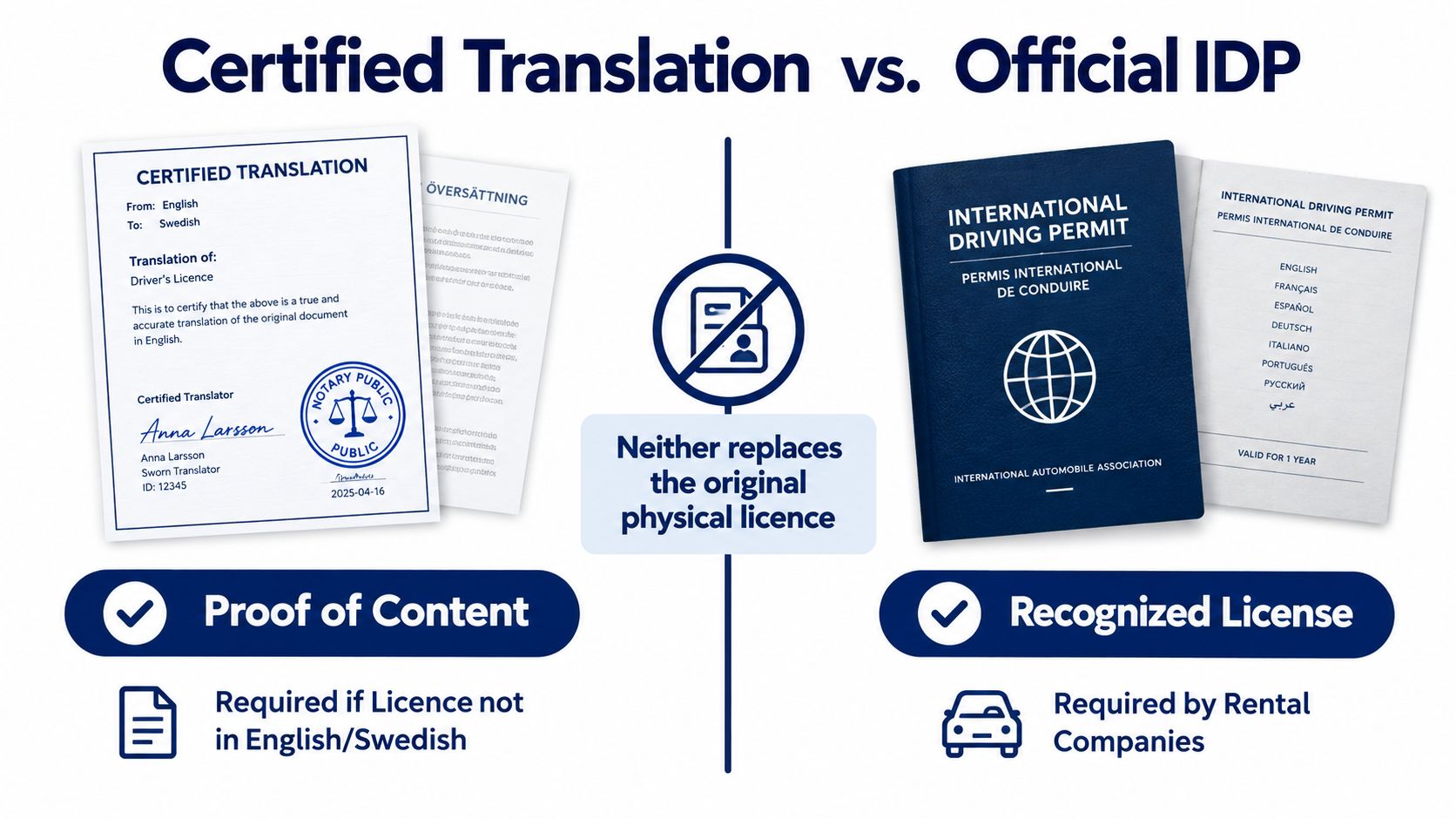
A certified translation is a signed and stamped rendering of the information on your national licence into a language the recipient can understand, commonly Swedish or English. It clarifies names, categories, dates, and restrictions. It has value only alongside the original physical licence, because it doesn't create a driving entitlement.
An IDP is an official booklet issued in the licence holder's home country under an applicable international road-traffic convention. It translates and presents the entitlements already granted by the national licence. It doesn't extend validity, add vehicle categories, or replace an expired card.
Choose based on the actual obstacle
| Your situation | Sensible companion | Why |
|---|---|---|
| Licence is in a non-Latin or unfamiliar script | Official IDP, and possibly a translation | The booklet gives staff a recognised interpretation of the licence |
| Licence uses Latin script but isn't in an accepted language | Certified translation | It makes the licence fields readable to Swedish authorities or rental staff |
| Rental company expressly requires an IDP | Official IDP | A translation may not satisfy a private company's policy |
| Licence is expired or missing | Neither document fixes it | You need a valid original licence first |
Arabic, Chinese, Thai, Japanese, and some Cyrillic-script licences deserve particular attention. An IDP can be the more practical option when you'll use the licence at multiple borders or rental counters, but obtain it from the authorised issuer in the country that issued your national licence. A Swedish translation service cannot turn itself into an official IDP issuer.
Watch the short explainer below for a visual comparison of the two document types.
For a readable companion to an original licence, review the Sweden driving licence translation service. The critical test is simple: carry the original licence, then add the document that matches the language, issuing-country, authority, and rental requirements.
Exchanging Your Licence After Swedish Residency
Once Sweden becomes your registered home, stop treating the foreign licence as a permanent solution. The Swedish route depends primarily on where the licence was issued and whether that origin is covered by an exchange arrangement.
EU and EEA licence holders generally have the cleanest path. They can usually continue using a valid qualifying licence or apply to exchange it through Transportstyrelsen without repeating the full Swedish testing process. The card still has to be valid, and the authority may request identity, residence, and licence documentation.
Designated non-EEA countries can have a separate exchange route. Japan, South Korea, and Switzerland are examples often associated with simplified treatment, but eligibility depends on the precise country arrangement and the current authority requirements. Expect documentation checks and, where required, a vision assessment or other condition. Don't assume that a familiar country name guarantees a direct swap.
| Licence origin | Direct exchange | Tests required | Typical timeline |
|---|---|---|---|
| EU or EEA country | Generally available for an eligible valid licence | Usually no new driving test | Depends on the application and authority processing |
| Switzerland or another designated exchange country | May be available under the applicable arrangement | Conditions may include checks or limited testing | Depends on eligibility and documents |
| Other non-EEA country | Usually unavailable as a direct exchange | Swedish licence process, including required theory and practical elements | Depends on preparation, booking, and test availability |
When you need the Swedish licence process
If your licence can't be exchanged, plan for the ordinary Swedish B-licence route. That can include a learner permit, risk education, theory preparation, and theory and practical examinations. The exact requirements should come from Transportstyrelsen and Trafikverket, not from an old forum post or a relocation group.
Sweden's transport-policy research also matters here because licence demand has changed over time. A study of national data found that licence holding among younger people began declining around 1990, with the pattern extending into the 30 to 34 age group. The transport-policy study describes a broad behavioural shift, not just a temporary reluctance among teenagers. That context helps explain why a foreign resident shouldn't assume every adult already understands the Swedish testing culture.
Start with Sweden's licence requirements for foreign drivers as a planning aid, then verify the current application route with Transportstyrelsen. Book preparation early, keep every original document, and don't wait until the foreign-licence window is about to close.
2026 Rule Changes That Affect Drivers in Sweden
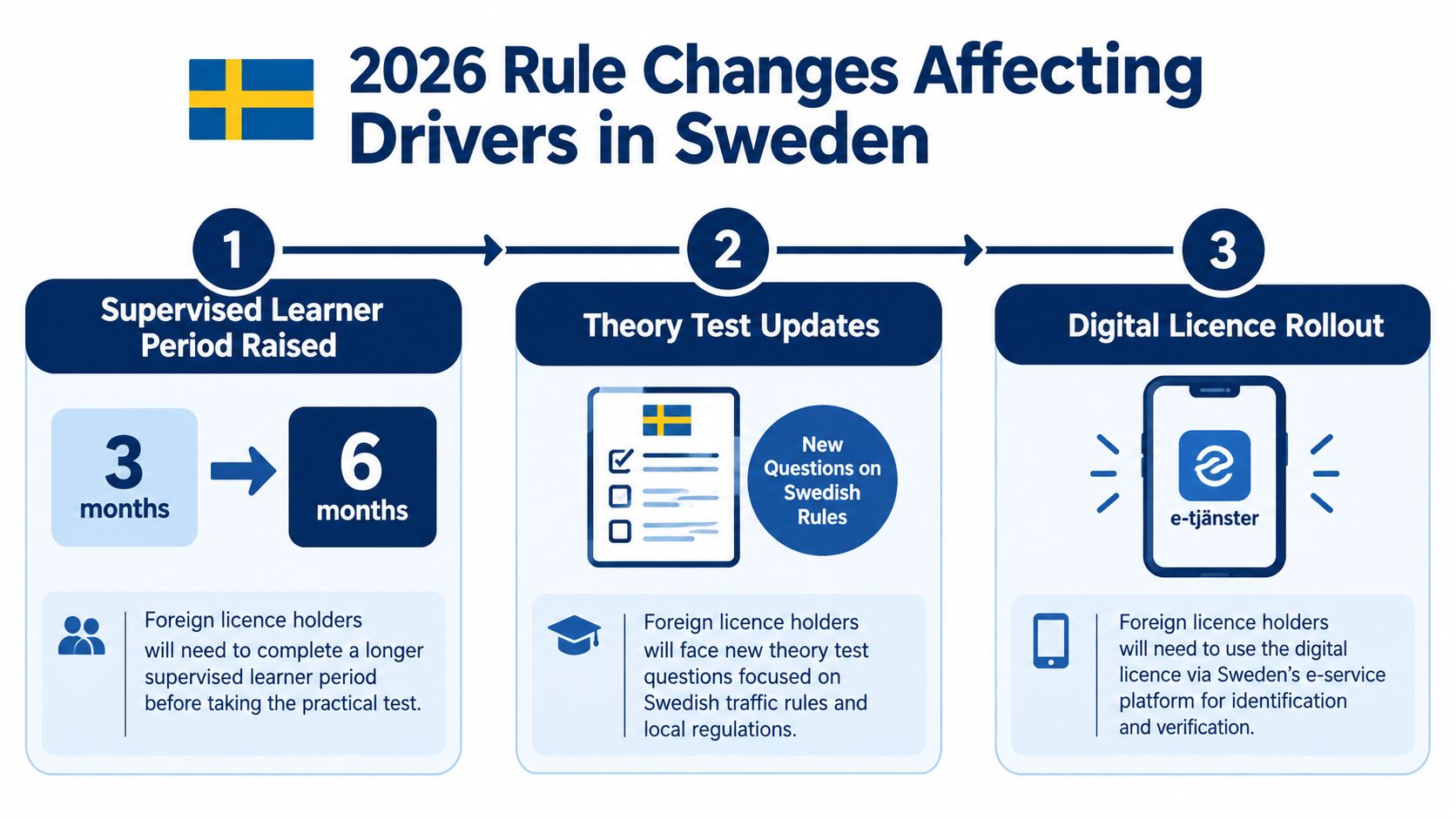
The 2026 changes are real, but several popular summaries are wrong. They describe a six-month supervised period, a twelve-month folkbokföring requirement, QR-coded IDPs, and other measures that aren't supported by the verified Swedish announcement. Don't plan around those claims.
The confirmed changes create a more specific timeline:
- From 1 August 2026: Sweden is set to abolish the introductory course requirement for private B-licence practice.
- From 19 August 2026: A passed category B theory test will remain valid for one year instead of four months.
- From 1 May 2026: Restrictions on driving-licence tourism are scheduled to begin.
These dates and measures are described on Trafikverket's Swedish driving-licence page. They don't turn a foreign licence into a Swedish one, and they don't remove the need to check whether your national licence remains valid for driving in Sweden.
What the timeline means in practice
If you're learning privately for a Swedish B licence, the removal of the introductory course can change how you prepare from August onward. It doesn't eliminate the need for safe supervision or competent practice. It only removes the specified course requirement.
The theory-test extension is more useful operationally. A pass lasting one year gives applicants a longer planning window for the practical test than the previous four-month period, but you still shouldn't postpone booking. Test availability, language choice, preparation quality, and your own driving readiness remain separate issues.
The licence-tourism restrictions matter most to applicants hoping to obtain a Swedish licence without a genuine connection to Sweden. If you're resident or relocating, keep evidence of your registration and follow the official route. For foreign-licence holders, the sensible response is to verify the rule that applies on the day you intend to drive, because the authority pages may update at different times.
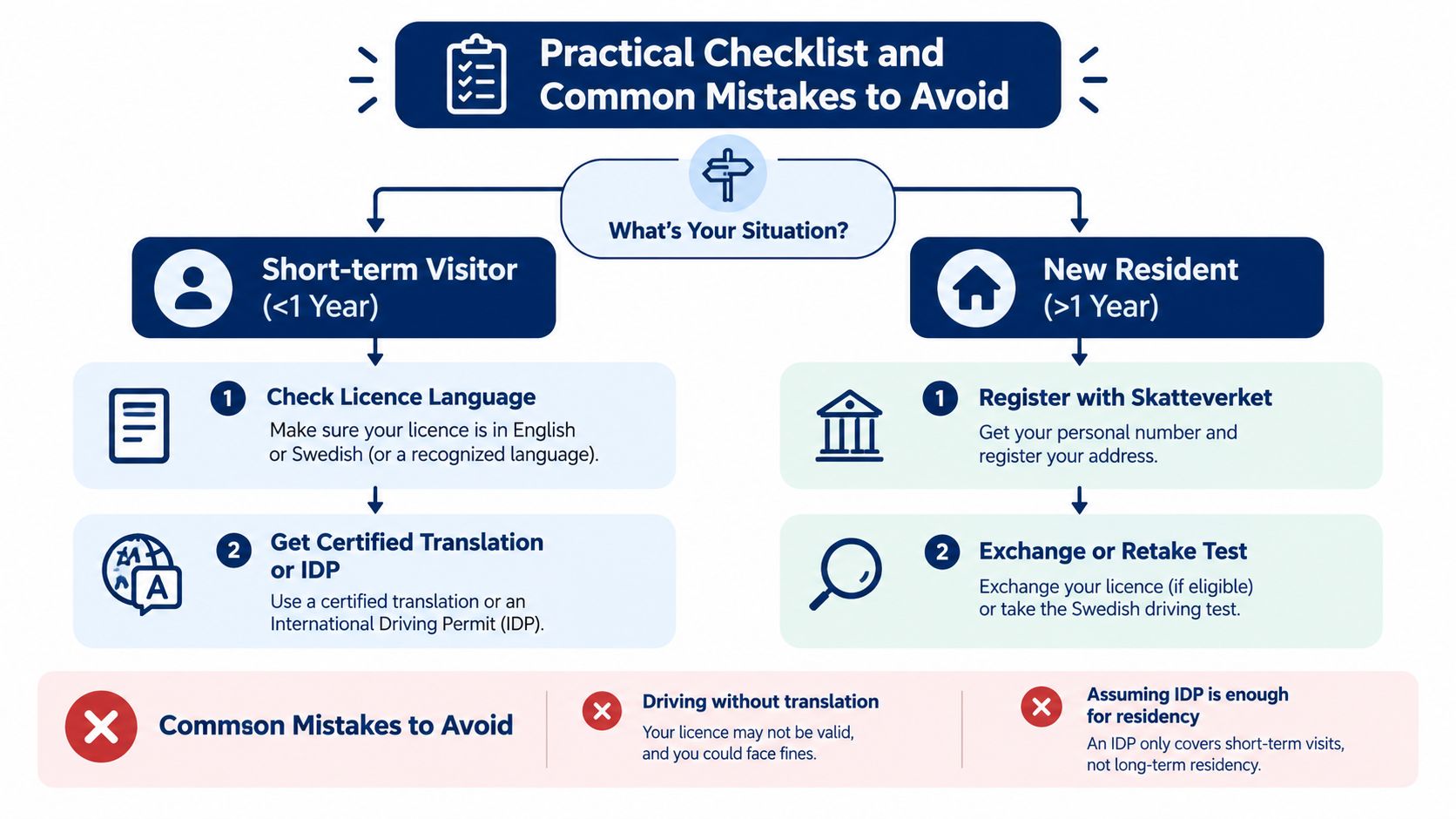
Practical Checklist and Common Mistakes to Avoid
Your correct route depends on your status, not your confidence behind the wheel. A driver who has rented cars around Europe may still be unprepared for a Swedish police stop if the licence is unreadable or the supporting document is missing.
Short-term visitor
Use this sequence before you book:
- Confirm the one-year position: Establish whether you're visiting or registered as resident, then identify the date from which the applicable period runs.
- Inspect the licence language: If the card isn't in an accepted language or uses an unfamiliar script, arrange a certified translation or official IDP.
- Ask the rental company directly: Get written confirmation that it accepts your issuing country, licence format, and companion document.
- Pack the originals: Carry the physical licence, passport or identity document, rental agreement, and the IDP or translation together.
- Check insurance conditions: Ask whether the insurer or rental company imposes language, licence-age, or documentation conditions beyond Swedish legal requirements.
The expensive mistake is arriving at the counter with only a phone image or a translation. Neither replaces the original.
New resident
Register your situation properly and determine whether your licence qualifies for exchange. EU and EEA licences often follow a different route from licences issued outside those arrangements. If direct exchange isn't available, begin the Swedish learner and testing process before your foreign-licence entitlement ends.
Swedish driving licences have category-dependent card validity. Standard private categories such as AM, A1, A2, A, B, and BE generally use a 10-year administrative validity period, while higher categories including C1, C1E, C, CE, D1, D1E, D, and DE generally use 5 years. The Swedish Transport Agency's licence-holder guidance explains the distinction. Don't confuse the card's renewal date with the conditions for earning or retaining a driving entitlement.
Long-term resident with a non-exchangeable licence
Choose a Swedish driving school that teaches the road situations you face in practice, including roundabouts, speed transitions, winter conditions, and hazard awareness. Study theory in a language you understand, but learn the Swedish signs and instructions rather than memorising translated answers.
Avoid these failures:
- Assuming residency changes nothing: A valid foreign licence can stop being usable under the applicable one-year rule.
- Treating an IDP as a Swedish licence: It only interprets an existing national licence.
- Using a translation by itself: It must travel with the original physical card.
- Trusting an outdated 2026 summary: Verify dates and requirements against the current Swedish authority page.
- Ignoring category limits: A car licence doesn't automatically authorise a lorry, bus, or motorcycle category.
Sweden sets the standard passenger-car licence age at 18, while motorcycle, lorry, and bus categories have different thresholds, including A1 from 16, A at 24 unless the applicant has held A2 for at least two years, C and CE generally at 21, and D and DE at 24. The Swedish Transport Agency's licence overview lists the category rules. Check your category before assuming that a document valid for one vehicle class covers another.
If you're travelling soon, gather your original licence first, verify the issuing-country rules, then add only the companion document you need. World Driving Permit provides certified licence translations for presentation with the original card and directs drivers to authorised IDP issuers when an official permit is required. Visit World Driving Permit to check Sweden's document requirements and prepare your translation before you reach the rental desk.