
Driver's License in Korea: Complete Guide for Visitors
You've landed in Korea, collected your bags, and reached the rental counter with your passport and home-country driver's license. Then the agent asks for an International Driving Permit, checks the original license, and starts asking how long you'll be staying. A document that seemed sufficient at home can suddenly become the difference between driving away and leaving the counter empty-handed.
The central issue isn't whether you can drive in Korea. It's which legal status applies to you today. A short-term visitor generally follows a temporary driving route, while a registered foreign resident may need to exchange a foreign license for a Korean one. The paperwork, proof of authenticity, and reliance on an IDP change at that threshold.
Korea is a high-penetration licensing market. Statista recorded about 34.44 million licensed drivers in 2023, including more than 18.4 million Type 1 ordinary license holders and about 13.2 million Type 2 ordinary license holders (Statista's South Korea licensed-driver data). That scale explains why rental companies and licensing offices treat document checks seriously. Prepare for the correct category before you book the car.
Table of Contents
- Understanding Your Driving Status in Korea
- Short-Term Visitor Requirements and Rental Desk Realities
- Korean License Classes and Vehicle Eligibility
- When an IDP Is Not Enough and Translation Bridges the Gap
- Crossing the Residency Threshold and License Conversion
- Document Preparation Timeline and Common Pitfalls
- Your Complete Korea Driving Preparation Checklist
Understanding Your Driving Status in Korea
At a Seoul rental desk, two travelers can present similar passports and receive different instructions. One is visiting for a short holiday and needs a valid IDP, original home-country license, and passport. The other has registered in Korea for a longer stay and is no longer dealing with the same temporary visitor arrangement.
That distinction is the first decision in any driver's license in Korea plan. Korean government guidance separates short-term visitor driving from the process for registered foreigners exchanging a foreign license (Korea's official foreigner driving guidance). Don't assume that a tourist rule continues unchanged after you register your stay.
The visitor route
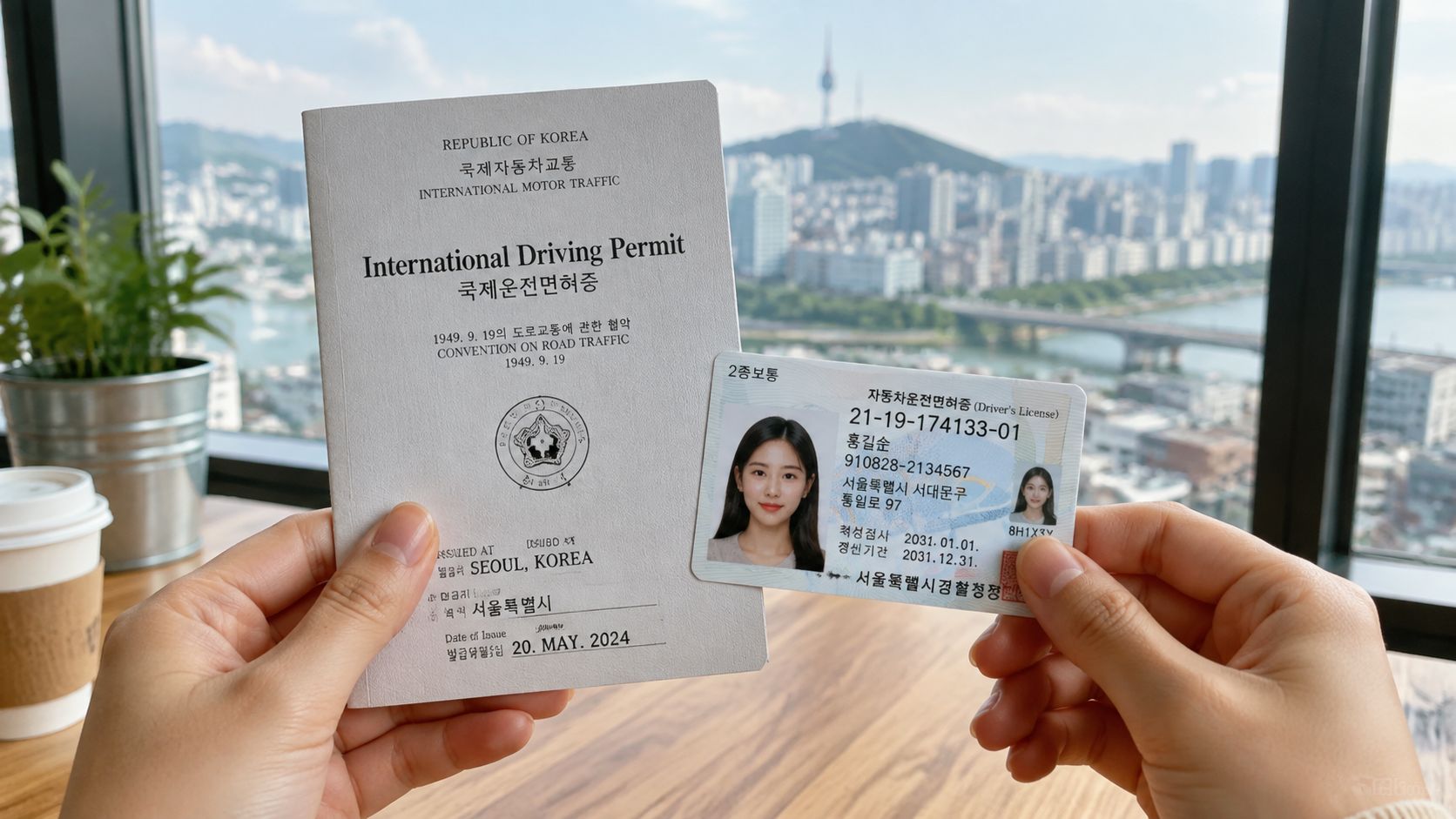
A short-term visitor normally drives with an International Driving Permit and the original home-country license together. The IDP is not a replacement for the national license. It acts as an international driving document that helps Korean officials and rental companies interpret the underlying entitlement.
Your passport matters because authorities and rental staff may need to verify your identity and entry status. If your plans are limited to a short visit, organize the temporary documents before departure rather than trying to solve the issue at the airport counter.
The resident route
Registration changes the practical question. Once you're living in Korea as a registered foreigner, you should plan for a Korean license exchange rather than treating an IDP as a permanent solution. Official guidance also distinguishes recognized and unrecognized foreign licenses, so eligibility depends on the issuing country and the evidence available for verification.
My recommendation is simple. Decide your status before reserving the vehicle. If you'll register in Korea, contact the relevant driver's license examination office early and ask which exchange path applies to your nationality. If you're only visiting, focus on an authorized IDP, your original license, and readable supporting documents.
Practical rule: Your arrival date, stay status, and registration record matter more than the label you use for your trip.
Short-Term Visitor Requirements and Rental Desk Realities
Short-term visitors often hear “bring an IDP” and stop preparing. That advice is incomplete. The rental company still needs to match the permit to your original license, passport, identity, and driving entitlement. If one document is expired, missing, or difficult to read, the agent may not be able to release the car.
Korean authorities allow short-term visitors to drive with an International Driving Permit and the original home-country license, as described in the government's official driving guidance for foreigners. Carry physical originals. A phone photo is useful as a backup, but it shouldn't be your only evidence.
What to put in your document folder
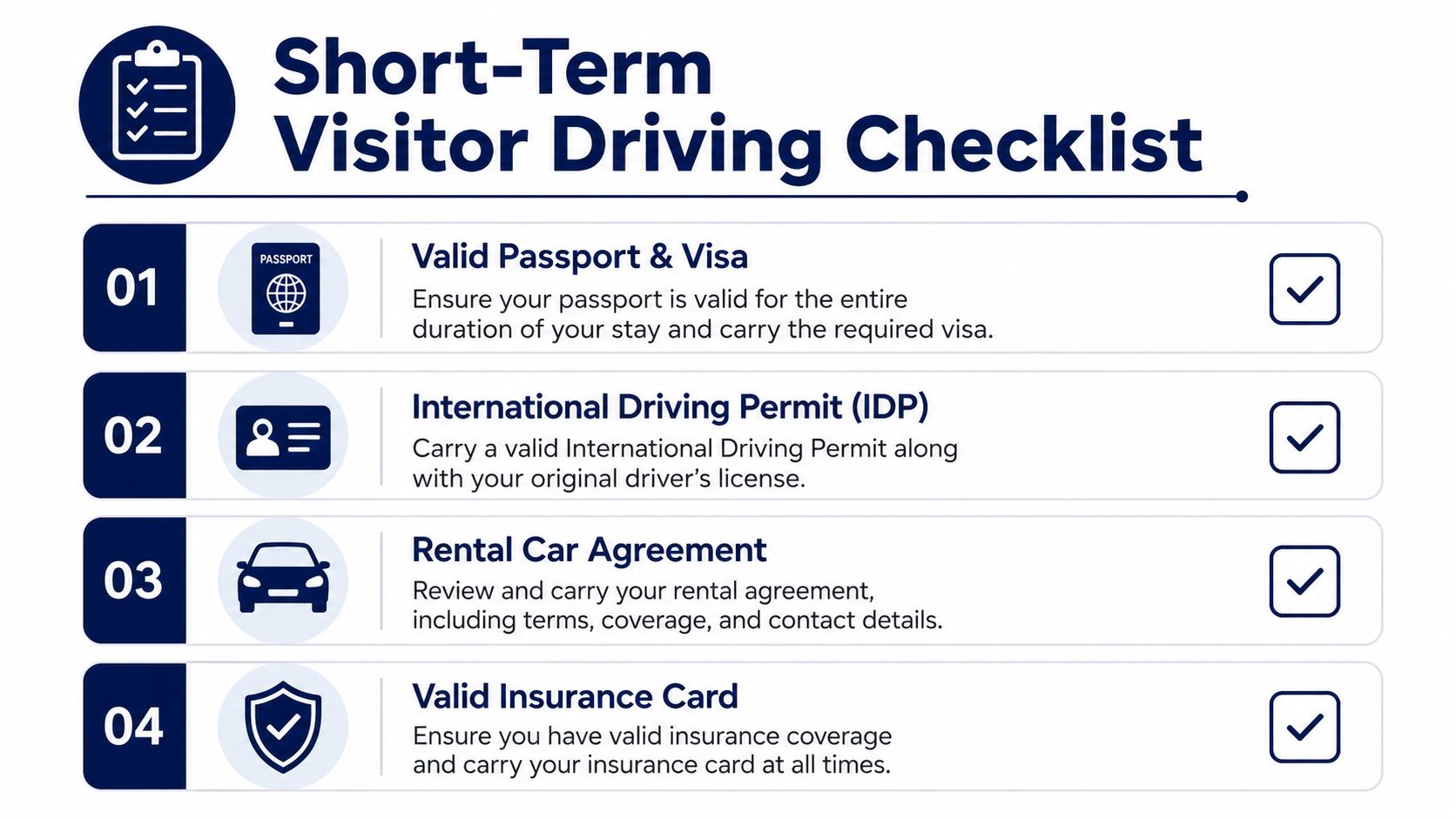
- Valid passport: Keep the passport you used to enter Korea available at pickup and while driving.
- Original national license: The IDP must be carried with the license that establishes your actual driving entitlement.
- Authorized IDP: Obtain it from the authorized issuing body in your home country. A translation document is not automatically an IDP.
- Rental agreement: Review the named-driver information and confirm that every person who'll drive is properly listed.
- Insurance documents: Keep the rental company's insurance or coverage confirmation with the agreement.
Rental agents commonly compare the name and date of birth across documents, inspect the license's validity, and check whether the IDP corresponds to the license presented. They may also ask about your entry date or stay status when the rental period is long or your documents raise questions.
Non-Latin licenses need extra planning
A license printed in a script the counter agent can't read creates a verification problem. The agent may be unable to identify the vehicle categories, expiry date, restrictions, or name without translation support. That doesn't mean an IDP is unnecessary. It means the IDP may need a readable companion.
Check the permit format and rental company policy before departure. For practical background on how authentication features can support document checks, review this guide to QR-code authentication for driving documents. Don't wait until the counter to discover that the company requires additional evidence.
Keep the originals together
Store the passport, original license, and IDP in the same travel wallet. Separate documents create avoidable delays at checkpoints and increase the chance that one item stays in your hotel room. The person driving should carry the complete set, not just the person who paid for the rental.
Korean License Classes and Vehicle Eligibility
Korea's license categories depend on vehicle specifications, not just broad labels such as “car” or “motorcycle.” Vehicle mass, seating capacity, and engine or displacement thresholds can affect the entitlement attached to a class. A standard passenger-car license shouldn't be treated as universal permission to drive every rental vehicle.
Korean license guidance identifies Class 2 Regular as the common passenger-car category. Class 1 reaches larger or heavier vehicles, including higher-capacity vans and trucks, while motorcycle and special-vehicle categories are handled separately (Korean license type guidance).
Korean License Classes by Vehicle Type
| License Class | Vehicle Type | Typical Rental Match |
|---|---|---|
| Class 2 Regular | Ordinary passenger vehicles within the class limits | Standard sedan, compact SUV, or ordinary passenger car |
| Class 1 | Larger, heavier, or higher-capacity vehicles within the applicable limits | Selected larger vans or commercial-style vehicles |
| Motorcycle class | Motorcycles governed by the relevant motorcycle entitlement | Motorcycle rentals, only where the license permits |
| Special-vehicle classes | Vehicles with specialized operating requirements | Specialized rentals, generally outside ordinary tourist bookings |
The important match happens between the vehicle listed by the rental company and the category your license authorizes. A vehicle's appearance can mislead you. A large passenger van may look like an ordinary car but fall outside the entitlement attached to a basic passenger license.
Don't rely on the rental label
Ask for the exact vehicle model, seating capacity, and relevant classification before signing. If the company offers a larger van, commercial vehicle, or motorcycle, send the specifications to the rental desk and ask whether your license and IDP cover it.
This is also an insurance issue. If you drive outside your licensed category, an accident can raise questions about whether you were properly authorized to operate the vehicle. The safest recommendation is to choose a normal passenger car unless you've confirmed the category in writing.
Match categories before you travel
Your home-country license may show categories differently from a Korean license. An IDP can help translate category names, but it doesn't expand your legal entitlement. The original license remains the foundation, and the Korean authority or rental company decides whether the documented category corresponds to the vehicle.
When an IDP Is Not Enough and Translation Bridges the Gap
An IDP solves the authorization format problem. It doesn't always solve the readability problem. If your original license uses a non-Latin script or presents restrictions in a format Korean staff can't interpret, an agent may still need help verifying the fields that matter.
Consider a license check at a rental counter. The employee needs to identify your name, license number, vehicle categories, issue date, expiration date, and restrictions. If those fields aren't legible to the employee, a translation companion can reduce uncertainty without replacing the original license or the official IDP.
Use an IDP when legal authorization is required
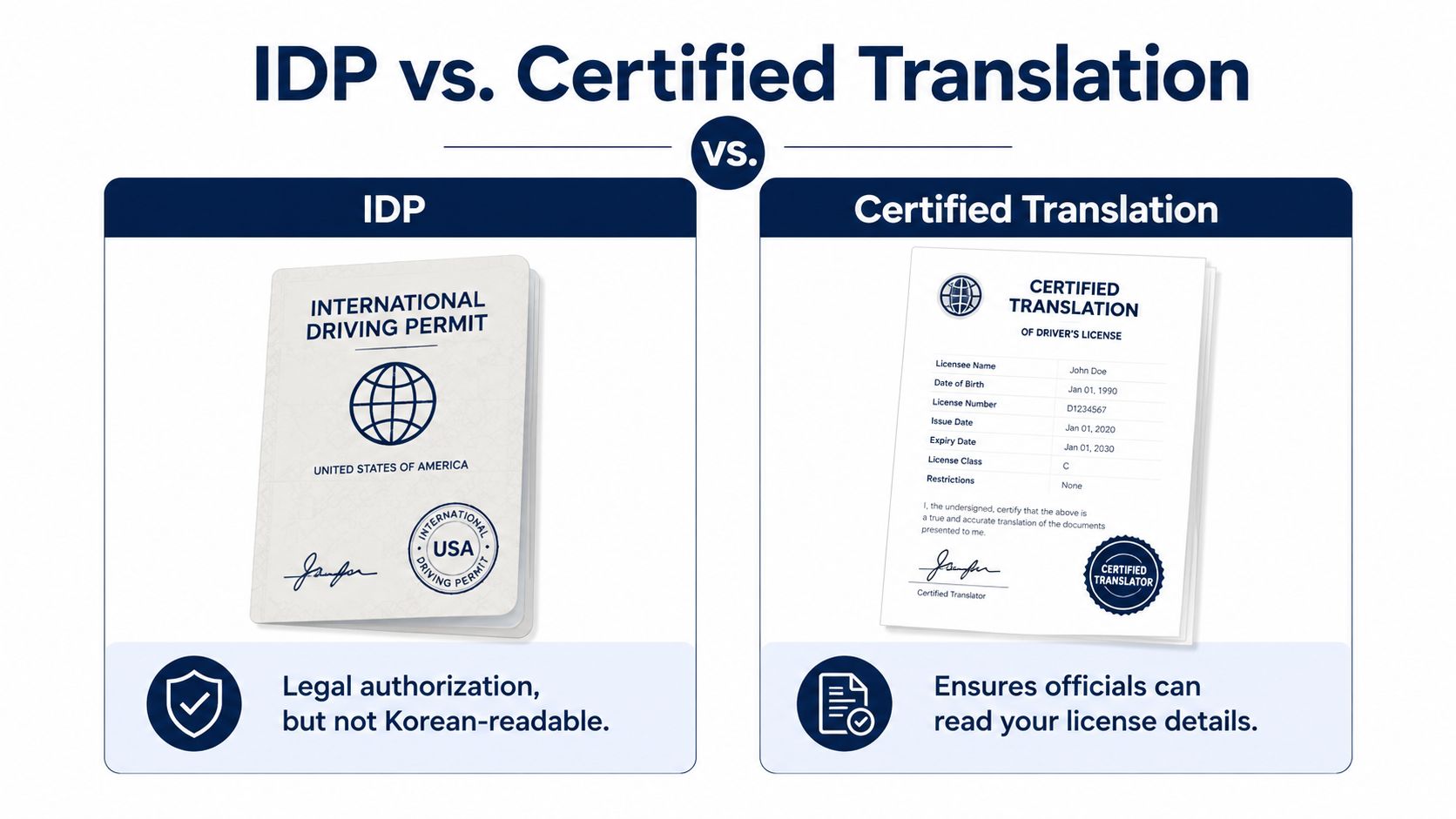
Choose an authorized IDP when Korean rules or the rental company require one. Carry it with the original national license. A certified translation isn't a substitute for an IDP where an IDP is the required legal document.
This distinction matters because travelers often buy a translation and assume the legal requirement is covered. It isn't. A translation makes the original license easier to understand. It doesn't create a new driving entitlement.
Add translation when verification is difficult
A translation companion becomes especially sensible when:
- The license uses a non-Latin script: Names and category information may not be immediately readable to Korean staff.
- The category system is unfamiliar: A translated field-by-field version helps the agent compare your entitlement with the rental vehicle.
- The license contains restrictions: Accurate presentation of restrictions can matter during a police or insurance review.
- You'll use several countries: A multilingual document can help when the itinerary changes and different officials need to inspect the same license.
World Driving Permit offers certified, word-for-word translations of national licenses, with digital delivery, QR verification, and language coverage across 28 languages, according to the publisher's product information. Its South Korea driving license translation service should be treated as a readable companion, not as an official IDP or government-issued Korean license.
A clear decision
Use the following order of priority:
- Confirm whether Korea requires an IDP for your license and status.
- Obtain the authorized IDP if required.
- Carry the original license.
- Add a certified translation when the original isn't readily readable or when a rental company requests one.
An IDP establishes the international document format. A translation helps another person read the license behind it.
Crossing the Residency Threshold and License Conversion
The point that catches visitors is the change in status after settling in Korea. An IDP can support temporary driving, but it does not remain a complete solution once you become a registered foreign resident. Korean guidance distinguishes temporary visitor authorization from resident license exchange, and local instructions state that residents may need to convert after registration rather than rely on an IDP indefinitely (Geumcheon-gu guidance for foreign drivers).
People often refer to 90 days or more as the practical threshold. Treat that only as a warning to check your status, not as a universal rule. Your foreign-resident registration, immigration record, license-issuing country, and the examination office's current policy determine which route applies. Check with the office handling your application before the IDP-based period ends. Review the South Korea document requirements for license exchange while confirming your own case.
Start with the issuing country
Korean authorities separate foreign licenses from countries recognized for exchange and licenses that require another process. Depending on the issuing country, you may need an embassy certificate, apostille-style verification, or a notarized translation for a license that is not in English (Namyangju's official foreign-license exchange guidance).
Build a working file containing:
- Original foreign license: Bring the valid physical license. A copy alone may not satisfy the office.
- Passport: Use the identity document connected to your Korean entry record.
- Proof of Korean registration: Confirm which foreign-resident card or registration evidence the examination office accepts.
- Entry and departure records: Officials may use travel history to verify your licensing circumstances.
- Embassy certificate or apostille: The required form depends on the issuing country and its recognition status.
- Translation: Arrange a notarized translation if the office requires one for a non-English document.
Follow the conversion sequence
First, confirm eligibility. Ask the driver's license examination office whether your issuing country is recognized and whether the exchange route covers your license category.
Second, secure authentication. Contact your embassy or the competent authority in the country that issued the license. Do not assume an embassy in Seoul still provides confirmation letters. Some applicants must arrange apostille processing through the issuing country.
Third, verify Korean records. Ask which passport entry evidence and immigration records the office currently accepts. Automated border processing can leave applicants without the proof needed at the appointment, so check before you go.
Fourth, prepare originals and translation. Bring the foreign license, passport, registration evidence, authentication document, and any required translation. Copies may not be accepted.
Finally, ask about testing. Exchange procedures vary by country and recognition status. A written or practical test may apply instead of a direct exchange.
Plan before temporary authorization expires
Do not wait until the final week. Korea's licensing system handles substantial recurring administrative demand. Official Korean legal information states that licenses are valid for 10 years up to age 70, 5 years between ages 70 and 75, and 3 years after age 75 (Korean legal information on license validity). Those renewal rules show why appointment availability and document checks deserve early attention, especially when your temporary driving basis is approaching its limit.
Document Preparation Timeline and Common Pitfalls
Good preparation starts with the document most likely to take longest, not the document that's easiest to download. For a short visit, that usually means confirming the IDP issuer and checking the original license. For a resident exchange, it may mean embassy verification or an apostille arranged through the country that issued the license.
Before booking the vehicle
Check the license expiration date, not just whether the card looks current. Confirm that the name matches your passport, the vehicle category is clear, and the rental company accepts your issuing country's license format.
Then ask the rental company for its foreign-driver policy in writing. Policies can differ between branches, especially for unusual vehicle categories, non-Latin licenses, or longer stays.
Prepare the hard document first. If authentication must come from your home country, the rental reservation should never be the first step.
Before departure
Place the original license, passport, IDP, rental confirmation, and insurance evidence together. If your license isn't easily readable in Korea, arrange a certified translation companion before you fly. Digital delivery can help time-constrained travelers, but you should still save the file offline and carry the original documents.
Review the permit's validity and format. An IDP that was issued by an unauthorized provider may not solve the rental company's legal requirement, even if the document looks official.
At the rental counter
Give the agent the full set at once. Don't hand over a translation while leaving the original license in your luggage. Ask the agent to confirm that the named driver, vehicle category, and insurance arrangement all match the documents.
If the counter refuses the rental, don't try to negotiate by showing a phone image or an unrelated translation. Call the company's central support line, document the reason for refusal, and arrange an alternative only after the authorization issue is clear.
For a resident exchange
Treat embassy certificates and apostilles as separate workstreams from Korean immigration records. Requirements change by reciprocity status, and the relevant office may reject a document that lacks the required authentication, translation, or original form.
Make one folder with a paper set and one encrypted digital backup. Keep the digital copy for reference and recovery. It shouldn't replace the originals requested by the licensing office.
Your Complete Korea Driving Preparation Checklist
Use this checklist before driving in Korea:
- Identify your status: Decide whether you're a short-term visitor or a registered foreign resident.
- Confirm the route: Visitors should verify IDP requirements. Residents should contact a Korean driver's license examination office about exchange eligibility.
- Check the original license: Confirm validity, identity details, categories, and restrictions.
- Match the vehicle: Ask for the exact model and seating or vehicle specifications before accepting a rental.
- Prepare authentication: If converting a foreign license, determine whether your country requires an embassy certificate or apostille.
- Arrange translation: Add a certified translation when officials or rental staff may not be able to read the original license.
- Carry the complete set: Keep your passport, original license, IDP, translation if used, rental agreement, and insurance documents together.
- Verify the branch: Confirm opening procedures, accepted documents, and exchange availability with the specific licensing office.
- Save backups: Store offline copies of your documents and reservation details, while continuing to carry the required originals.
- Recheck before driving: If your status changes after arrival, stop relying on tourist guidance and reassess your Korean license obligations.
The right approach is proactive. Korea's licensing rules are manageable when you establish your status, authenticate the documents early, and match the license category to the vehicle instead of improvising at the counter.
World Driving Permit provides certified license translations with digital delivery, QR verification, and optional printed documents, which can help make a foreign license readable alongside the original IDP. Visit World Driving Permit to check the South Korea document requirements and prepare the translation support your itinerary calls for.