
アメリカ レンタカー 保険: A Practical Guide for Foreign Drivers
You're standing at a U.S. rental counter with a foreign driving licence in one hand and a contract full of unfamiliar abbreviations in the other. The agent asks whether you want CDW, LDW, liability protection, personal accident cover, and protection for your luggage, while a line forms behind you. You know you need to drive, but you don't know which protection you already have, which option fills a real gap, or whether your licence documents will be accepted.
That moment is where アメリカ レンタカー 保険, or U.S. rental-car insurance, becomes confusing. The safest choice isn't automatically buying every product, and it isn't automatically declining everything because your credit card includes rental protection. You need to separate damage to the rental car, liability to other people, medical expenses, personal belongings, and licence acceptance before you sign.
Table of Contents
- Why Insurance Feels Different at a U.S. Rental Counter
- The Core Coverage Types Explained Simply
- What Your Credit Card and Home Policy Already Cover
- Why Liability Is the Gap Most Renters Miss
- Presenting a Foreign Licence at the Rental Desk
- Common Misconceptions Foreign Drivers Bring
- Your Pre-Trip Decision Checklist
Why Insurance Feels Different at a U.S. Rental Counter
You arrive at a U.S. rental desk with a foreign licence, passport, and International Driving Permit. The agent points to several coverage options and asks for quick yes-or-no answers. The contract follows U.S. state rules and the company's own conditions, so familiar insurance terms may not work as you expect.
The pressure comes from separate products with short abbreviations. CDW, LDW, SLP, PAI, and PEC may appear in the same conversation, although each addresses a different risk. A European driver might expect one collision-protection product, while a visitor from Asia may assume the quoted rental price includes a broader package. At a U.S. counter, damage to the rental car, liability to other people, medical expenses, and belongings are often presented as separate decisions.
The wording can hide the practical question: what would you pay if something went wrong? A waiver may concern the rental vehicle, while liability protection concerns claims from other people. Personal accident cover and baggage protection address still different losses. Reading the acronym is less useful than asking who pays, under which conditions, and what exclusions apply.
Rental-car protection also developed as a substantial add-on product. A Los Angeles Times account of rental-car insurance pricing described daily waiver charges rising from about $5 per day in 1981 to $7–$8 per day by 1985, and then $9–$13 per day by 1986, while the stated protection expanded from customer liability to the full value of the rental vehicle. Those figures are historical. They still illustrate why a daily price does not reveal how broad the protection is.
Why foreign drivers feel the pressure more sharply
A domestic renter may know whether a personal auto policy follows them into a rental vehicle. A foreign visitor may have a home-country policy that excludes the United States. The precise boundary depends on the policy, so the rental desk cannot assume that protection travels with you.
The counter also moves quickly. You may be asked to decline a waiver before checking whether your card benefit requires that choice. A damage option may receive prominent attention, while liability protection receives less explanation, even though they cover different exposures.
Practical rule: Treat every counter question as a coverage decision, not a formality. Ask, “What does this protect, and what does it not protect?”
Your foreign licence and its translation establish, or help demonstrate, eligibility to drive. They do not create insurance coverage. Keep those questions separate before signing the agreement.
The Core Coverage Types Explained Simply
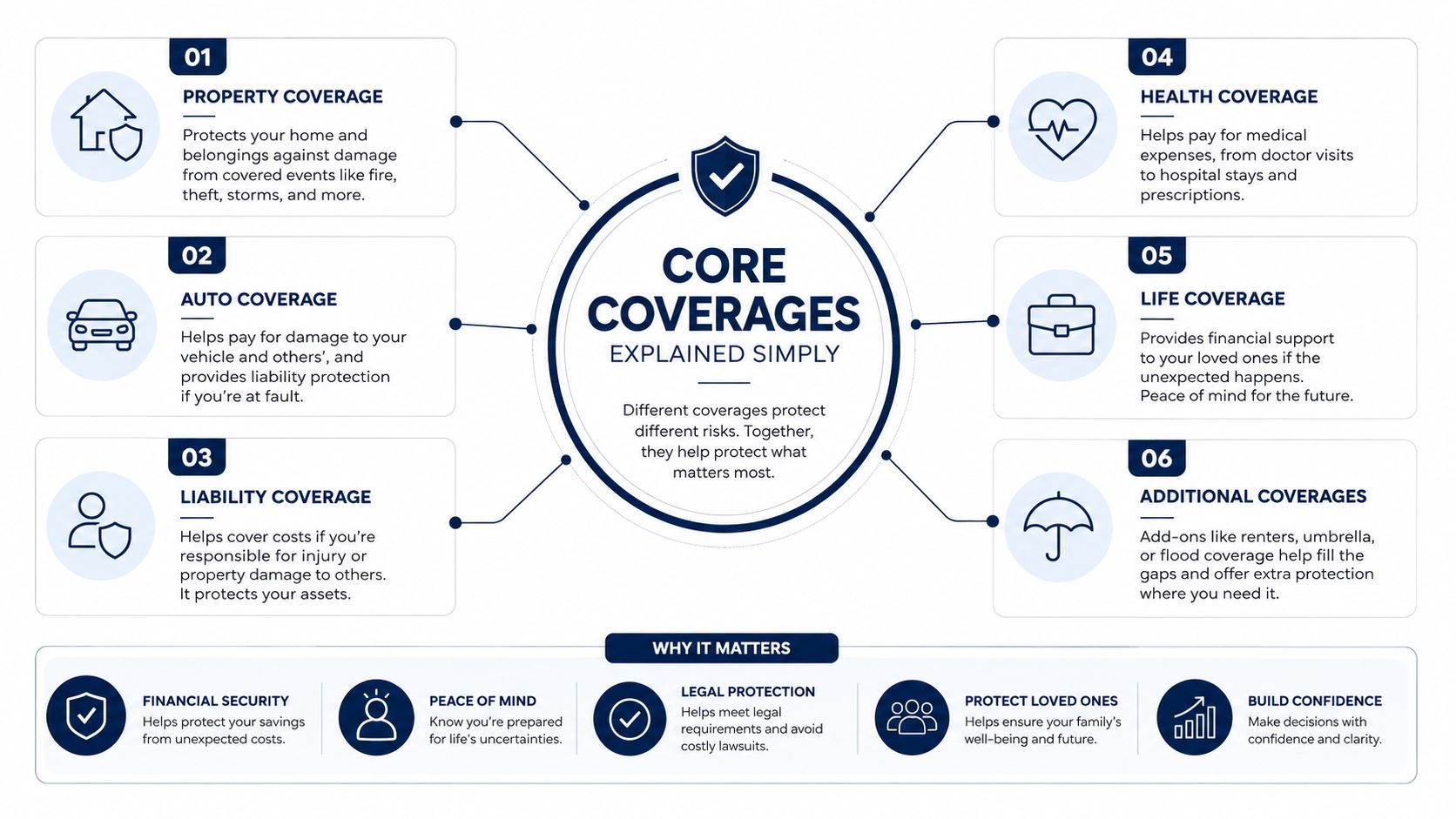
Rental protection becomes manageable when you stop reading the abbreviations as one package. Each product answers a different question: what happens to the rental car, what happens to another person, what happens to you, and what happens to your belongings?
Protection for the rental vehicle
CDW, or Collision Damage Waiver, is a contractual waiver from the rental company. Instead of buying a conventional insurance policy, you pay for the company to waive some of its right to charge you for damage to the rental car, subject to exclusions and contract conditions.
Think of CDW as a damage refund promise. If the contract applies, the rental company may reduce or waive your financial responsibility for collision damage, but you still need to check deductibles, prohibited use, unauthorised drivers, and excluded parts.
LDW, or Loss Damage Waiver, often covers collision damage and loss through theft. Rental brands sometimes use LDW and CDW differently, so the exact contract matters more than the label. A useful mental shortcut is that CDW focuses on damage, while LDW may also address the vehicle being stolen or otherwise lost.
Neither waiver should be assumed to cover every part of the car. Roofs, undercarriages, tyres, and windshields may be excluded unless a separate roadside or premium protection option applies. Ask specifically about gravel damage, glass, tyres, towing, keys, and administrative charges.
Protection for people and belongings
SLP, LI, SLI, or LIS, depending on the rental company, means supplemental liability protection. This is your umbrella against claims from other people if you cause bodily injury or property damage. It's separate from protection for the rental car.
PAI, or Personal Accident Insurance, is a medical top-up for the driver and passengers after a covered accident. It may overlap with travel medical insurance, employer cover, or health insurance, so read the exclusions and benefit limits before accepting it.
PEC, or Personal Effects Coverage, is a luggage-style rider for certain belongings stolen from or damaged in the rental vehicle. It can overlap with travel insurance or card benefits, and it may have strict conditions about unattended items and proof of ownership.
These products are not interchangeable. A waiver for the rental car won't pay the other driver's hospital bills, while liability protection won't repair your suitcase or cover treatment for your own injury. The agent may present them together, but you should evaluate them separately.
What Your Credit Card and Home Policy Already Cover
At the rental counter, a card that looks well protected may cover only one part of the problem. Check the benefit terms before your trip, because credit-card rental coverage usually concerns damage to, or theft of, the rental vehicle. It does not automatically cover every charge or every person involved in an accident.
Card benefits often come with several conditions. You may need to pay the full rental cost with the eligible card, decline the rental company's CDW or LDW, follow the permitted rental period and vehicle rules, and list only authorised drivers. Some benefits are secondary, so another applicable policy must be considered first. Keep the benefit guide available, not just the card itself.
Your home-country motor policy needs a separate review. A U.S. or Canadian auto policy may address a rental vehicle under its stated terms. A policy issued elsewhere may not apply in the United States. Ask the insurer in writing about the states on your route, liability to other people, collision damage, theft, administrative fees, and loss-of-use charges claimed by the rental company. A translated summary can help you explain the policy at the desk, but it does not expand the policy's territory or benefits.
| Coverage Source | Damage to Rental Car | Liability to Others | Medical / Personal Effects | Typical Gap for Foreign Drivers |
|---|---|---|---|---|
| Credit-card rental benefit | Often limited to covered damage or theft of the rental vehicle | Usually not included | Usually limited or excluded | Conditions may require full card payment and declining CDW or LDW |
| Personal auto policy from home | Depends on territorial wording and policy terms | Depends on territorial wording and policy terms | Usually separate from the motor policy | Many policies do not extend outside the U.S. or Canada |
| Rental-company CDW or LDW | Designed for covered damage or loss to the rental vehicle | Not the same as third-party liability | Usually not the main purpose | Exclusions may apply to tyres, glass, roof, undercarriage, misuse, or unauthorised drivers |
| Rental-company SLP or LI | Does not primarily repair the rental vehicle | Designed for covered claims from other people | Usually separate | Limits, exclusions, and state-specific terms must be checked |
| Travel medical or belongings policy | Usually not intended to repair the rental car | May not cover driving liability | May cover medical care or belongings under its wording | Driving exclusions and documentation requirements can apply |
Questions for your card provider
Ask precise questions rather than, “Does my card cover rental cars?”
- Does the benefit apply in the United States?
- Is it primary or secondary?
- Must I decline CDW or LDW?
- Must I pay the complete rental with this card?
- Does it cover theft, tyres, glass, towing, loss of use, and administrative fees?
- Does it cover liability to other drivers, passengers, pedestrians, and property owners?
A reply limited to “collision damage” identifies a vehicle-damage benefit. It does not confirm protection for third-party claims. If the card provider cannot answer the liability question, treat that as an unanswered gap and ask the rental company what liability protection is available.
Why Liability Is the Gap Most Renters Miss
CDW and LDW protect the rental vehicle. They don't normally protect you from claims by other people. If you injure another driver, damage a family's vehicle, or hit property beside the road, the relevant question is third-party liability, not whether the rental car itself can be repaired.
This distinction gets buried because “damage waiver” is easy to understand at a glance. The sign may show a prominent daily price for protecting the vehicle, while supplemental liability protection appears as another acronym that sounds optional. For a foreign renter whose home policy doesn't apply in the United States, declining that product without a replacement can leave a serious gap.
A tourist in Florida skids during rain and strikes a family minivan. The tourist's credit card may help with damage to the rental car if the benefit conditions are met. That doesn't mean the card will pay for the minivan, injuries to its occupants, treatment for a pedestrian, or claims involving damaged roadside property.
What the available data tells you
A Consumer Reports survey of more than 6,000 members who rented from traditional rental companies found that only 10% bought insurance from the rental agency. That figure shows how many domestic renters decline the counter product, often because they rely on an existing auto policy, card benefit, or personal risk tolerance. It doesn't prove that declining is safe for an international visitor whose home policy may stop at the border.
The federal government uses a different negotiated structure for eligible U.S. government travellers. The Defense Travel Management Office explains that the U.S. Government Rental Car Program includes LDW and liability insurance at no additional cost, with liability limits of $25,000 for property damage, $100,000 per person, and $300,000 per incident. That arrangement illustrates how coverage can be bundled into a negotiated fleet program, but it isn't a standard benefit for ordinary tourists.
| Risk Covered | CDW / LDW | Supplemental Liability |
|---|---|---|
| Damage to the rental car | Main purpose | Not the main purpose |
| Theft or loss of the rental car | Often included under LDW terms | Not the main purpose |
| Damage to another vehicle | Usually excluded | Main purpose, subject to terms |
| Injury to another driver or passenger | Usually excluded | Main purpose, subject to terms |
| Damage to roadside or private property | Usually excluded | May apply, subject to terms |
| Your own medical expenses | Usually excluded | Usually excluded |
| Your luggage | Usually excluded | Excluded |
The card covers the car, not necessarily the people outside it. Confirm liability separately before declining the rental company's protection.
For foreign drivers, liability deserves a direct question: “What protection applies if I injure someone or damage property, and what is the limit?” If the agent can't explain it clearly, ask for the contract wording before signing.
Presenting a Foreign Licence at the Rental Desk
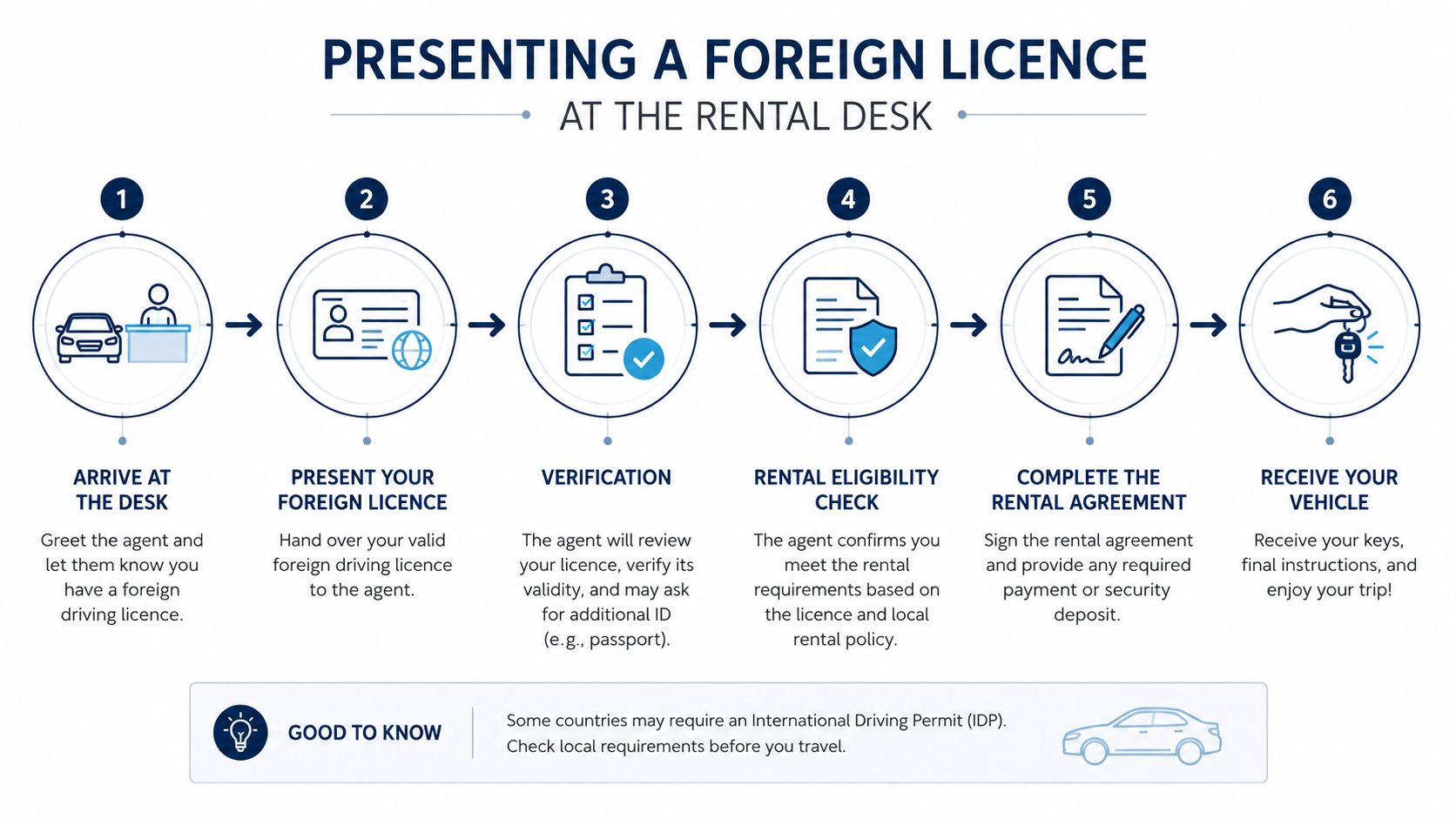
The agent isn't only checking whether your card looks official. They're trying to establish that the document belongs to you, identifies the correct driver, shows a valid driving entitlement, and can be understood under the rental company's procedures.
Hand over your original national licence, passport, and any required International Driving Permit together. The agent may compare your photograph, romanised name, country of issue, issue date, expiry date, and vehicle class information. If your licence uses a non-Latin script, staff may also need a readable translation or an IDP to interpret those fields.
How an IDP fits into the process
An International Driving Permit is a translation and supporting document, not a replacement for your national licence. You still need the original licence that establishes your underlying driving entitlement. An IDP also doesn't expand your licence class, change its expiry date, or make an invalid licence valid.
Rental-company requirements can be stricter than the minimum rule you find in a state's visitor guidance. A company may ask for an IDP when the national licence isn't written in English or when staff can't readily interpret the document. Check the exact policy of the brand and pickup location before travelling.
A certified companion translation can help when the licence is valid but difficult for non-local staff to read. It should mirror the identity and licence fields accurately, including the holder's name, date details, issuing country, licence number, categories, restrictions, and validity information. It must travel with the original licence.
A translation cannot solve every problem. It can't substitute for a required official IDP, correct a mismatch between your passport and licence, or create a missing vehicle category. This guide to driving in the United States with a foreign licence explains the distinction between readable documentation and the underlying legal requirements.
Small document problems that cause large delays
Name order can create confusion when the passport shows family name first but the licence uses a different sequence. A licence without clear romanisation may also force the agent to compare characters manually. Laminated or unusual cards may not scan cleanly, even when they're genuine.
Show the documents in this order:
- Passport, for identity and entry information.
- Original national licence, for the actual driving entitlement.
- IDP or certified translation, for interpretation and supporting evidence.
- Rental reservation, so the agent can match the primary driver and booking details.
The video below demonstrates the kind of licence presentation workflow that helps reduce confusion at a rental desk.
Keep the documents together rather than passing over a translation by itself. Staff need to see the companion document alongside the original, because the translation explains the licence but doesn't establish independent authority to drive.
Common Misconceptions Foreign Drivers Bring
At the rental counter, a foreign driver presents a licence, passport, and payment card, then hears several optional coverage offers. The risky assumption is that one document or product automatically fills every gap. Before accepting or declining anything, identify what is protected, where the protection applies, and which conditions activate it.
“My home-country policy follows me automatically”
Ask your insurer about a U.S. rental specifically. A policy that works at home may exclude rentals abroad, and travel insurance may cover medical treatment without covering damage to the rental vehicle or claims from other drivers. Get the answer in writing, including the vehicle type, rental period, and liability limits.
“My gold or platinum card removes all risk”
A card benefit can help with damage to or theft of the rental vehicle, but it usually does not replace liability protection for injuries or damage to other property. Insurify's overview of credit-card rental coverage explains that eligibility may depend on paying the full rental with the card and declining the company's CDW or LDW.
A card benefit is a contract with conditions, not a universal travel shield.
Check whether the benefit is primary or secondary, which vehicle categories it excludes, and whether administrative fees or loss-of-use charges are included. The rental desk's waiver and your card coverage answer different questions, so declining one should follow a confirmed review of the other.
“Buying every counter product means I'm fully protected”
Each product addresses a different risk. CDW or LDW concerns the rental vehicle, SLP or LI concerns claims from third parties, PAI concerns occupants, and PEC concerns belongings. Purchasing all of them can create overlapping protection, while exclusions, deductibles, prohibited-use clauses, and limits may still apply.
Read the offer as a specific answer to a specific exposure. If your travel medical policy covers eligible treatment, PAI may duplicate part of that benefit. If your card covers vehicle damage but not liability, those decisions must be made separately.
“A translated licence is the same as an IDP”
A translation makes the licence readable. It does not change the original licence's class, validity, restrictions, or legal status. An official IDP is a separate document when the rental company or local authority requires one, and it must be carried with the national licence.
Review this International Driving Permit requirements guide before ordering documents. At the counter, show the original licence and its companion translation or IDP together. The companion document explains the licence, but it does not independently grant driving authority.
Your Pre-Trip Decision Checklist
The easiest rental-counter experience starts before you leave home. Put the licence question, insurance question, and payment question in one preparation routine instead of treating them as separate errands.
Confirm the driver and documents
- Check each state on your route: Confirm that your national licence is accepted for the places where you'll drive, not only where you collect the vehicle.
- Verify the vehicle category: Make sure your licence authorises the class of vehicle you intend to rent.
- Check names carefully: Compare your passport, booking, national licence, IDP, and translation. Resolve different name orders before departure.
- Arrange required documentation: If the rental company or local authority requires an IDP, obtain the official document through an authorised issuer.
- Prepare readable support: If staff may struggle to read your licence, carry a certified English translation beside the original. A service such as World Driving Permit provides certified word-for-word licence translations as a readable companion document, but it doesn't replace an official IDP where one is required.
Audit your coverage
Call your card provider and insurer. Save the answers, not just the name of the representative.
- Card conditions: Confirm whether you must pay the complete rental with the card and decline CDW or LDW.
- Vehicle damage: Check theft, glass, tyres, undercarriage, roof, towing, loss of use, and administrative fees.
- Third-party liability: Confirm whether anyone pays for injuries to other people and damage to their property.
- Medical protection: Check whether your travel policy covers driving-related injuries, emergency treatment, and evacuation.
- Personal effects: Ask whether belongings stolen from a vehicle are covered and what proof the claim requires.
Prepare for the counter
Choose the eligible credit card you'll present, if you're relying on its rental benefit. Keep the benefit terms available offline, because airport connectivity and hurried explanations aren't reliable.
Before signing, ask the agent:
- What protects damage to this vehicle?
- What protects injuries to other people?
- What protects damage to other vehicles or property?
- What exclusions apply to tyres, glass, the roof, and the undercarriage?
- Are all listed drivers covered?
- What happens if the car is stolen, towed, or unavailable after an accident?
- What documents do you need from me if there's a claim?
Photograph every page of your licence, IDP, translation, insurance evidence, and rental agreement. Store encrypted digital copies in cloud storage and carry printed backups in a separate place.
For broader document preparation and overseas rental planning, use this guide to renting a car in a foreign country. The night before pickup, place your passport, original licence, IDP or translation, reservation, card, and coverage notes in one folder. A few minutes of sorting at the hotel can prevent an hour of uncertainty at the airport counter.
World Driving Permit offers certified, word-for-word translations of national driving licences into 28 languages, with digital delivery and an optional printed booklet for presentation alongside the original licence. If you're preparing for a U.S. rental desk, visit World Driving Permit to check the translation options and confirm whether you also need an official IDP.