
International Driving Permit Requirements: A Practical 2026
You're at the rental desk, the car is booked, and the agent has your passport in one hand and your domestic licence in the other. Then comes the question that catches a lot of travelers off guard, “Do you have the permit?” If you've ever wondered why a perfectly valid home licence can still lead to a stalled pickup, the answer sits in the international driving permit requirements that sit behind rental counters, police checks, and local road rules.
That confusion isn't random. Some countries work under the 1949 Convention on Road Traffic, others use the 1968 framework, and the rules aren't uniform worldwide, as the UK's country lists and official treaty references make clear (UNECE presentation on IDP rules). A permit can be essential in one destination, unnecessary in another, and completely useless at home. The tricky part is that a certified translation can sometimes help a rental agent read your licence, but it won't always satisfy the officer at a checkpoint.
Table of Contents
- What an International Driving Permit Does
- Who Needs an IDP and Who Does Not
- Eligibility Documents and Validity Periods
- How and Where to Apply for an Authorised IDP
- When Certified Translations Are Accepted Instead
- Real World Enforcement at Rental Counters and Checkpoints
- Pre Trip Checklist and Country Specific Resources
What an International Driving Permit Does
A traveller can have a valid domestic licence and still be turned away at the counter. An International Driving Permit, or IDP, does not grant new driving rights. It translates the licence you already hold, and it only works when it is paired with a valid national licence in a country that accepts that treaty format.
The system grew from the Geneva and Vienna treaty frameworks, which is why people still refer to both the 1949 and 1968 versions. The 1949 permit is a paper booklet, and official references state that it is valid for one year (UNECE presentation on the 1949 IDP validity rule). AAA also says IDPs are honored in more than 150 countries worldwide, which shows why the document matters even though acceptance still depends on the destination (AAA country and application guidance).
Practical rule: an IDP is a reader-friendly companion to your home licence, not a replacement for it.
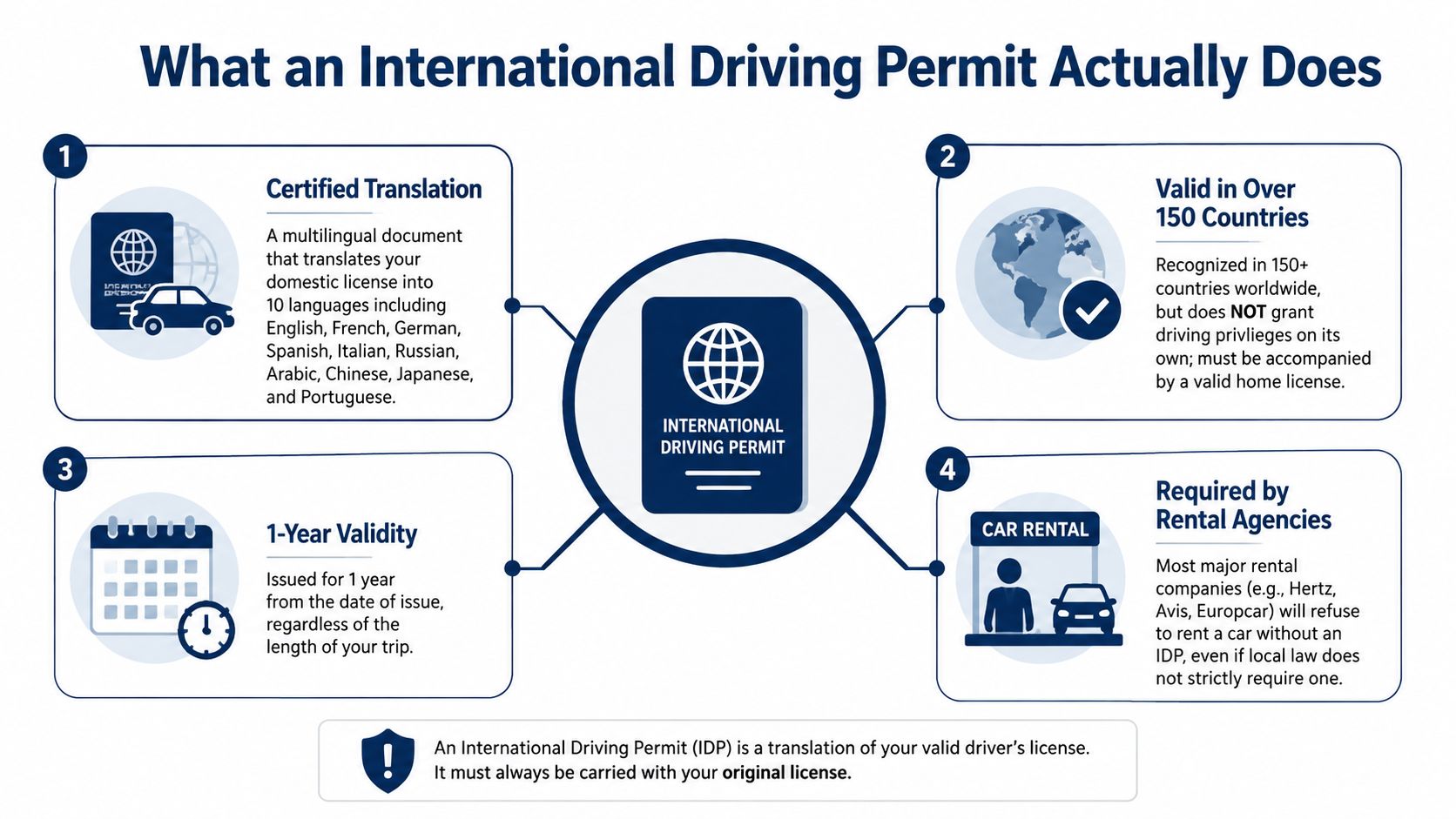
The easiest way to read the rule is this. Your home licence proves you are licensed. The IDP helps foreign officials read that licence quickly, especially where language and legal format do not line up. That is why an IDP can matter at a rental desk even when a traveller expects a plain licence to be enough.
Who Needs an IDP and Who Does Not
A border officer and a rental agent do not always read the same rulebook. That is why the answer depends on where you're going, where you're licensed, and which treaty framework the destination uses.
The 1949 and 1968 systems are not interchangeable. One country may expect a paper booklet that matches the older convention, while another may accept the later format, and some places require no IDP at all for certain visitors. If you want a quick way to test your route before you book, start with do I need an international driving permit, then check the destination's official rules.
For many travellers, the safest habit is to treat the destination as the deciding factor, not the passport alone. A U.S., Canadian, Australian, or Japanese licence may need a 1949 IDP in one market, while an EU-format licence holder may need a 1968 permit outside the EU. U.S. guidance also warns that many countries require an IDP for U.S. citizens (U.S. international driving guidance).
| Home License | 1949 IDP Needed | 1968 IDP Needed | No IDP Required |
|---|---|---|---|
| U.S. licence | Often, depending on destination | Sometimes, depending on destination | In some destinations with local exemptions |
| Canadian licence | Often, depending on destination | Sometimes, depending on destination | In some destinations with local exemptions |
| Australian licence | Often, depending on destination | Sometimes, depending on destination | In some destinations with local exemptions |
| UK photocard licence | Sometimes, depending on destination | Sometimes, depending on destination | EU, Switzerland, Norway, Iceland, Liechtenstein for short travel under UK guidance |
| EU licence | Sometimes, depending on destination | Often outside the EU, depending on destination | Domestic EU travel |
That table covers the legal baseline. Rental counters can still ask for more. A company may request an IDP even where local police would not, because staff need to protect the booking record and insurance paperwork. At a checkpoint, the officer usually wants to see whether the licence format is easy to read and whether it matches the local rule that applies there.
An IDP also does not solve every language problem, and a certified translation is not the same thing. A translation can help a rental clerk or official understand a licence, but it does not replace an IDP where the country requires the permit itself. That distinction is where many travel guides blur the line: translations can fill a communication gap, while an IDP is the document some countries ask to see before they let you drive.
Eligibility Documents and Validity Periods
A traveller who arrives with the wrong paperwork can be turned away before the counter clerk even checks the car keys. The safest place to start is the base licence. It must be valid domestic driving licence, and issuers often want it to have been held for a minimum period, with proof of identity and residence in the issuing country. If the licence is damaged, expired, or the photo does not meet the issuer's rules, the application can fail before printing.
What issuers commonly ask for
The application packet usually includes a completed form, passport-style photos, the original licence and a copy, proof of identity, and the fee. Some issuing bodies also check whether the domestic licence will stay valid for the whole trip. France's official portal shows how specific those checks can be, because it asks for supporting documents, proof of address, and a licence in good condition, which is a useful reminder that the process is not standard everywhere (RAC summary of current IDP guidance).
Validity matters as much as the paperwork. A 1949 IDP is tied to a one-year use window and cannot be treated as a long-term substitute for a domestic licence. A 1968 permit can last longer under its own convention rules, but it still depends on the underlying licence remaining valid. Like a passport with a stamp inside it, the permit points back to the licence that supports it.
| Requirement | 1949 IDP | 1968 IDP |
|---|---|---|
| Base licence | Must be valid | Must be valid |
| Typical application items | Application, photos, licence copy, identity checks | Application, photos, licence copy, identity checks |
| Validity constraint | One year from issue, tied to the home licence | Longer under convention rules, still tied to the home licence |
| Renewal | New application required | New application required |
| Residency | Usually issued in the applicant's home jurisdiction | Usually issued in the applicant's home jurisdiction |
The treaty wording also matters in practice, because the permit is built to work with local enforcement expectations, not replace them. The UNECE reference on the 1949 permit wording makes clear that the document sits alongside the domestic licence, which is why a valid home licence is still the starting point.
Apply before you feel rushed. A rejected application close to departure turns into a travel problem fast, especially if your documents are borderline. Travellers who check photo specifications early and keep their licence in good condition usually avoid the most frustrating delays.
How and Where to Apply for an Authorised IDP
A valid application starts with the right issuer. Apply through the national motoring body, not an embassy, travel agency, or a site that prints a booklet. In the U.S., that means approved organisations such as AAA or AATA; other countries use their own authorised clubs and motoring associations, with equivalent bodies in places like Canada, Ireland, and New Zealand. The issuer matters because the permit must follow that country's own administrative rules.
Prepare the packet before you submit anything
The usual pack is straightforward: a valid domestic licence, passport-style photos that match the issuer's specifications, a completed form, and the fee. Some offices accept online or digital submission for certain permit types, while others still use post or in-person filing. Timelines matter too. UK guidance says you cannot apply more than three months before travel, and you cannot get one issued after you have already left, which means the permit has to be part of your trip planning (RAC guidance on IDP timing).
For U.S. travellers, the approved route is still through the recognised motoring bodies. If you want the process laid out step by step, use how to get an international driving permit. It helps to treat the permit like a passport endorsement for driving. The home licence is the main document, and the IDP is the booklet that lets foreign readers interpret it at a glance.
Speed and format vary by issuer. A clean application can move quickly, while postal routes take longer because each step has to be checked manually. If your photos, licence copy, or application details are incomplete, the delay is usually administrative rather than mysterious. That is why travellers are better off treating the IDP as part of the departure checklist, not as a last-minute errand.
When Certified Translations Are Accepted Instead
A certified translation sounds similar to an IDP because both help a foreign reader understand your licence. The difference is legal weight. An IDP is the treaty document; a certified translation is a readable companion that some destinations and some rental desks accept as a convenience.
That distinction matters most in countries that never joined the IDP conventions, where a translation can sometimes be the practical answer. It can also help at private rental counters in treaty countries when the staff only need to read your name, dates, and licence categories. But at a police checkpoint, the officer may want the actual treaty booklet, not just a translated copy.
A translation can make your licence legible. It does not automatically make it valid for roadside enforcement.
There are also clear red flags. A self-translated sheet won't do the job, and a notarised copy is not the same thing as a certified translation. Digital printouts without a wet signature can also fail when a counter agent or checkpoint officer wants a formal document they can trust at a glance. If the country expects an IDP, a translation alone is usually a backup, not a substitute.
| Scenario | Official IDP | Certified Translation |
|---|---|---|
| Country signs IDP treaty and requires permit | Required | Usually not enough on its own |
| Private rental desk wants a readable licence | Often accepted | Sometimes accepted as a courtesy aid |
| Police checkpoint in treaty country | Expected | May not satisfy enforcement |
| Non-treaty country with local translation practice | May not be available or required | Can be the practical option |
World Driving Permit is one option people use when they need a certified, word-for-word licence translation for presentation with the original licence. It isn't an IDP, and that distinction matters in destinations where a treaty booklet is still required.
Real World Enforcement at Rental Counters and Checkpoints
The sharpest problems usually show up where the paperwork is checked by a person, not a website. A driver can land, clear immigration, and still be turned away at the rental desk if the counter staff decide the document set doesn't satisfy company policy or insurer expectations. That's why the same licence can be fine in one place and rejected in another.
One common pattern is a traveller with a U.S. licence in a destination that expects a 1949-convention document. If the rental agency's policy requires the permit, the counter agent can refuse the vehicle even if the traveller assumed the home licence was enough. The refusal isn't about the quality of the licence, it's about the document format the company is willing to process.
A different problem appears at checkpoints. A UK driver in Spain who shows the wrong treaty booklet can still run into trouble because Spain's current system sits under the convention framework it follows, not the traveller's assumption. The same logic explains why some destinations accept a translation at the desk but not from a traffic officer, the agent needs to read the paper, while the officer needs the right legal document.
Japan is another place where many travellers get tripped up because a local workflow may rely on translation or a specific permit route rather than a casual assumption that a home licence is enough. The lesson is the same across markets. If the document set isn't exactly what the destination expects, the driver can lose the rental, the trip, or both.
If the desk says no, the road usually says no too.
Insurance is the part people forget until something goes wrong. Driving without the correct permit can create coverage problems, which means collision or theft claims may be harder to rely on when you need them most. That's why the paperwork matters before the keys are handed over, not after.
Pre Trip Checklist and Country Specific Resources
The cleanest way to handle international driving permit requirements is to reduce the trip to a short pre-booking checklist. First, confirm whether your destination wants a 1949 IDP, a 1968 permit, or no IDP at all for your licence type. Then verify that your domestic licence stays valid for the whole trip, gather the photos and signed application, and time the issue so the document arrives before you leave.
A practical checklist that actually works
- Confirm the destination rule: Check the country list first, because the treaty version can change by destination.
- Verify your home licence: Make sure it's valid, legible, and not close to expiring.
- Prepare the paperwork: Have your application, photos, identity documents, and a copy of the licence ready.
- Choose the correct permit version: Request the permit that matches the destination's treaty framework.
- Ask the rental company early: Some desks require the permit even when local law is looser.
- Order any needed translation: Use it as a companion where the destination accepts translations, not as a substitute where it doesn't.
- Save the issuer's contact details: If you lose the permit or need clarification, you'll want the local motoring body's help fast.
Authoritative routing usually starts with your national motoring club or licence issuer, not a reseller. In North America, that means AAA or CAA. In the UK, check the official DVLA and motoring-club guidance. In Australia and New Zealand, use the local motoring associations that issue the permit, and for destination-specific issues like Japan or Brazil, confirm the current rule set before booking the car.
For a destination-by-destination overview, use IDP requirements by country. If you're travelling on a tight schedule, get the permit question answered before you reserve the vehicle, because that's where most avoidable delays start.
If you want a readable companion for your licence and a clear way to check when a certified translation is enough, visit World Driving Permit before you book your next car. It's a practical way to prepare the paperwork travelers keep getting asked for at rental desks, checkpoints, and insurer reviews.