
Licencia De Conducir De Honduras: A Complete Travel Guide
You land in another country, hand over your Honduran licence at the rental desk, and the agent starts scanning it like it might answer in English. The card is real, your driving history is real, but the fields are still written for a Spanish-speaking system, and that's where the confusion begins. A licencia de conducir de Honduras can work as a solid travel document, but only if you know what it says, what it doesn't say, and when a translated companion still isn't enough.
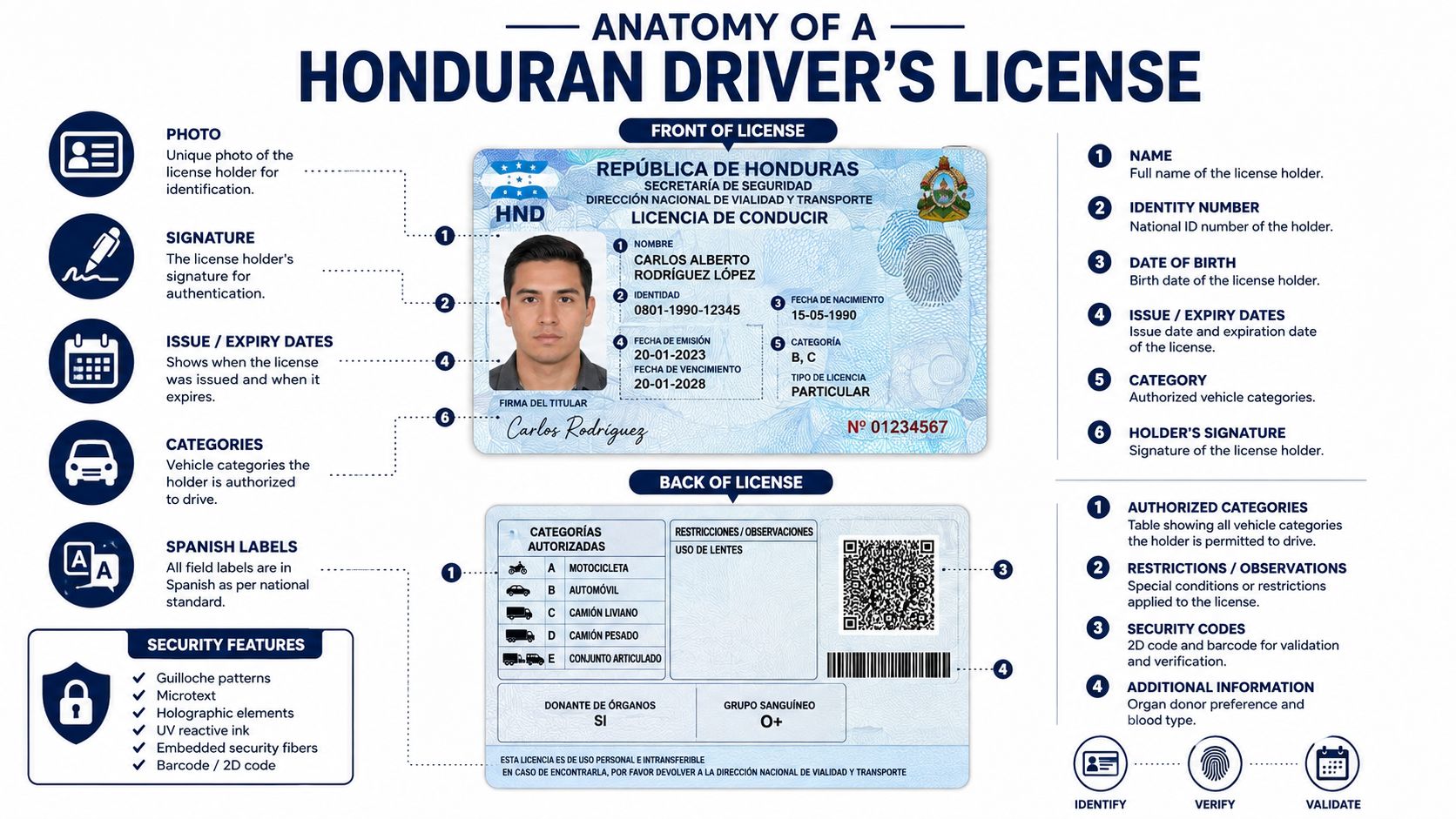
If you want a visual reference for how a licence card is laid out, this sample makes the moving parts easier to identify: sample licence layout.
Table of Contents
- What the Licencia de Conducir de Honduras Looks Like
- Licence Categories and What Each Field Means
- How Widely the Licence Is Actually Issued
- Renewal, Replacement, and Keeping the Card Valid
- Translation Companion Versus International Driving Permit
- Which Fields Must Be Translated to Be Useful Abroad
- Why Clear Documentation Matters at Checkpoints
- A Pre-Trip Checklist for Driving With a Honduran Licence
What the Licencia de Conducir de Honduras Looks Like
A Honduran driving licence is straightforward for local use because the system assumes Spanish reading, local categories, and familiar administrative terms. Abroad, that same clarity disappears fast. A border officer, insurer, or rental agent may see a name, a number, a category, and dates, but not know which line matters most or whether a category matches the vehicle you want to drive.
Why the card stops being self-explanatory abroad
That problem is less about the card itself and more about context. A licence is built for the issuing country's rules, so its wording, abbreviations, and category labels make sense inside Honduras first. Outside Honduras, the same fields can look incomplete if the person checking them doesn't read Spanish or doesn't know the Honduran classification system.
The practical fix is not to replace the original card. It's to make the original card readable in the place where you're showing it. That's why travellers often need a companion document that renders the licence into a language the counter agent can read.
Practical rule: carry the original licence first, then add whatever makes it readable for the country you're entering.
What to focus on when you look at the card
Start with the obvious fields, then check the ones that affect permission to drive. The photo, signature, issue date, expiry date, and category are the details that usually decide whether a foreign reader can make sense of the document quickly. If the card's layout is unfamiliar, the safest approach is to identify those essentials before you travel, not after you've already reached the desk.
The Honduran card also matters because it ties identity to driving privilege, not just to a person's name. That distinction becomes important later when you compare a translation companion with a true International Driving Permit.
Licence Categories and What Each Field Means
Honduras uses a tiered licensing framework, and the category on the card changes what the licence authorises. For Type A/B and subcategories, the minimum age is 18, and applicants must be able to read and write. For Type C1/D1, the minimum age is 23. For Type C/D/CE, the minimum age is 25. For heavier or commercial categories, the law also requires at least sixth-grade basic education, along with medical, psychometric, theoretical, and practical evaluations before issuance, according to the official regulation on driving licences (Acuerdo No. 1012-2021).
Reading the category before you travel
That category line matters more than many travellers expect. A non-commercial licence won't satisfy a counter agent who is checking for a commercial class, and the reverse is true too. If your card shows one class and the vehicle rental or local rule expects another, the issue is not translation, it's category mismatch.
The rest of the card is usually easier to interpret once the category is understood. The full name, identity number, licence number, issue date, expiry date, and issuing authority are the fields that most often need careful reading. In plain terms, those lines tell a foreign reviewer who you are, what you're allowed to drive, and whether the card is still valid.
Why the layout confuses non-Spanish readers
Spanish abbreviations are the main friction point. A foreign agent may not know whether a short label refers to the issuing office, a restriction, or a licence type. That's why a clean translation needs to preserve each field, not just convert the headline text.
A useful way to think about it is this, the category tells you what you may drive, while the issue and expiry dates tell you whether you may drive today. If either part is unclear, the document loses value at the counter.
A licence that reads clearly in Spanish can still fail at a foreign desk if the category is not rendered in plain language.
How Widely the Licence Is Actually Issued
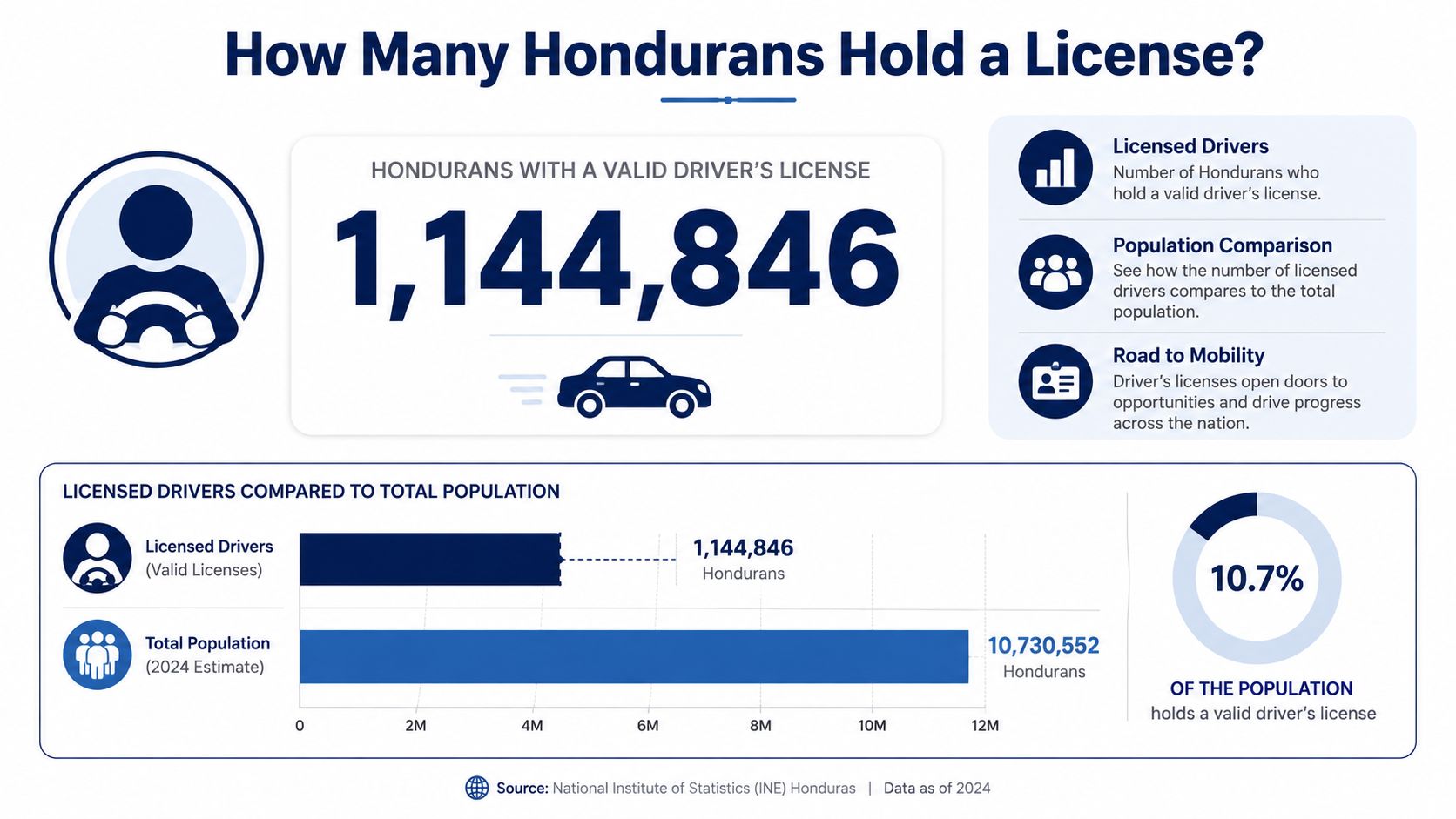
A document that appears in everyday traffic, renewals, and enforcement is one that foreign staff are more likely to encounter in practice, even if they aren't trained on it. In the Distrito Central, more than 1,144,846 driving licences were issued over the last decade, including new licences and renewals, according to local reporting based on official data from the National Directorate of Road and Transportation (El Heraldo). Of those, 924,046 were requested by men, about 81%, and 220,800 were requested by women, about 19%, from the same report.
What those numbers tell a traveller
The most useful takeaway is not the size alone. It's the fact that the licence is part of normal life at scale, which means the card is not a niche document. Rental desks, insurers, and police officers who work around Honduran travellers will see the format often enough to recognise it as legitimate, even if they still need help reading the details.
The same reporting says 699,508 licences were issued between 2012 and 2022, equal to 61% of the decade total in the capital. That concentration matters because the capital's licensing trends often serve as the best available proxy for national demand and administrative capacity in Honduras. When the capital carries that much licensing activity, it shapes how the document is produced, renewed, and checked.
Why foreign staff still misread it
High volume doesn't mean high familiarity at the counter. A foreign agent may see the card often enough to know it's a licence, but not enough to understand the class, dates, or restrictions without help. That's where a readable companion becomes practical, because it turns a Spanish administrative card into a document a non-Spanish reader can work through line by line.
The report also notes 195,988 light-vehicle licences were requested by women, which reinforces a broader point, female participation has grown, but the system still reflects a deep gender gap. For travellers, the relevance is simpler, the document is widespread, real, and routinely used, so it's worth preparing it properly before crossing a border.
Renewal, Replacement, and Keeping the Card Valid
Renewal problems usually begin with timing. A card that is close to expiring can create friction at a rental counter before it ever causes trouble on the road, so keeping the licence current matters just as much as carrying it. Recent Honduras-focused guidance describes a renewal workflow that now emphasizes medical examination, bank payment, a Zoom appointment, and pickup at a transit office, rather than a purely in-person process (Honduras Cuentanos).
What to verify before you leave home
The most practical move is to check the expiry date first, then confirm what the current renewal path asks for. If you are travelling soon, do not assume the process is the same as what a cousin or coworker handled a few years ago. The workflow has shifted toward online coordination, and public articles have not always kept up.
There is also documented confusion around the theoretical test passing mark. One source says 70%, another says 80%, and an exam-prep page also states 70%. That inconsistency is exactly the kind of detail that can trip up a first-time applicant or someone renewing after a long gap, so it is smarter to verify the current threshold directly before studying.
Replacement is a different problem
A lost or stolen licence is a replacement issue, not a renewal issue. The question is not only whether the card is still valid, it is how to replace a missing credential. In practice, travellers should keep a digital record of the card's details and carry whatever identity documents the issuing authority expects, because replacing a lost licence is much easier when the original information is still available.
If your trip depends on the licence, renew early. If the card goes missing, treat replacement as its own process, not a delayed renewal.
The key idea is simple, keep the document valid before travel, because most foreign checks do not care why a licence is expired. They only care whether it can be accepted today.
Translation Companion Versus International Driving Permit
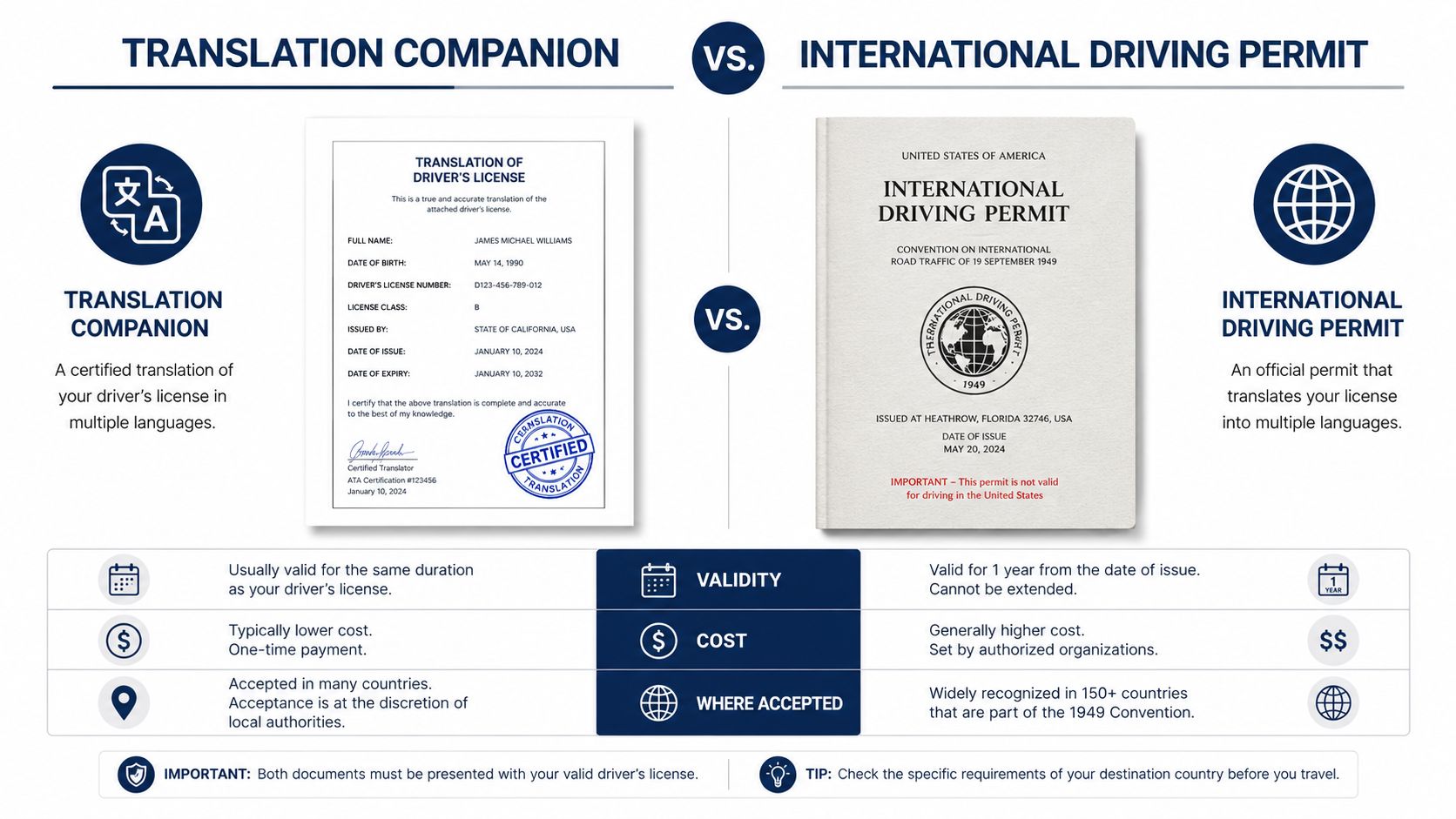
A lot of travellers get caught here. A translation companion is not the same thing as an International Driving Permit. One makes your existing Honduran licence readable. The other is a separate permit document that some destinations legally require.
What the translation companion actually does
A good translation companion turns the card into something a rental clerk or officer can read without guessing at the Spanish. World Driving Permit describes its service as a certified, word-for-word translation into 28 languages, delivered digitally in minutes with an optional printed booklet, and it also says acceptance is determined locally. That matters because the companion is built for readability, not for replacing the original licence or overriding local rules.
The value is practical. At a counter, the agent can compare the translation with the original licence and see the relevant fields in a familiar script. That can help with rentals, roadside checks, insurers, and road authorities when the local staff just need to understand what your card says.
What an IDP does instead
An IDP is different because it's its own travel document, and some countries or rental companies treat it as the required credential. The important point is that an IDP is not a translation page attached to your licence. It's a separate document class, and the rules around it depend on the destination.
World Driving Permit's Honduras guidance page routes travellers toward official IDP issuers when a genuine IDP is needed, which is the right instinct. If the destination says an IDP is required, a translation companion won't replace it. If the destination accepts a readable translation alongside the original licence, the companion can be enough.
How to decide which one you need
Use the local rule first, not the document you happen to have in hand. A translation companion helps when the problem is legibility. An IDP helps when the problem is legal recognition of the permit format. Acceptance can vary by country and even by rental company, so the safest reading is always the destination's own rulebook.
For readers comparing options, the relevant internal reference is International Driving License guidance.
Which Fields Must Be Translated to Be Useful Abroad
A translation only helps if it covers the fields that matter at the counter. On a Honduran licence, the most important items are the full name, identity document number, licence number, licence class or category, issue date, expiry date, restrictions, and issuing authority. If any of those are left vague, the foreign reader still has to guess.
What a useful translation should make obvious
The reader should be able to see, at a glance, who the licence belongs to and what it authorises. That means the translation has to preserve the structure of the original card, not just the words. It also has to render the category in a way that a non-Spanish speaker can understand, because category confusion is one of the fastest ways to create a delay at a desk.
World Driving Permit says its process uses AI-powered OCR that reads 50+ licence formats, followed by a human 5-point review before issuance. It also says the result is rendered across 28 languages, including right-to-left scripts, with no per-language fees. Those details matter because they explain how the translation stays readable without turning into a separate design project for each language.
What to look for in a translation pack
A useful pack usually includes the certified translation itself, a QR-verifiable version, and sometimes optional extras like an official cover letter or a printed passport-format booklet. That combination helps because some checks are visual, some are digital, and some involve a quick document review rather than a formal legal process.
For travellers who want one reference point for the document format, the translation page is here: Driving licence translation details.
A good translation doesn't argue with the original licence, it makes the original licence readable enough to be checked fast.
Why Clear Documentation Matters at Checkpoints
At a checkpoint, a Honduran licence is only useful if the officer can read what matters quickly. Honduras treats licence compliance as a serious enforcement issue, and that helps explain why clear documentation matters when the card is checked abroad. From 2023 to the date of the report, the DNVT sanctioned more than 28,000 drivers for driving without a licence, including 17,131 in 2023 and 10,913 so far in 2024, with a first-offense fine of 600 lempiras and a 50% increase for repeat offenses within one year (La Prensa).
Why that enforcement climate matters overseas
The same reporting says 122,437 licences were confiscated in total, with 66,069 cases, or 53.9%, linked to drunk driving. It also says the DNVT suspends at least 500 licences daily, and 5% of suspensions are accompanied by vehicle confiscation (La Prensa). The point is simple, the licence is treated as a regulated document, not a casual card kept in a wallet.
That enforcement pattern carries over in the way foreign officers react to paperwork they cannot read at a glance. They do not need to know Honduran law in detail to see that a missing, unclear, or suspicious document deserves a closer look.
How a readable companion helps in practice
A translation companion with QR verification and a signed statement of accuracy reduces that friction. It gives the officer a legible version of the card, along with a way to confirm that the translation matches the original licence, without making them decode Spanish abbreviations on the spot.
That still does not guarantee acceptance, because local rules decide the outcome. What it does is shorten the exchange, reduce confusion, and make the document easier to verify when language is the only barrier.
A Pre-Trip Checklist for Driving With a Honduran Licence
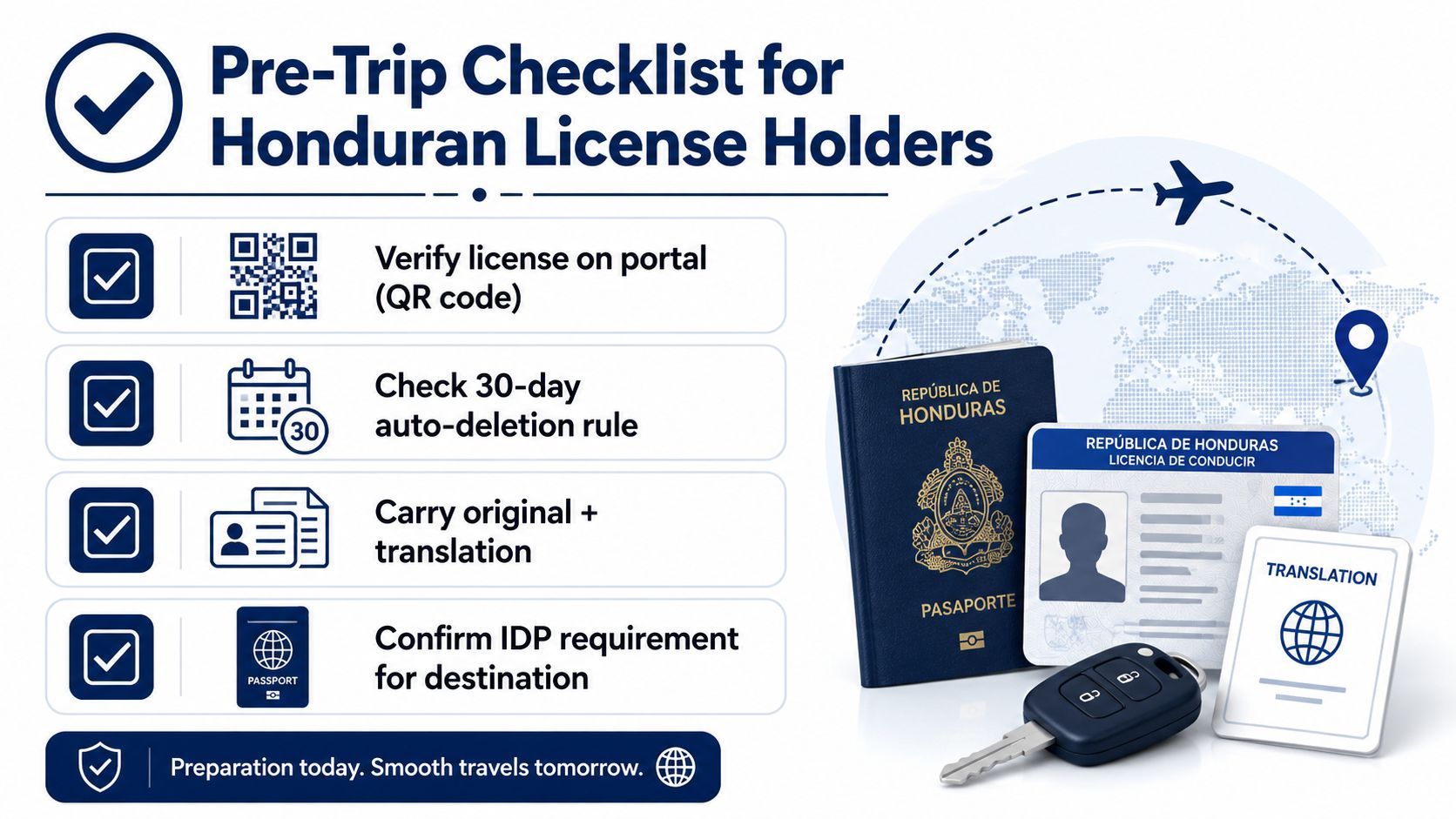
Before any trip, do four things in order. First, check the licence expiry date. Second, confirm the category on the card matches the vehicle you plan to drive. Third, verify whether your destination wants a translation companion, an IDP, or both. Fourth, carry the original licence with the readable companion, not one without the other.
A few practical questions travellers ask
Does the translation help with motorcycles? Only if the destination accepts the underlying licence category for that vehicle class. The translation can make the category legible, but it can't create permission that isn't on the card.
Can a minor be added to the process? That depends on the service's rules and the travel context, but the key issue is still the original licence and whether the destination accepts it for the intended driver.
What about agency or platform use? Travel agencies and booking platforms often need readable document packs for multiple clients, and some services support business workflows, bulk handling, or API integration for that purpose.
How long should I keep the translation pack? Keep it with the original licence for the whole trip, especially if you're crossing multiple borders or using more than one rental company.
The simplest safe habit
Use the translation as a legibility tool, not as a substitute for legal permission. If the destination requires an IDP, route to an authorised IDP issuer before you go. If the destination accepts a translated licence alongside the original, carry both and keep them together.
World Driving Permit provides certified licence translations that can make your Honduran card readable at rental desks, checkpoints, and insurer counters when local staff don't read Spanish. If you're preparing a trip, visit World Driving Permit to check the document options, compare them with your destination's rules, and decide whether you also need an IDP before you drive abroad.