
Indian International Driving Licence: 2026 Guide
You've landed at an overseas airport, collected your bags, and reached the car-rental counter with your passport and Indian driving licence in hand. The agent scans the licence, looks uncertain, and asks for an International Driving Permit. You assumed your Indian licence would be enough, and now the first day of your trip is suddenly less straightforward.
That situation is common because an Indian licence, an International Driving Permit, and a certified translation serve different purposes. The official permit supports international recognition under a treaty framework, while a translation companion helps foreign staff read the information printed on your licence. Knowing the difference before you travel can prevent a refusal at the counter, confusion during a police check, and an expensive last-minute scramble.
Table of Contents
- What an Indian International Driving Licence Actually Is
- How to Apply for an IDP Through Your Local RTO
- IDP Versus Certified Translation for Driving Abroad
- Why the Official Process Creates Friction for Travelers
- How to Decide What You Need for Your Destination
- Your Pre-Trip Driving Document Checklist
What an Indian International Driving Licence Actually Is
The document many travelers call an Indian international driving licence is officially an International Driving Permit, or IDP. India's participation in the modern IDP system is connected with the 1949 Geneva Convention on Road Traffic, which entered into force on 26 March 1952. India is cited in government and industry references as a country operating within that convention framework, issuing or recognizing permits under its model. (Background on India's IDP framework)
An IDP doesn't give you a new driving entitlement. It works as a translation and recognition companion to your valid Indian driving licence, presenting key licence information in a standardized, multilingual booklet. You must carry both the original Indian licence and the IDP when driving abroad. Showing the booklet by itself can leave a rental employee or police officer without proof of the underlying domestic licence.

What the permit can and can't do
An Indian IDP is issued only to an Indian resident who holds a valid Indian driving licence. It isn't available to someone who has only a learner's permit, and it can't replace a domestic licence that has expired. The application also connects the permit to a planned journey, with official guidance requiring destination-country and trip-duration details in the application. (Indian government IDP requirements)
The permit is temporary. Indian-issued IDPs are generally valid for one year, and Delhi's transport authority states that the traveler should obtain a driving licence from the destination country within that validity period where local rules require one. (Delhi Transport Department guidance)
That short period matters for students, expatriates, and frequent travelers. An IDP isn't a permanent foreign licence, and it doesn't authorize you to ignore the destination country's age limits, insurance rules, vehicle restrictions, or local licensing requirements.
Practical rule: Keep the original Indian driving licence, the IDP booklet, passport, and rental paperwork together. The counter agent usually needs to see the documents as a set.
The IDP is also a physical document issued through India's transport administration. Online forms may help begin an application, but a downloadable file isn't the same thing as the official permit booklet. India adopted a standardized Model IDP format from Annexure 10 of the 1949 Convention in August 2022, covering the presentation of the cover, size, and pages. (India's Model IDP format)
How to Apply for an IDP Through Your Local RTO
At a rental counter overseas, a missing document or mismatched name can stop the handover before you reach the car. Start the Indian application early, and treat the process as preparation for both the RTO and the foreign rental desk.
Step 1, confirm the issuing authority
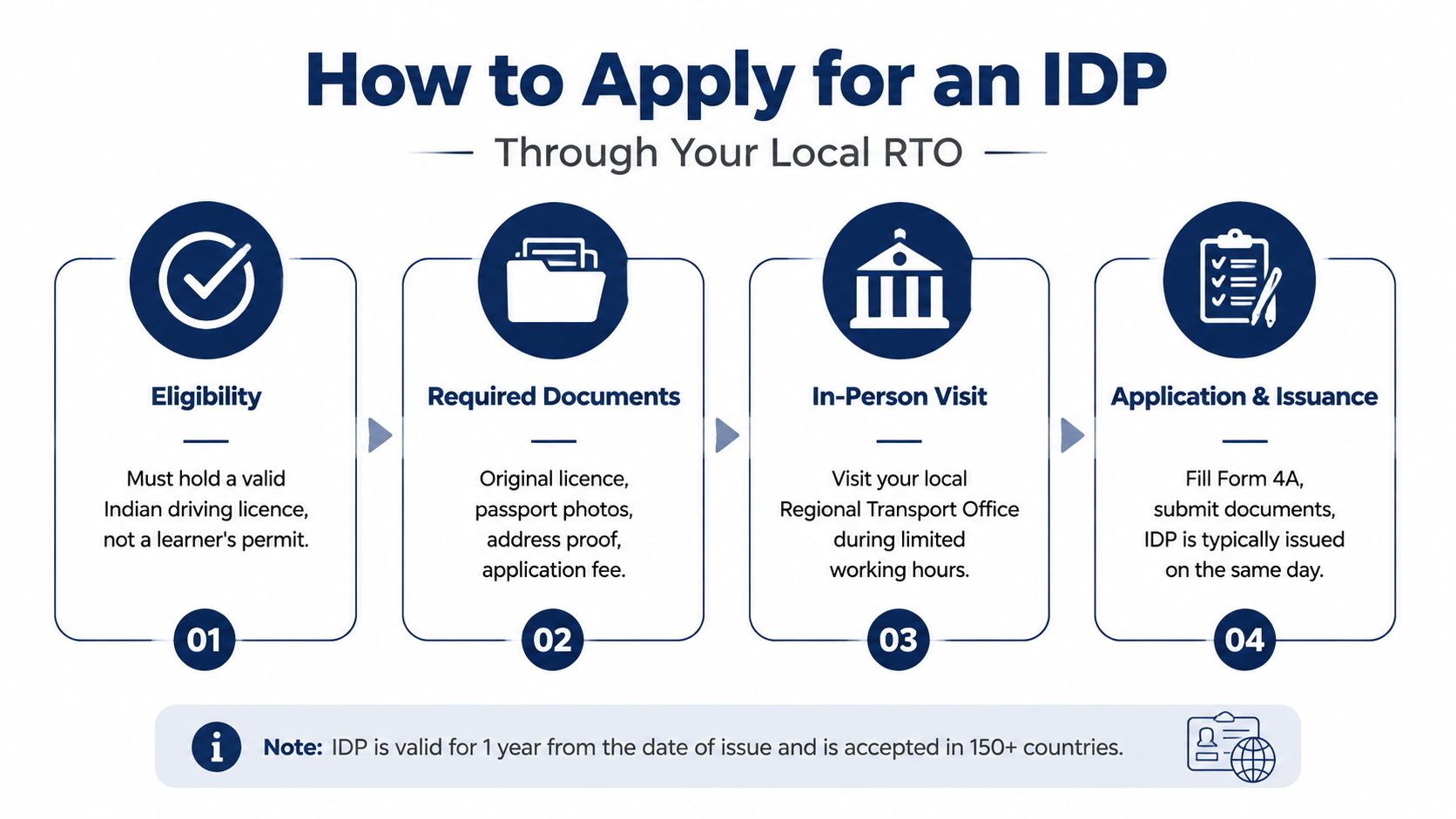
Begin with a valid Indian driving licence, Indian residency, and travel documents supporting your planned journey. The application uses Form 4A and goes through the relevant Regional Transport Office or transport authority. (National Portal guidance for applying for an IDP)
Find the RTO that issued your licence or covers your current address. Procedures can differ between offices, so check its instructions before making the trip. Parivahan Sewa may let you start part of the application online, but the local authority can still require document checks or in-person verification.
Step 2, build the document folder
Prepare the papers the office commonly requests:
- Form 4A: Enter the destination countries and trip information requested by the authority.
- Original Indian driving licence: Check that your name and identity details match your passport. The IDP is tied to this licence.
- Passport and visa: These support identity and overseas travel verification.
- Air-ticket copy: Travel evidence may form part of the application file.
- Photographs: Bring the format and quantity requested by your RTO, plus spare copies if practical.
- Medical documentation: The authority may request a medical certificate, commonly associated with Form 1A.
Ask whether the office needs originals, photocopies, or both. This small check can prevent a return visit. It also helps to keep the folder arranged in the same order as the checklist, so an officer can review it quickly.
Step 3, pay the applicable charges
The amount depends on the issuing office and the charges shown during your application. Use the RTO or official application portal as the payment reference, rather than relying on an informal fee estimate. Keep the receipt with your application papers.
Step 4, complete verification and collect the permit
Submit the form and supporting documents for inspection. Some offices may finish promptly, while others can request another verification or collection step. Do not schedule a self-drive itinerary around same-day issuance unless your RTO has confirmed that timing.
Apply several weeks before departure. That buffer gives you time to correct a name mismatch, replace an unsuitable photograph, or provide another document. A guide to obtaining an International Driving Permit can help you understand the general sequence, while your local RTO decides what your application requires.
At the rental desk, present the IDP with your original Indian licence, passport, and booking documents. The permit may satisfy the formal requirement, while a clearly readable translation companion can help staff identify licence details quickly when language or format creates confusion.
Remember that the IDP generally follows a one-year validity period and depends on the underlying Indian licence remaining valid during use. As noted earlier, destination-country rules can still impose separate licensing conditions.
IDP Versus Certified Translation for Driving Abroad
A rental desk often has a practical problem, not a legal one. The employee needs to identify your name, licence category, issue details, and validity dates quickly, often in a language they can read. An IDP can help because it follows an international convention format. A certified licence translation addresses the readability problem by rendering the original licence information into the relevant local language or another requested language.
Those functions overlap, but they aren't interchangeable. An IDP is an official permit issued through the authorized transport system and must travel with your original licence. A certified translation is a professionally prepared companion to that licence. It doesn't become a government-issued driving permit merely because it is accurate or easy to read.
Compare the documents before you travel
| Feature | International Driving Permit | Certified Licence Translation |
|---|---|---|
| Issuer | Authorized transport authority under the applicable national process | Professional translation provider |
| Main purpose | International recognition and standardized presentation | Clear reading of licence details in another language |
| Used alone | No, it must accompany the original Indian licence | No, it should accompany the original licence |
| Government permit | Yes, within the relevant issuing framework | No |
| Best use | Destinations or rental policies requiring an IDP | Rental desks or checkpoints needing readable licence information |
| Acceptance | Depends on destination law and the rental company | Depends on local law, the authority, and the rental company |
An IDP may be mandatory where the destination's rules require the convention document. In that situation, a translation isn't a substitute unless the relevant authority expressly accepts it. Conversely, some rental companies or local officials may focus first on whether they can understand the licence, especially when the original card uses unfamiliar scripts.
The safest choice depends on the destination's actual rule and the rental company's written policy. A readable translation can reduce counter confusion, but it can't override a legal IDP requirement.
You'll find a useful side-by-side explanation in this IDP and translated licence comparison. It's particularly helpful when the rental company's booking page uses vague language such as “international licence” without explaining whether it means an IDP or a translation.
Carrying both can remove two different risks. The IDP supports formal recognition, while the translation helps a person read the original licence accurately.
Why the Official Process Creates Friction for Travelers
You arrive at an overseas rental desk after a long flight. Your booking is confirmed, but the staff member pauses over the Indian licence, asks for another document, and checks whether the permit format meets company policy. The official process may have been completed correctly, yet the desk still needs information it can read and verify quickly.
India's official route is organized around transport-office verification, physical documents, and the issuing jurisdiction. Travel arrangements often run on a faster timetable. Cars are reserved online, schedules change, and the document requirement may appear only in a confirmation email.
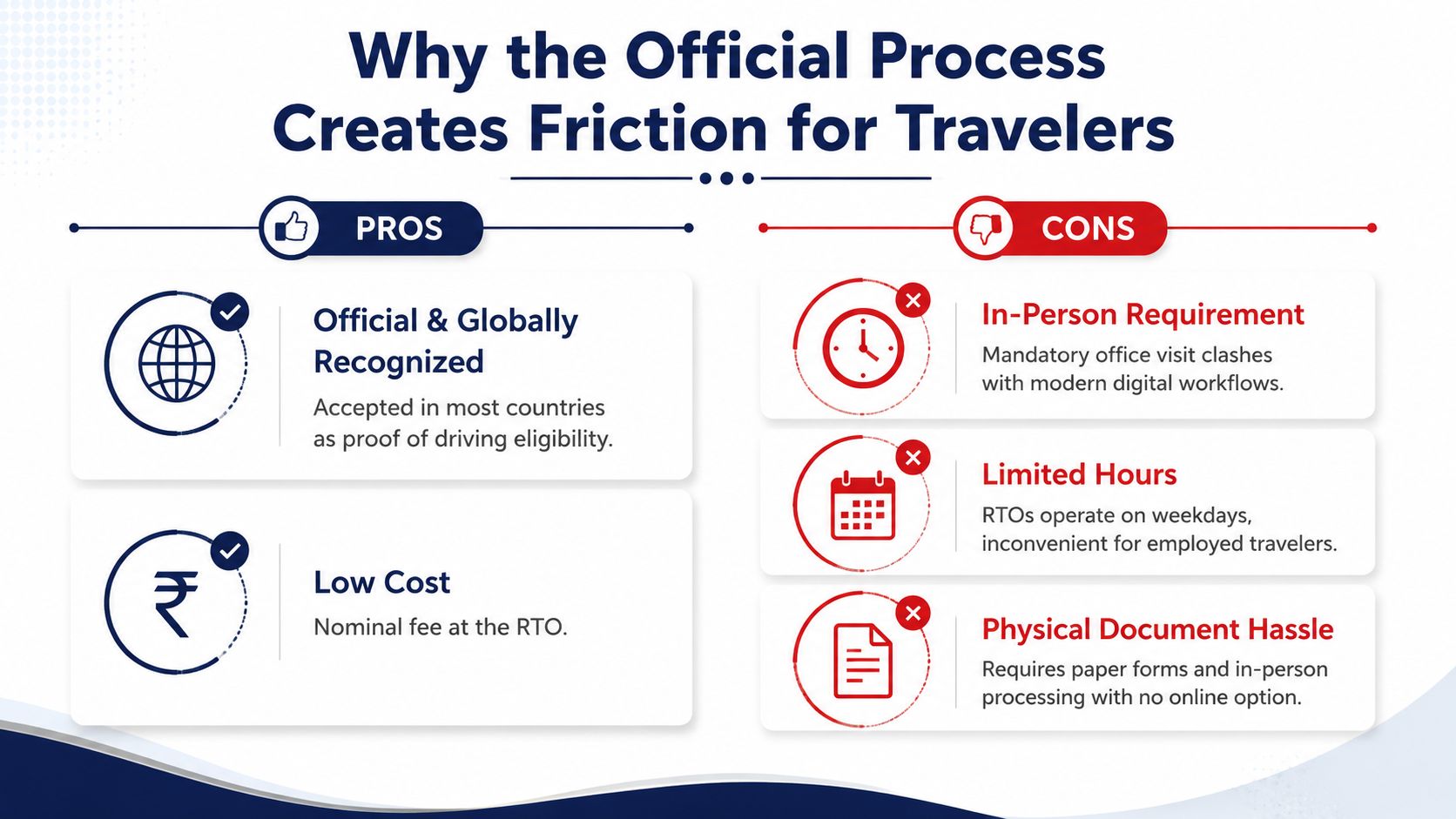
Recent process guidance describes an online application followed by an appointment or in-person verification. Some states may also require biometrics or collection through the RTO after the form is submitted. (Recent overview of India's IDP process) That timing creates difficulty for anyone already away from the relevant city or preparing to leave soon.
Where delays appear
Location is the first pressure point. Eligibility does not always mean instant access. You may still need to visit the RTO connected with your licence or residence, and office hours can clash with work, exams, connecting travel, or family duties.
Document consistency creates another pause. A spelling difference between your passport and licence, an unclear photograph, or a record requiring manual review can lead to correction and another visit. The official route provides controlled verification, but it was not designed as an instant travel add-on.
The permit's limited validity adds repeat work. An Indian IDP generally lasts one year, so travelers taking later trips may need to complete the official process again rather than rely on one permit indefinitely.
Why a translation companion can help
A certified translation addresses a practical readability problem. At an airport counter, roadside check, or insurance discussion, a foreign employee may struggle to interpret the original Indian card. A clear rendering of its fields gives staff a way to check the information without guessing.
For urgent trips, a digital translation companion may be easier to obtain than an office-issued booklet. World Driving Permit provides certified, word-for-word translations of national driving licences into 28 languages, with digital delivery and an optional printed booklet. Acceptance depends on local authorities and company policy, and the service states that it is not an IDP or government document.
Use the translation as a readability aid. Where the law or rental contract requires an IDP, apply through the authorized Indian channel and carry the translation as a companion document.
How to Decide What You Need for Your Destination
Don't choose documents from the destination name alone. Check three separate authorities: the country's transport or embassy guidance, the rental company that will hand over the vehicle, and any insurer whose conditions apply to your booking. Those sources can use different wording, and a rental desk may impose requirements that are stricter than a general travel page.
Use this decision path
First, ask whether the law requires an IDP. Countries operating within the 1949 Geneva or 1968 Vienna convention systems may recognize an Indian IDP, but recognition doesn't mean every vehicle category or rental arrangement is automatically covered.
Next, check the rental company's document list. Save the policy page or email confirmation. If it says “original licence and IDP,” bring both. If it requests an official translation, ask whether a certified translation is accepted and whether it must be in a particular language.
Finally, assess readability. If the original Indian licence contains information that local staff may struggle to interpret, a translation companion can help even when you already have the IDP. It supports the human verification step at the desk, but it doesn't replace the original licence.
| Destination | IDP Required | Certified Translation Accepted | Recommended Approach |
|---|---|---|---|
| UAE | Confirm with the relevant emirate and rental company | Confirm locally | Carry the original licence and follow the rental company's stated requirement |
| Thailand | Check current transport rules and rental policy | Confirm before booking | Obtain the required official permit and add a readable translation if requested |
| European countries | Requirements differ by country | Acceptance differs by country | Check the specific country, not just “Europe,” and carry both when policies are unclear |
| United States | Rules differ by state and rental company | Acceptance differs by state and provider | Verify the state rule and rental contract before departure |
These examples are a reminder that no universal “IDP accepted everywhere” rule exists. Use a destination-specific guide to IDP requirements by country, then confirm the result with the actual rental branch. Ask a direct question: “Do you require the government-issued IDP, a certified translation, or both with the original Indian licence?”
If the answer is unclear, carrying both documents offers the strongest practical protection against a language-based dispute. It still doesn't guarantee legal permission, so local rules remain decisive.
Your Pre-Trip Driving Document Checklist
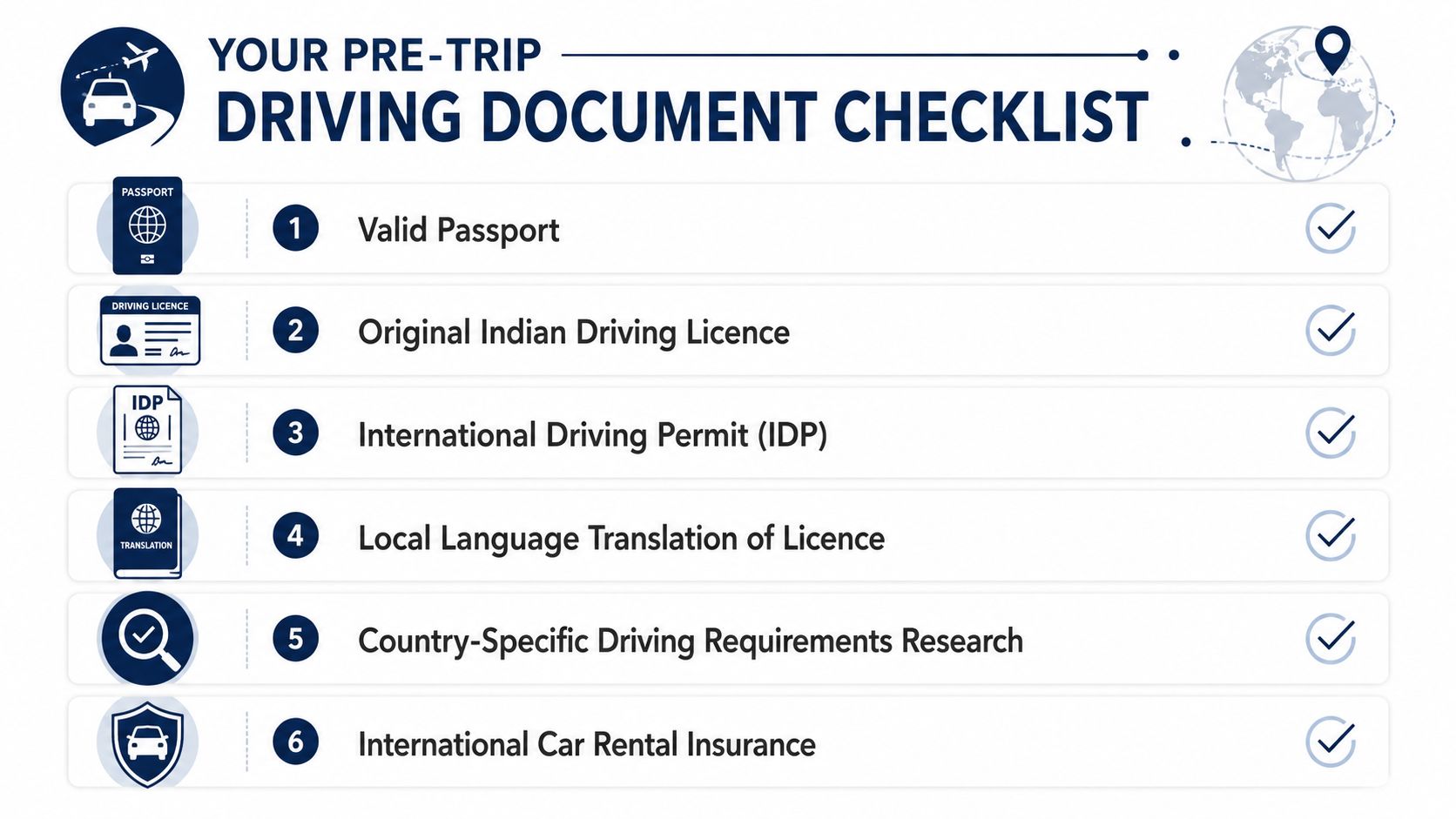
At a rental desk, a missing document can delay the handover even when you followed India's official process. Pack the documents as one travel file, while keeping their roles separate. Your original Indian licence proves your domestic entitlement. The IDP supports recognition where local rules require it. A certified translation companion helps staff read licence details quickly.
Before each self-drive trip, check:
- Verify the Indian licence: Confirm that it is valid, legible, and consistent with your passport. Carry the original, not only a scan.
- Confirm destination rules early: Check the transport authority, embassy, and rental company requirements. Ask whether they require an IDP, a certified translation, or both.
- Prepare the RTO application: Gather Form 4A, passport, visa, ticket, photograph, and any medical documents your authority requests.
- Check the validity window: An Indian IDP is generally valid for one year and must stay paired with a valid Indian licence. The official process guidance was provided earlier in the article.
- Add a readable translation when useful: Treat it as a companion for rental desks, checkpoints, insurers, or multilingual travel. It does not replace an IDP when that permit is legally required.
- Keep the packet accessible: Store your passport, original licence, IDP booklet, translation, rental agreement, and insurance documents together.
Start before departure becomes urgent. If time is short, ask the rental branch what it will accept and request written confirmation. An online document may improve readability, but it does not automatically replace an official physical permit.
World Driving Permit provides certified, word-for-word licence translations in 28 languages, with digital delivery in minutes and an optional printed booklet for presentation alongside your original Indian licence. Visit World Driving Permit to check destination requirements before ordering.