
Driving in Mexico with US License: 2026 Guide & Tips
Yes, you can drive in Mexico with a valid U.S. driver's license as a tourist, generally for a visitor stay of up to 180 days. But the license is only one part of the document stack, and Mexican auto liability insurance is the indispensable document that most often causes serious trouble.
You're at a rental counter with your bags in the trunk, or waiting at a border checkpoint with a line of cars behind you. The agent or officer asks for your license, passport, entry paperwork, insurance, and vehicle documents. Your U.S. license is valid, but that alone may not release the rental car, authorize your personal vehicle beyond the border zone, or protect you after a collision.
That's the practical reality of driving in Mexico with a U.S. license. Think in layers: your license proves you can drive, your passport and FMM support your visitor status, Mexican insurance addresses financial responsibility, and a vehicle permit may be required for your own car. Missing any one of those pieces can turn a straightforward road trip into a long and expensive interruption.
Table of Contents
- Can You Drive in Mexico With a US License
- Understanding the Legal Rules for Your US License
- The Non-Negotiable Requirement Mexican Auto Insurance
- Renting a Car vs Driving Your Own Vehicle
- Navigating Checkpoints and Common On-Road Pitfalls
- Your Essential Pre-Trip Checklist for Driving in Mexico
Can You Drive in Mexico With a US License
A traveler arrives at a rental desk expecting one simple check: hand over a valid U.S. license and receive the keys. Instead, the agent compares the name on the reservation, asks for a passport, checks insurance arrangements, and requests a payment card or other paperwork. The traveler has the right license, but the transaction still depends on the rest of the file.
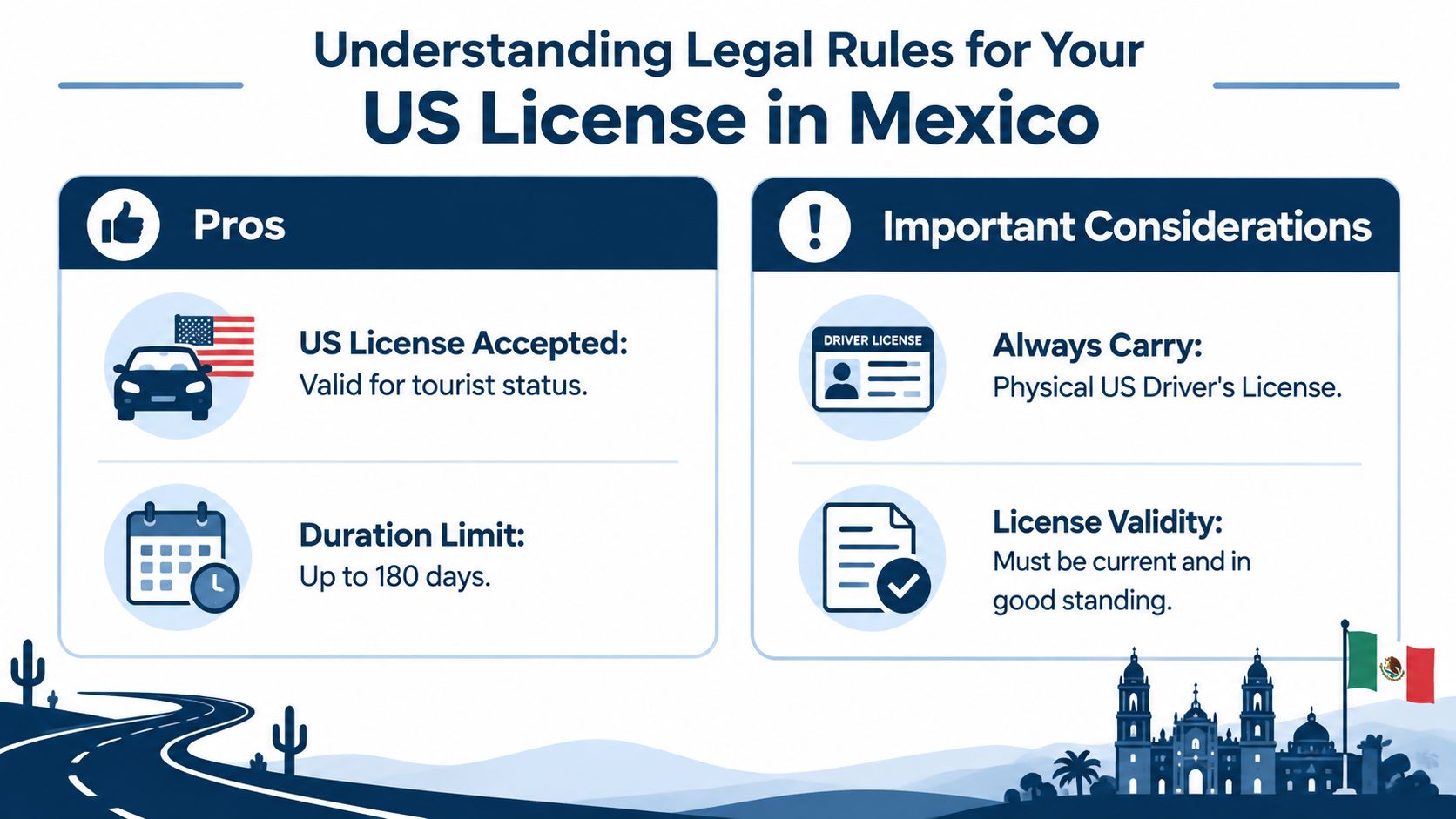
The direct answer is yes. A valid U.S. driver's license is generally accepted for tourist driving in Mexico, with travel guidance commonly describing the privilege as tied to the visitor's permitted stay, sometimes up to 180 days. That acceptance comes from your status as a visitor, not from a permanent right to drive indefinitely. Current guidance on U.S. licenses in Mexico makes that distinction important for tourists, students, expatriates, and business travelers whose immigration status may change.
Your license is the driving-privilege document, not proof that your car is legally insured in Mexico. U.S. auto liability coverage generally isn't recognized as valid Mexican liability proof, so a driver can be licensed and still be unlawfully or inadequately insured. The same problem appears with a personal vehicle that lacks the required import paperwork.
Practical rule: Prepare for Mexico as if you need a folder, not a card.
That folder should contain your physical U.S. license, passport, FMM or other entry documentation, Mexican insurance certificate, and rental or vehicle paperwork. If you're unsure whether an International Driving Permit is useful for your route or circumstances, review the guidance on whether you need an International Driving Permit, while keeping the original U.S. license with you.
Understanding the Legal Rules for Your US License
The cleanest way to understand the rule is to separate visitor status from residency. A valid U.S. license is generally accepted when you're visiting Mexico as a tourist. Guidance describing the arrangement commonly connects its duration to the tourist authorization, with some sources specifying a ceiling of 180 days. Travel-license guidance for U.S. visitors describes this as a time-limited visitor privilege rather than an indefinite authorization.
Your FMM, or Forma Migratoria Múltiple, matters because it helps establish the basis for your stay. Keep it with your passport and make sure the information is consistent with your travel circumstances. A license doesn't replace immigration documentation, and an FMM doesn't replace insurance or vehicle paperwork. Each document answers a different question.
Tourist driving and resident driving are different
Tourists can generally use a valid U.S. license during the period supported by their visitor status. Once you establish residency, that visitor privilege no longer provides the same long-term basis for driving. Residents must obtain a Mexican state-issued license, and local procedures can involve in-person testing or documentation. Expatriate licensing guidance for Mexico treats the change in status as a compliance boundary.
That boundary matters if you extend a trip, accept a local assignment, enroll in a program, or move to Mexico. Don't assume that continuing to hold a valid U.S. license keeps the tourist rule alive after your immigration status changes.
What an IDP or translation can and can't do
An International Driving Permit or certified translation can make an English-language license easier for a rental employee, insurer, or official to read. It can also reduce friction in areas where an officer isn't accustomed to U.S. license formats. However, it isn't a substitute for the original license, and a translation companion doesn't automatically create a Mexican driving privilege.
If your rental agency or route-specific authority recommends an IDP, follow that operational requirement. For broader preparation, a Mexico driving requirements guide can help you distinguish between the original license, a translation, an official permit, and supporting documents. Carry the physical U.S. license even when you also carry an IDP or translation.
The Non-Negotiable Requirement Mexican Auto Insurance
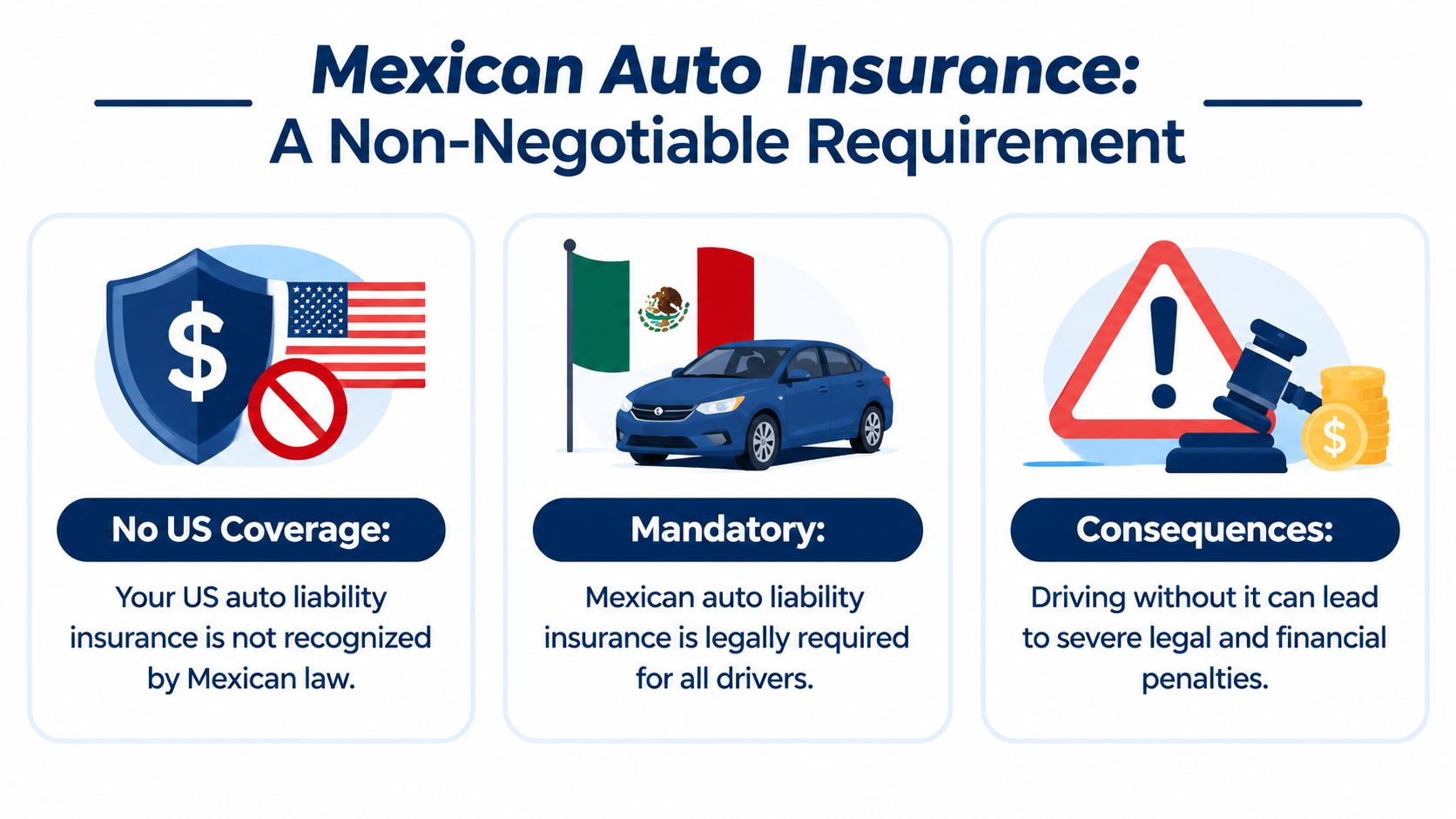
The most dangerous assumption in this subject is that license acceptance means your U.S. insurance follows you into Mexico. It doesn't. Travel and insurance guidance consistently emphasizes that Mexican auto liability insurance is mandatory, while a U.S. policy isn't recognized as valid liability proof in Mexico. State Farm's guidance on driving to Mexico highlights the gap between having a recognized license and carrying legally recognized liability coverage.
That gap matters after a crash, not just during a routine stop. A valid license may establish that you were allowed to operate the vehicle, but it doesn't establish that you can address damage or injuries under Mexican requirements. Without the right policy, you can face financial exposure and serious legal complications while authorities determine how the incident will be handled.
Choose coverage based on the vehicle and trip
At minimum, arrange Mexican liability coverage issued for use in Mexico. Some drivers choose liability-only protection because it addresses the required third-party responsibility at a lower level of coverage. Others add protection for collision, theft, roadside assistance, or medical expenses, depending on the car, route, and risk they're willing to retain.
The trade-off is straightforward:
- Liability-only coverage: Meets the core financial-responsibility need but leaves more of your own vehicle risk with you.
- Broader coverage: Costs more, but can provide a more complete response if the vehicle is damaged, stolen, or disabled.
- Rental-company coverage: May be offered at the counter, but you should read the terms instead of assuming every option is included.
- Pre-trip policy purchase: Lets you review limits, exclusions, assistance contacts, and proof of coverage before you reach the border.
Buy from a provider or broker that issues coverage for Mexico, and save the policy certificate where you can retrieve it without relying on a weak mobile connection. Carry a printed copy as well. The goal isn't merely to say you bought insurance. You need to prove the policy details quickly after a stop or collision.
Why U.S. coverage doesn't close the gap
Your domestic policy may contain language about limited international protection, but that doesn't necessarily satisfy Mexican liability requirements. Treat any U.S. coverage as a separate benefit unless the policy specifically provides recognized Mexican coverage through an appropriate arrangement. Don't present a U.S. insurance card as your only proof of legal liability coverage.
The sensible order is license first, Mexican insurance second, then the remaining documents. That order reflects the serious repercussions of failure. A missing translation may create delay or confusion. Missing Mexican liability insurance can leave you exposed during critical incidents.
Renting a Car vs Driving Your Own Vehicle
The document stack changes depending on who owns the vehicle. A rental car usually reduces border paperwork but adds contract requirements. Your own car gives you control over the vehicle but makes you responsible for import documentation, ownership evidence, and the correct permit for the route.
Renting a car
At the rental desk, start with identity consistency. Rental operators commonly require the driver's license name to match the reservation exactly. A middle name omitted from the booking, a recent name change, or a reservation made under a companion's name can create a release problem even when the person standing at the counter has a valid license. Rental documentation guidance for Mexico describes this as a common practical requirement.
Bring:
- Physical U.S. license: It must be current and usable for the trip.
- Passport and visitor paperwork: These establish identity and travel status.
- Reservation confirmation: Check the driver name before departure.
- Rental agreement: Keep it in the vehicle while driving.
- Mexican liability proof: Confirm exactly what the rental price includes and what the agency requires.
- Payment method: Follow the agency's rules for deposits and vehicle release.
The cheapest online rental price isn't always the cheapest workable arrangement. A low headline rate can become less attractive when mandatory coverage, deposits, roadside assistance, or vehicle restrictions appear at pickup. Ask the agency in writing which Mexican liability coverage is included, whether additional protection is optional, and whether the car may be taken on your planned route.
If you're comparing agencies, use a foreign-country car rental checklist before you book. The useful comparison isn't just daily price. It's whether the agency's documentation, insurance, driver-name, and cross-border rules match your itinerary.
Driving your own vehicle
Your own U.S.-plated car requires a different layer of proof. Carry current registration and documentation showing your right to use the vehicle. If the car is financed, leased, or registered to someone else, obtain written permission from the relevant owner or lienholder before traveling.
A Temporary Vehicle Importation Permit, commonly called a TVIP, may be required when you take a personal vehicle beyond the applicable border-free area. Confirm the route and permit requirement through the official process before crossing. The permit isn't interchangeable with your license, registration, passport, FMM, or insurance.
Keep these documents together:
- Registration: Shows the vehicle's identifying and ownership information.
- Ownership or authorization papers: Explain why you're entitled to take the vehicle into Mexico.
- Passport and visitor documentation: Support your entry and stay.
- TVIP, when required: Authorizes the temporary importation of the vehicle for the applicable trip.
- Mexican insurance: Covers the vehicle under Mexican requirements.
Renting usually wins on simplicity for a short trip. Bringing your own car can make sense when you need that specific vehicle, but the paperwork burden and permit risk are yours. Decide based on the route and documentation, not only on comfort or advertised rental price.
Navigating Checkpoints and Common On-Road Pitfalls
A checkpoint is easier to handle when every document has a clear place. Keep your license, passport, visitor paperwork, insurance certificate, registration, rental agreement, and vehicle permit accessible, but don't leave valuables or loose originals exposed in the cabin.
Mexico's road-safety environment deserves respect. The OECD and International Transport Forum reported 15,979 road deaths in 2022, a mortality rate of 12.4 deaths per 100,000 inhabitants, and a risk factor of 2.9 deaths per 10,000 registered vehicles in its Mexico country profile. The OECD/ITF Mexico road-safety profile provides the underlying figures. Those figures don't predict what will happen on your particular route, but they do support a conservative approach to speed, fatigue, night driving, and documentation.
Use a calm checkpoint routine
Slow down, follow instructions, and keep your hands visible. Officers may ask for identification, vehicle documents, or proof of insurance. Answer directly, avoid arguments, and show the requested document rather than handing over an unorganized bundle of papers.
A practical routine looks like this:
- Pull over safely: Turn off the engine if instructed and remain attentive.
- Identify the request: Ask politely which document the officer needs.
- Show originals: Present the physical license and official paperwork.
- Explain your status: If language is a problem, use a translation companion alongside the original license.
- Record official details: If you receive a ticket or incident number, keep it with your insurance records.
- Call the insurer after a collision: Follow the policy's claims instructions and don't negotiate liability casually at the roadside.
Reduce avoidable road risk
Mexico includes busy urban roads, rural stretches, toll routes, and roads with conditions unfamiliar to visitors. Read signs carefully, allow more stopping distance than you think you need, and treat unmarked speed bumps, uneven pavement, pedestrians, cyclists, and livestock as real hazards. Local driving habits may differ from what you're used to, but copying aggressive behavior isn't a safety strategy.
Don't drive after drinking, use a handheld phone, or continue when you're too tired to make good decisions. If a traffic stop becomes confusing, remain courteous and request the official process for any citation. Your insurance provider, consulate, and emergency contacts should be saved before departure, not searched for after a crash.
Your Essential Pre-Trip Checklist for Driving in Mexico
The best checklist follows the order in which problems usually appear: entry, driving authority, insurance, then vehicle authorization. Don't keep everything only in an email account. Store secure digital copies and carry paper copies of the documents an officer, rental agent, or insurer may request.
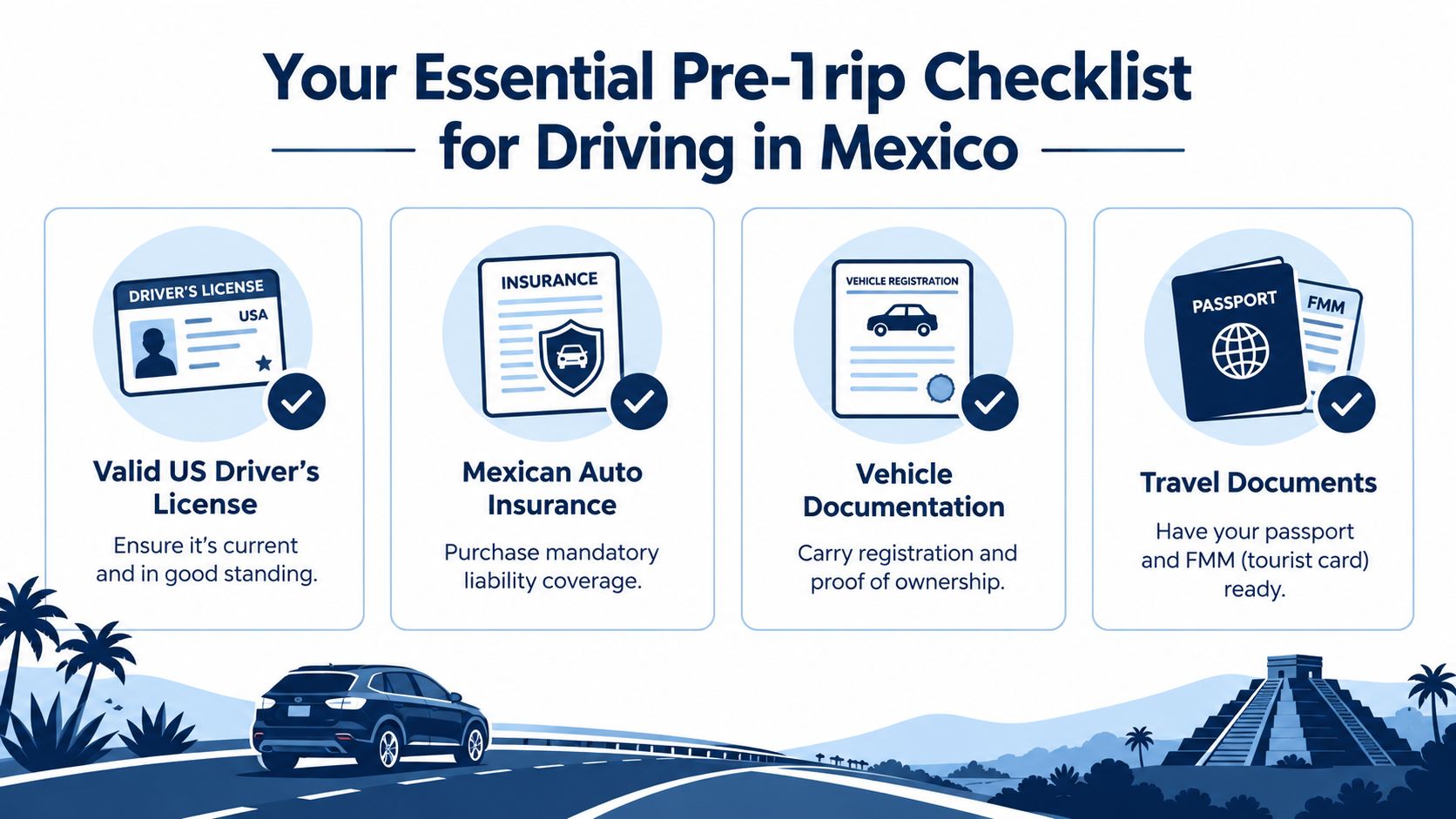
Personal documents
- U.S. driver's license: Confirm that it's valid for the entire trip and carry the physical card.
- Passport: Keep it accessible with your entry records.
- FMM or visitor documentation: Make sure it matches your travel status and intended stay.
- Translation support: Consider an IDP or certified translation when a rental company, insurer, language barrier, or route-specific authority makes it useful. It supplements the original license.
Vehicle documents
If you're renting, check the reservation and rental agreement before leaving the counter. The driver's name should match the booking details, and you should know which documents the agency expects in the vehicle.
If you're taking your own car, add:
- Registration and ownership evidence: Carry current vehicle records.
- Authorization letter: Get permission when the car is financed, leased, or registered to another person.
- TVIP: Confirm whether your route requires a Temporary Vehicle Importation Permit and obtain it through the applicable process.
- Rental agreement: Keep it in the car when using a rented vehicle.
Insurance and contacts
- Mexican liability policy: Buy and verify coverage before driving. A U.S. policy alone isn't valid Mexican liability proof, as emphasized in the earlier insurance guidance.
- Policy certificate: Carry printed and digital copies, including claims and roadside-assistance contacts.
- Emergency contacts: Save your insurer, travel companions, consulate, and local emergency resources.
- Route review: Check border, rental, and vehicle-permit requirements for your specific itinerary.
Your U.S. license remains the foundation, but the complete stack is what makes the trip workable. Remember that the license privilege is tied to visitor status. Once residency is established, you'll need a Mexican state-issued license rather than relying on the tourist arrangement, as outlined in Mexico expatriate licensing guidance.
World Driving Permit provides certified, word-for-word translations of national driving licences into 28 languages, delivered digitally with an optional printed booklet, for use alongside your original licence where a readable translation helps at rental desks, checkpoints, insurers, or road authorities. Check your destination requirements and prepare your supporting documents by visiting World Driving Permit.