
Driving in Italy with Us License
A US license by itself isn't enough for driving in Italy. You must carry it with either an International Driving Permit or an official Italian translation, and the relevant Italian rules allow this arrangement for up to one year from residence registration before a resident needs an Italian licence. Italian Ministry of Foreign Affairs guidance and U.S. Embassy guidance make the tourist-versus-resident distinction clear.
You're probably asking because the trip is close, the rental car is already booked, and your American licence is sitting in your wallet looking perfectly valid. At a rental desk in Rome, Milan, or Naples, that licence proves you can drive in the United States. It doesn't automatically give an Italian rental agent or police officer the information they need in Italian.
The practical rule is simple: bring the original US licence and a companion document before you collect the keys. For a tourist, that companion document can be an IDP or an official Italian translation. For someone who becomes an Italian resident, the answer changes, and that's where most travel guides become dangerously vague.
Table of Contents
- Can You Legally Drive in Italy With a US License
- International Driving Permit vs Certified Translation
- Documents to Carry Every Time You Drive
- The One-Year Rule for US Residents in Italy
- Rentals, Police Stops, and What Actually Happens on the Road
- Insurance and Damage Coverage for US Drivers
- Common Road Rules and Costly Mistakes to Avoid
- Pre-Departure Checklist for US Drivers Headed to Italy
Can You Legally Drive in Italy With a US License
You arrive at Rome Fiumicino, collect your luggage, and walk to the rental counter. The agent asks for your passport, credit card, US licence, and then a document you didn't expect. You show the licence again. The agent still wants the translation or permit.
The agent is following the rule. A US licence alone doesn't satisfy Italian requirements for a visiting driver. Italy allows a non-EU licence to be used when it's accompanied by either a valid International Driving Permit or an official Italian translation. The original licence remains essential, because the companion document isn't a replacement.
The Italian Ministry of Foreign Affairs explanation of foreign driving licences describes the temporary permission for foreign drivers and the requirement for an IDP or official translation. The U.S. Embassy's transportation guidance gives Americans the same practical instruction, including the advice to obtain an IDP before departure.
What you need at the counter
Bring these documents together:
- Your original US licence: It establishes your identity and the vehicle categories you're authorised to drive.
- An International Driving Permit: This presents the licence information in a recognised format for Italian authorities.
- An official Italian translation: This performs the same companion-document function when it meets the applicable formal requirements.
- Your passport: The rental company uses it to connect the licence to the person standing at the desk.
The exact document route depends on your plans and what you can obtain before leaving. The Italy driving document requirements are useful for checking the paperwork before you travel, but don't treat an online checklist as permission to leave the original licence at home.
Practical rule: If your itinerary includes a rental car, arrange the companion document before the flight. Solving the problem at the airport is a poor plan.
For a short holiday, either companion option can make the difference between driving away and losing time at the desk. The important point is not which document looks more convenient. It's that one of them must travel with the original US licence.
International Driving Permit vs Certified Translation
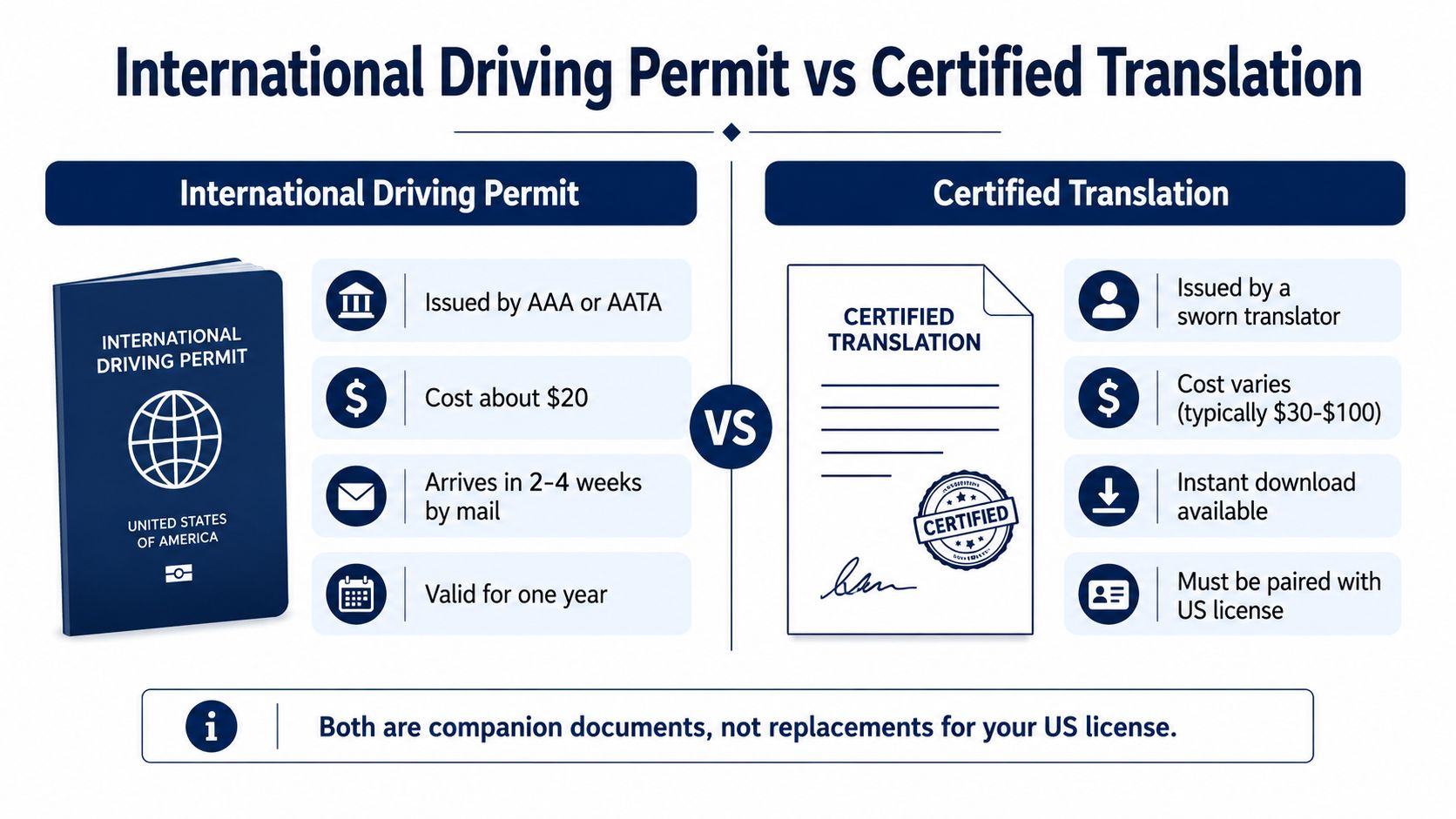
The IDP and the official Italian translation serve the same broad purpose, but they aren't identical documents. One is an internationally familiar permit format. The other is a translation of the details printed on your national licence.
For most visitors picking up a car immediately after landing, an IDP is the straightforward choice. The U.S. Embassy's Italy driving guidance says Americans should obtain one before departure, and explains that it's valid for one year and can't be renewed. That makes it a time-limited companion document, not a second licence.
An official Italian translation can make sense for someone staying longer, buying a vehicle, or dealing with Italian administrative offices. It should be an official or sworn translation, not an informal version produced by a friend or a general translation app. The translator's job is to make the licence categories, names, dates, and restrictions understandable to an Italian authority.
Choose based on the trip
| Option | Best fit | What to verify |
|---|---|---|
| International Driving Permit | A normal tourist rental, especially when you're arranging documents before departure | It's issued through an authorised US issuer and carried with the matching licence |
| Official Italian translation | A longer stay or a situation involving Italian authorities, insurers, or a vehicle purchase | It's formally prepared, accurate, and includes the relevant licence information |
| Both documents | A complicated itinerary or a traveller who wants an extra layer of documentary clarity | Keep both with the original licence, while remembering neither replaces it |
The Italian licence translation option is worth considering if you need a readable Italian document and can't arrange an IDP in time. Confirm the acceptance requirements for your exact situation rather than assuming every translation product has the same legal status.
Be especially careful with scooters. A translation or permit should reflect the vehicle class your US licence authorises. Don't rent a 125cc scooter until you've checked that the relevant category is represented in your paperwork. The rental agent may focus on the car reservation, but police and insurers can examine the category after an incident.
Documents to Carry Every Time You Drive
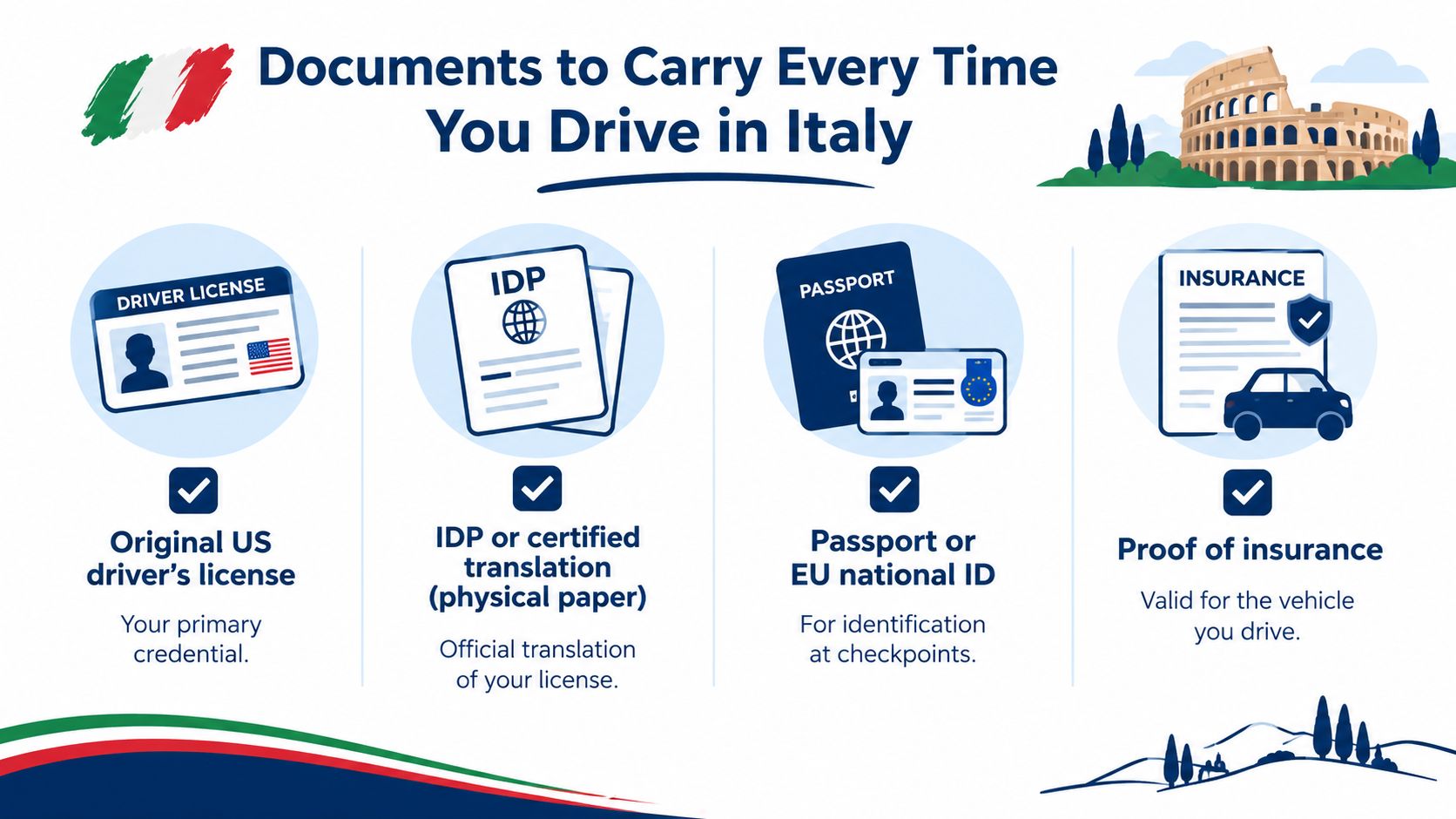
Keep the complete paper stack within reach, not buried in checked luggage or split between different bags. If an officer stops you on a motorway or after a minor collision, producing the documents quickly is far easier than explaining why the evidence is somewhere else.
The original US licence is the primary credential. It identifies you and shows which vehicles you may drive. The IDP or official Italian translation helps an Italian officer interpret that credential, but it has no useful role by itself.
Your passport or EU national ID connects the documents to you. A rental company's agreement also matters when you're driving a hired car, because it shows that you're authorised to use that vehicle.
Build one roadside folder
- Original licence: Keep the physical card, not just a photograph stored on your phone.
- Companion document: Carry the physical IDP or official translation beside the licence.
- Identity document: Use your passport or other accepted identity document for checkpoint verification.
- Insurance evidence: Carry the rental policy information or other proof showing that the vehicle has the required cover.
The insurance page is easy to overlook. Rental companies generally provide documentation connected to the vehicle, but you should know where it is before leaving the lot. If you're stopped, the officer may want to see proof that the car is insured, not merely hear that you bought coverage at the counter.
Digital copies are useful backups, but they shouldn't be your only plan. Put the originals in a secure glove-box folder during the drive, and keep a separate copy or scan available in your accommodation. Don't leave your passport permanently in the car, especially when parking in an unfamiliar area.
Driving without the required companion document can lead to a serious administrative penalty. Article 135 of Italy's Codice della Strada, as summarised in this legal explanation, provides for a fine of 400 to 1,600 euro when a non-EU driver operates a vehicle without the required IDP or official translation.
The One-Year Rule for US Residents in Italy
The most important distinction in driving in Italy with a US license is not the age of the licence or the length of the rental. It's residency.
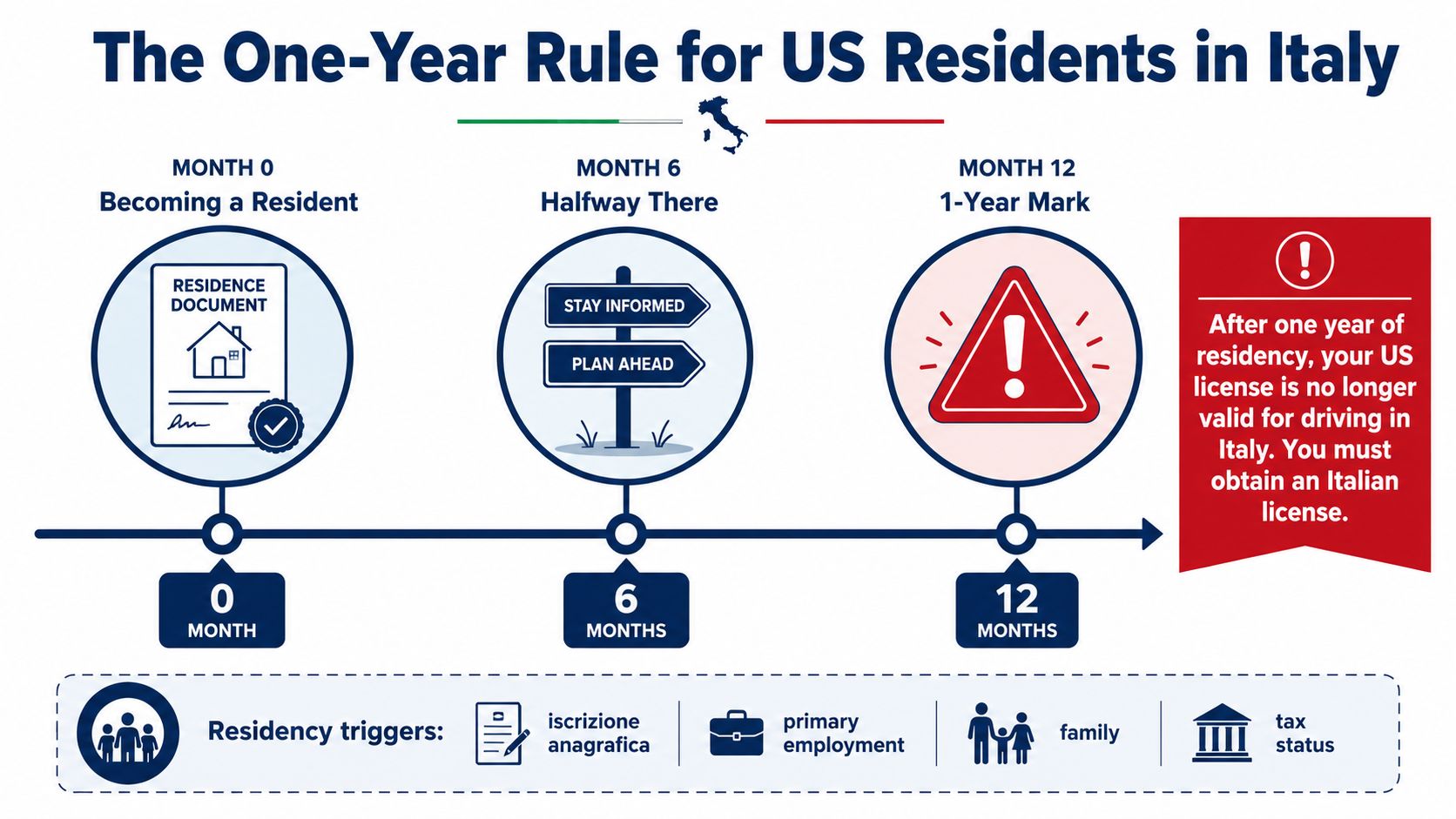
A tourist can use a valid US licence with the required companion document. An American who registers as a resident in Italy has a limited transition period. The Italian Ministry of Foreign Affairs states that the temporary permission applies for up to one year from residence registration, while the U.S. Embassy explains that registered residents must obtain an Italian licence within one year.
Residency changes the answer
The clock is tied to the official residence record, not to how long your US licence has left before expiration. An IDP that's still valid doesn't extend the resident driving period. Neither does a fresh translation.
The administrative route is also different from a holiday rental. The U.S. Embassy's guidance for Americans in Italy states that the United States and Italy don't have a reciprocal licence exchange agreement. The residency transition can therefore require the Italian licensing process rather than a simple exchange of the US card.
That process can involve a written test, a road test, a medical examination, and supporting documents. Start gathering information from the local Motorizzazione Civile before the transition period is nearly finished. An autoscuola can help with forms and test preparation, but it can't turn a tourist document into a permanent Italian licence.
A two-week visitor and a newly registered resident may hold the same US licence, but they aren't operating under the same rule.
Remote work, family commitments, or a longer stay can make the tourist assumption obsolete. If you've registered your residence, check the date on that record and plan the Italian licence process early. Waiting until the final weeks creates avoidable pressure, particularly if local appointments or exams aren't immediately available.
Rentals, Police Stops, and What Actually Happens on the Road
At the rental counter, the interaction is usually quick when the documents are ready. You hand over the physical US licence and the IDP or translation, then show your passport and payment card. If the companion document is missing, the clerk may refuse to release the vehicle even if the reservation has already been paid.
That outcome isn't a technicality. Rental contracts commonly require the driver to hold the documentation needed to drive legally in the country. The foreign rental car preparation guide can help you organise the desk-side requirements before you arrive.
What a roadside check looks like
A police stop can involve the Carabinieri, Polizia Stradale, or municipal officers. The officer may ask for:
- The licence and companion document: They compare the identity and vehicle categories.
- Passport or identity document: This confirms who's driving.
- Insurance evidence: The rental policy or vehicle documentation shows cover.
- Rental agreement: This confirms that you're authorised to use the car.
Keep originals accessible in the glove box, but don't leave everything in one vulnerable place when the car is parked. A practical arrangement is the documents folder in the vehicle during the drive, with secure backup scans stored separately from the originals.
The friction usually comes from missing paperwork, not from the fact that the licence was issued in the United States. A calm driver who produces the correct documents gives the officer a clear record to check. A driver searching through luggage at the roadside creates uncertainty and can turn a routine stop into a much longer conversation.
If there's a crash, contact the rental company and follow the local reporting instructions. Don't assume that a phone photograph of the licence or a screenshot of the insurance page will resolve every question. The physical document set is still the safest option.
Insurance and Damage Coverage for US Drivers
Your US auto insurance may not protect you in Italy in the way you expect. Some policies include limited rental benefits, while others exclude international driving altogether. A credit-card benefit can also come with conditions about the vehicle, the rental period, the driver, and the type of damage.
Start with the rental company's mandatory third-party liability cover, usually described as RC Auto. Then examine the optional protections separately. Collision Damage Waiver, excess reduction, theft protection, and personal accident cover solve different problems, so don't accept a single “full coverage” label without reading the exclusions.
Read the counter paperwork line by line
| Coverage | What it covers | Common gap for US drivers |
|---|---|---|
| Third-party liability | Damage or injury caused to other people or property | A US policy may not provide the required Italian cover |
| Collision Damage Waiver | Reduces the renter's responsibility for covered vehicle damage | Tyres, glass, roof, underside, and interior damage may be excluded |
| Excess reduction | Lowers the amount you may pay after covered damage | The reduced excess may still be substantial |
| Theft protection | Addresses loss of the rental vehicle through theft | Personal belongings and excluded circumstances may remain your responsibility |
| Personal accident cover | Provides benefits linked to injuries to occupants | It doesn't replace liability cover for harm caused to others |
Ask whether every authorised driver is named in the agreement. If your partner or friend will drive, adding them properly is safer than assuming permission carries over automatically.
Photograph the car before leaving the lot, including wheels, glass, bumpers, roof, and the interior. Take another set when you return it, and keep the rental agreement, policy summary, and return confirmation together. That paper trail won't prevent an accident, but it can make a disputed damage claim much easier to assess.
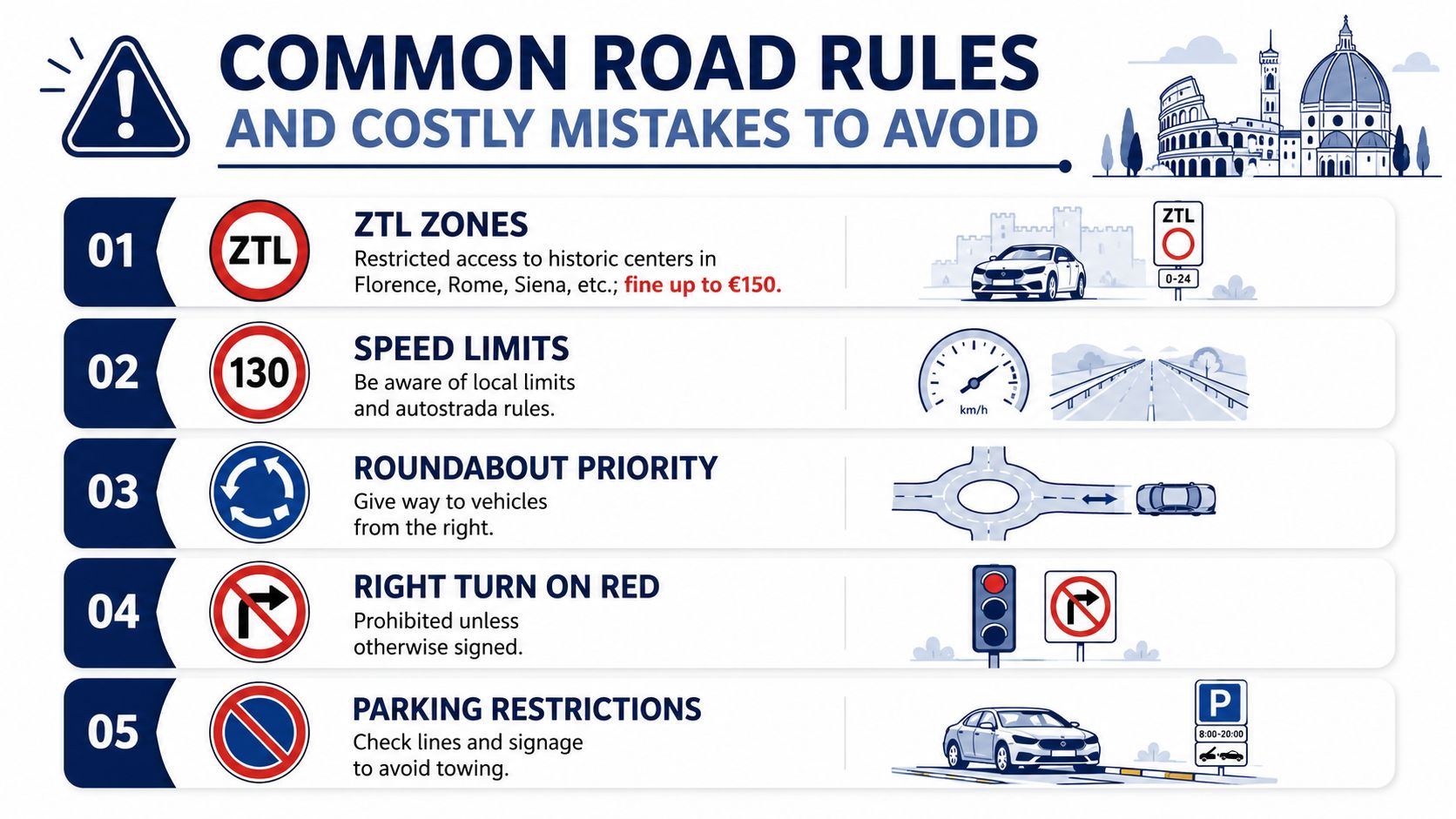
Common Road Rules and Costly Mistakes to Avoid
The paperwork gets you into the car. Local road habits determine whether the trip stays pleasant.
Start with ZTLs, or Zona Traffico Limitato. These restricted traffic areas protect historic centres in cities such as Florence, Rome, Siena, and Milan. Cameras read number plates, and a rental company may receive the notice first before passing the administrative matter to you.
Slow down where the signs change
Italian routes can move from a built-up street to a narrow rural road with little warning. Read the posted limit rather than relying on what feels normal from driving in the United States. On motorways, watch for changes near toll areas, construction, and junctions.
Roundabouts require attention too. Yield according to the signs and markings, and don't assume the US habit you use at home will apply automatically. Right turns on red aren't generally permitted unless a signal or sign specifically authorises the movement.
Parking colours also matter. Blue spaces commonly indicate paid parking, white markings may indicate permitted parking, and yellow markings are generally reserved. Always read the nearby sign, because the paint alone doesn't tell you the full restriction.
Avoid the easy penalties
- ZTL entry: Don't follow a navigation app into a historic centre without checking whether the vehicle is authorised.
- Parking: Pay attention to lines, meters, resident restrictions, and signs before walking away.
- Lighting: Use the required lights outside built-up areas and in conditions where visibility demands them.
- Breakdowns: Put on a high-visibility vest before leaving the vehicle on the roadside.
- Tolls: Follow the lane markings at motorway booths and keep the payment method ready.
Watch this short visual guide before departure:
The best defensive habit is simple: park outside the historic centre and walk in unless you've confirmed access. Italy is far easier to enjoy when you stop trying to force a rental car into streets designed long before cars existed.
Pre-Departure Checklist for US Drivers Headed to Italy
Treat the drive as a paperwork project first and a sightseeing project second. A few minutes spent checking the documents at home is better than discovering a problem at the rental desk after a long flight.
Before you leave the United States
- Confirm your licence: Make sure the physical US licence is current for the trip and shows the vehicle category you intend to drive.
- Choose the companion document: Arrange an authorised IDP or an official Italian translation. Don't assume a casual translation or phone app will satisfy an Italian authority.
- Check the residency question: If you're moving, registering residence, or planning an extended stay, record the date that residency begins and plan for the Italian licensing process.
- Review the rental agreement: Confirm the accepted documents, named drivers, vehicle class, deposit requirements, and collection conditions.
- Read the insurance terms: Identify third-party liability, collision protection, excess, theft cover, exclusions, and the process for reporting damage.
Pack the physical originals
Put the US licence, companion document, passport, rental agreement, and insurance evidence in one secure travel folder. Carry the originals, while keeping scans in a secure phone folder and a separate backup location.
Check that the vehicle includes the required safety equipment, including a reflective vest for roadside use. Save the rental company's emergency number before leaving the airport, because a minor incident is much easier to manage when you aren't searching for contact details beside the road.
Plan the route before turning the key
Review ZTL boundaries for every city where you'll drive. Set the navigation system to avoid restricted areas, and identify parking outside the historic centre. If the route uses toll motorways, decide whether you'll pay at the booths or use an available electronic toll arrangement.
Finally, rehearse the document check. Licence first, companion document beside it, passport and insurance immediately behind. When the rental agent or officer asks, you'll be ready instead of rummaging through your luggage.
World Driving Permit provides certified, word-for-word driving licence translations in multiple languages, with digital delivery and an optional printed booklet for presentation at rental desks, police checkpoints, and insurers. If you need a readable companion document for driving in Italy with a US license, visit World Driving Permit and check the Italy requirements before your departure.