
Driving in Iceland with US License: Rules and Rental Tips
A valid, original, full U.S. driver's license in Latin script is generally accepted for driving in Iceland, and most U.S. drivers don't need an International Driving Permit. The license must be valid, readable, and held for at least one year, but a temporary paper license or digital copy can still fail at the rental desk.
That's the part most articles get right, then they stop too soon. The problem with driving in Iceland with a U.S. license isn't usually nationality or whether American licenses are recognized. It's the gap between Icelandic legal permission and a private rental company's paperwork rules.
A rental agent can ask for the original physical card, check the issue date, compare your name with your passport and credit card, and reject documents that Icelandic road law might otherwise recognize. My advice is simple: treat the rental counter as the stricter test. Arrive with the exact documents the supplier confirmed in writing, not with a screenshot of a generic travel article.
Table of Contents
- What a U.S. License Actually Gets You in Iceland
- Do You Need an International Driving Permit or Translation
- License Type, Age, and Duration Rules U.S. Drivers Miss
- What Rental Desks Really Check Beyond the License
- Insurance Choices That Protect U.S. Drivers in Iceland
- Iceland Road Rules and Hazards in Real Driving Conditions
- Weather, Route Planning, and Safety Checks Before You Drive
- Your Pre-Departure Checklist for Driving in Iceland
What a U.S. License Actually Gets You in Iceland
A standard U.S. driver's license works in Iceland when three conditions are met. It must be current and unexpired, it must be a full license rather than a learner's or provisional credential, and it must be printed in English or another Latin-based script. Icelandic authorities and rental staff need to read your name, license category, photograph, and expiration date without guessing or relying on an unofficial translation. Iceland driving-license guidance outlines these core requirements.
You also need to carry the original physical card. A phone photograph, scan, photocopy, or digital-only credential isn't a substitute at the counter. That distinction causes more failed pickups than the IDP question, especially for travelers who recently moved, renewed a license, or are waiting for a replacement card.
Practical rule: Put the physical license in your passport wallet, not in checked luggage and not in a rental app.
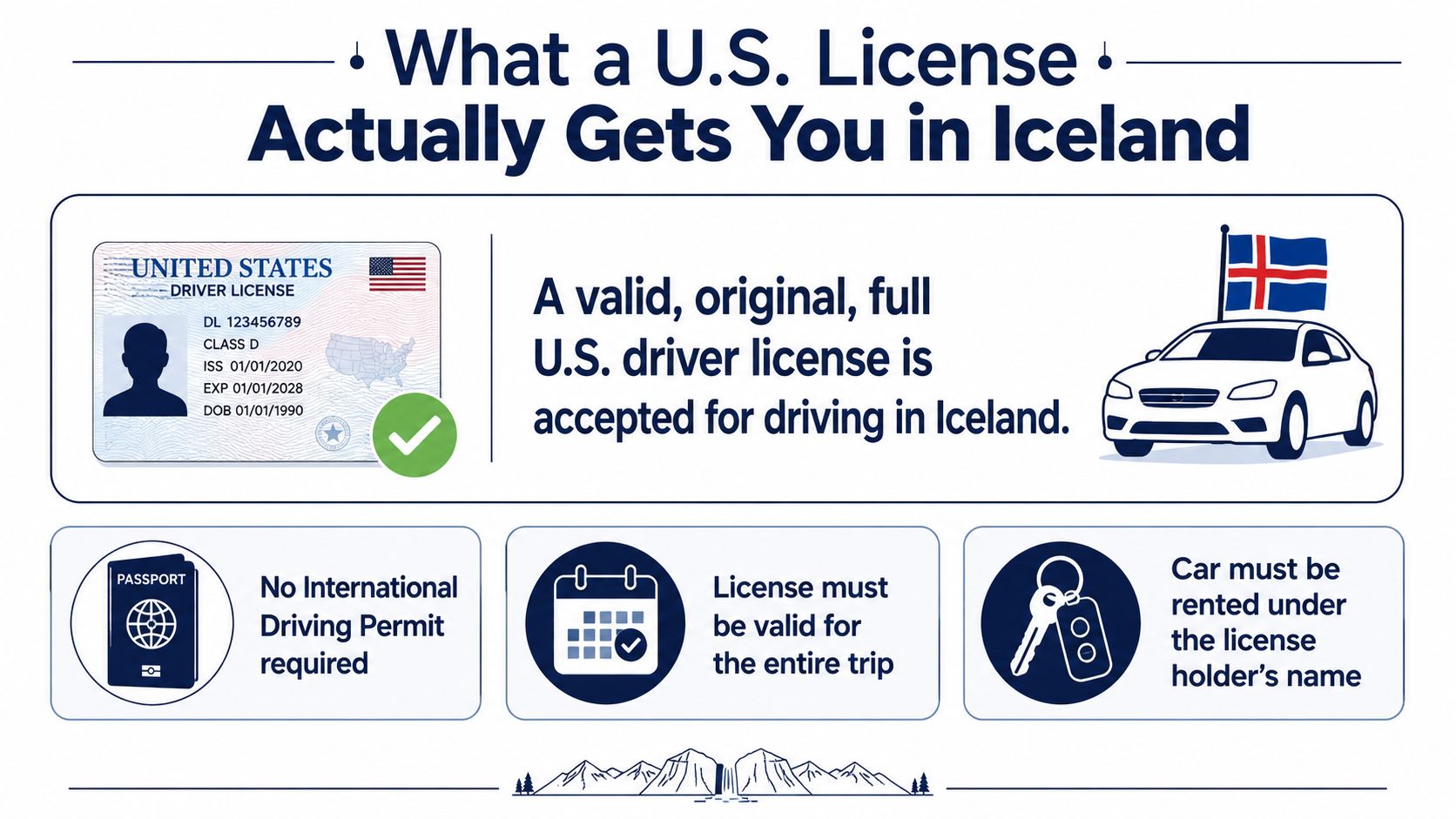
Tourists don't need a separate driving visa or Icelandic residency step for a short visit. Your visitor status and your driving documents are separate issues, however. A valid license lets you operate a suitable vehicle under Icelandic rules. It doesn't guarantee that every supplier will accept every document format, vehicle category, or driver profile.
Before booking, compare the rental company's stated requirements with the information in this Iceland license requirements guide. Then email the supplier if your card is temporary, recently replaced, damaged, or written in anything other than Latin characters. Get the answer attached to your reservation.
Do You Need an International Driving Permit or Translation
The popular advice is usually wrong in one of two directions. Some articles claim every American needs an IDP, while others say an IDP is never useful. The accurate answer separates legal recognition from rental-desk acceptance.
A normal U.S. license written in English generally meets Iceland's licensing requirement. Most American visitors can drive without an IDP because the document is readable and identifies the driver, vehicle class, and validity dates. An IDP is a translation companion, not a replacement for your state license, so carrying one without the original card solves nothing.
Rental companies are private businesses. They can apply additional verification rules, particularly when staff can't confidently interpret the license or when the document looks unusual. A translation or IDP becomes more sensible when the license uses a non-Latin script, omits information that Icelandic staff need to verify, or comes from a jurisdiction whose format the supplier doesn't regularly handle.
The document edge cases that matter
A standard plastic card in English is the easy case. The difficult cases are:
- Non-Latin scripts: Ask the rental company whether it requires an IDP or certified translation, and carry the original license alongside it.
- Temporary paper licenses: Don't assume a printed interim document will be accepted merely because it's legally valid in your home state.
- Digital credentials: A state wallet or phone image may prove identity at home, but it doesn't replace the physical card for an Icelandic rental pickup.
- Worn or damaged cards: If a scanner can't read the barcode or the dates are unclear, staff may refuse the handover.
For a short trip with a clear English-language license, I wouldn't buy an IDP just because an internet checklist says “international driving.” If your chosen supplier explicitly requires one, comply or choose another supplier. The small fee is cheaper than losing access to a prepaid rental. Review the conditional guidance in this foreign-license driving guide for Iceland before you decide.
License Type, Age, and Duration Rules U.S. Drivers Miss
The most important age rule is easy to overlook: Iceland's standard driving age for regular cars is 20, which is higher than the legal minimum in many U.S. states. A valid state license doesn't override Iceland's age requirement. Rental companies can also apply different thresholds by vehicle category, so a driver who qualifies for a small car may not qualify for a larger SUV or 4x4.
Your license generally needs to have been held for at least one year. That requirement catches young Americans and people who recently received a first license. It can also create confusion after a replacement or renewal, because the rental company may want evidence of the original licensing history rather than seeing a newly printed card.
What the counter can and can't use
| License Type | Accepted at Counter? | Notes |
|---|---|---|
| Standard plastic U.S. license | Generally yes | Carry the original card, passport, and required payment card. |
| REAL ID compliant card | Generally yes | REAL ID status doesn't change the basic driving assessment. |
| Non-REAL-ID plastic card | Generally yes | Readability, validity, and license class matter more than the federal marking. |
| Temporary paper license | Often rejected | Confirm directly with the supplier before travel. |
| State-issued digital ID | Not a safe substitute | Bring the physical license even if your state supports mobile credentials. |
| Learner's or provisional license | Not suitable for a normal rental | A full driving credential is expected. |
Don't confuse a printed license summary with the license itself. A backup copy can help if the rental agent needs a record for their file, but it won't replace the original physical card. Carry your passport as the identity document that supports the license, and keep a separate paper copy of your reservation and emergency contacts.
If you're under the rental company's age threshold, expect a restricted vehicle choice or an additional young-driver charge. Ask for the exact rule attached to your selected car before paying. The phrase “standard car available to drivers over 20” tells you nothing about a premium SUV, camper, or Highland-capable vehicle.
What Rental Desks Really Check Beyond the License
The rental agent isn't only asking, “Can this person drive in Iceland?” The agent is deciding whether the company can identify the driver, secure payment, authorize the vehicle category, and enforce the rental contract. That's why a valid license can still be followed by a refusal.
The first check is usually identity. Your name should match across the booking, passport, license, and payment card. If the main driver's card belongs to someone else, the supplier may require that person to become the named driver or may reject the payment arrangement. Add every intended driver to the contract before departure. An unlisted driver can create both coverage and liability problems.
The desk-level checklist
| Requirement | Economy, such as Toyota Yaris | SUV or 4x4, such as Dacia Duster or Suzuki Jimny |
|---|---|---|
| License format | Original, valid physical card | Same, with closer attention to category and supplier rules |
| License history | Often subject to the one-year requirement | May be checked more strictly for specialist vehicles |
| Age | Iceland's regular-car minimum applies | Category thresholds may be higher |
| Payment card | Usually required in the main driver's name | Hold and eligibility rules can vary by vehicle |
| Additional driver | Must be registered | Must be registered, especially when route risk is higher |
| Route suitability | Main paved roads and appropriate conditions | Confirm whether the model is allowed on planned routes |
Credit-card holds and payment policies vary by company, insurance package, and vehicle. Don't arrive assuming a debit card will work because it works for hotels or domestic rentals. Ask the supplier what card type, cardholder name, and available funds the contract requires.
The same caution applies to upgrades. A low headline price may not include an additional driver, navigation equipment, child seat, broader damage protection, or a vehicle suitable for your route. Read the contract and inspect the car before leaving. Photograph the body, wheels, windshield, roof, and interior, then make sure existing damage appears on the handover record. The broader foreign-car-rental document guide explains why those counter checks deserve attention.
Insurance Choices That Protect U.S. Drivers in Iceland
Basic rental protection is only the starting point. Iceland's roads expose vehicles to risks that many U.S. drivers rarely encounter together, including loose gravel, wind-driven sand, volcanic ash, rough surfaces, and water hazards. A policy that sounds thorough may still exclude the damage most likely to occur on your planned route.
Start by identifying the deductible, also called the excess. Super CDW and SCDW options generally reduce the amount you could owe after covered damage, but they don't automatically cover every excluded event. Read the exclusions rather than choosing the package with the most reassuring name.
Match cover to the road
| Coverage Type | What It Covers | Recommended for U.S. Drivers |
|---|---|---|
| Basic CDW | The supplier's baseline collision protection, subject to an excess and exclusions | Accept it as the foundation, then read the excess |
| Super CDW or SCDW | Reduces the remaining financial exposure for covered collision damage | Strongly consider it if you'll drive outside the capital area |
| Gravel protection | Helps address chips or damage from loose stones, subject to contract terms | Recommended for rural routes and gravel sections |
| Sand and ash protection | Addresses specified sand or volcanic ash damage | Valuable when forecasts and route conditions create exposure |
| Tire and underbody cover | May cover damage to tires, wheels, or lower vehicle components | Consider it for rough routes, but confirm what is excluded |
| Water or river-related cover | May be limited or unavailable, especially for prohibited crossings | Never treat insurance as permission to cross water |
| Excess-refund product | A third party may reimburse some eligible excess after a claim | Consider only after checking exclusions and claim process |
Common exclusions include sand and ash damage, gravel chips, tires, undercarriage damage, river crossings, flooding, and off-road driving. F-roads have their own vehicle and access rules, and no insurance product makes illegal off-road driving acceptable. A U.S. auto policy or credit-card benefit may also exclude Iceland, gravel damage, F-roads, or prohibited use. Get written confirmation before relying on it.
My recommendation is to choose the strongest suitable SCDW option, then add gravel and sand-and-ash protection when your route or season justifies it. Don't buy coverage to compensate for a poor vehicle choice or unsafe decision. Insurance protects against contractually covered events. It doesn't protect a driver who ignores a closure, leaves the marked road, or enters water.
Iceland Road Rules and Hazards in Real Driving Conditions
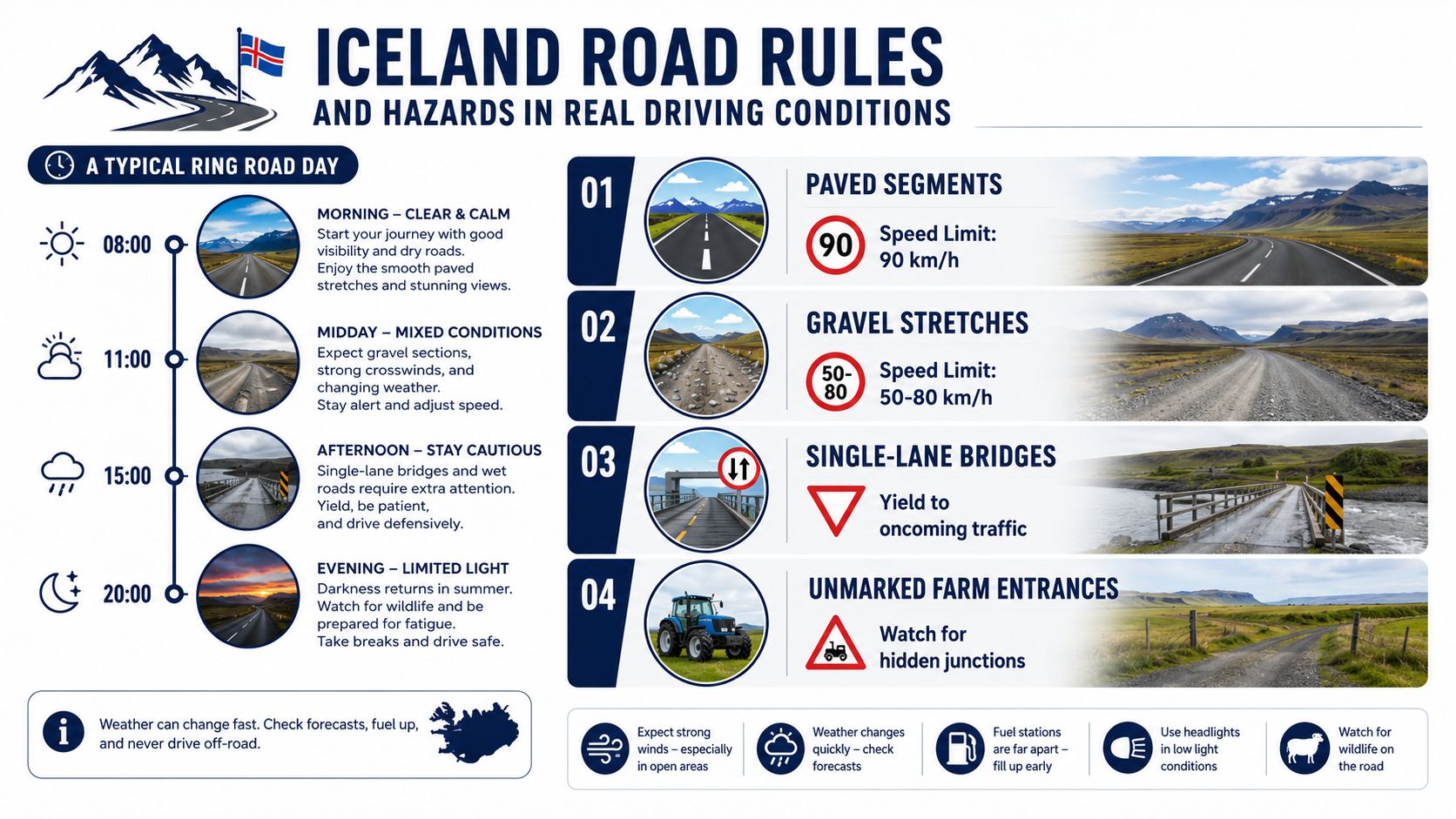
A Ring Road day can begin on smooth pavement and become demanding within minutes. On paved rural roads, the general limit is 90 km/h, while gravel roads generally carry an 80 km/h limit, and towns and residential areas commonly use 30 to 50 km/h limits, as summarized in Iceland driving guidance. Treat those figures as ceilings, not targets. Wind, visibility, gravel, animals, and surface changes should determine your actual speed.
As you leave Reykjavík, keep your headlights on and stay to the right. A paved road can narrow unexpectedly, and a bridge may have only one lane. The driver who reaches a single-lane bridge first has priority, but both drivers still need to slow down early enough to judge the situation safely.
What surprises American drivers
Gravel is the classic mistake. A U.S. driver sees a posted limit and maintains speed, then brakes late when stones scatter across the lane. Slow before the surface changes, increase following distance, and don't hug an oncoming vehicle that can throw rocks into your windshield.
Livestock create a different problem. Sheep and horses can move toward the road without behaving like predictable traffic. If an oncoming driver flashes headlights in daylight, take it as a warning and reduce speed. Look beyond the bend, farm entrance, or parked vehicle before continuing.
- Stay on marked roads: Off-pavement shortcuts damage the natural environment and can violate local rules.
- Use proper pull-offs: Don't stop on a narrow verge just to take a photograph.
- Respect F-road restrictions: Confirm that the road is open and that your vehicle is permitted before entering.
- Buckle everyone in: Seatbelts are not optional for passengers.
- Keep the cabin sober: Don't drink before driving, even if a U.S. rule feels more familiar.
The steering position and traffic side will feel familiar because Iceland drives on the right with left-hand steering. The unfamiliar part is how quickly road, wind, and visibility conditions can change. This short driving video gives you another visual reference for the road environment:
Weather, Route Planning, and Safety Checks Before You Drive
Iceland driving is a weather-and-route decision before it becomes a vehicle decision. A capable rental car can't make a closed road safe, and an all-wheel-drive system won't solve poor visibility, crosswinds, or a driver who has planned a route with no time for delays.
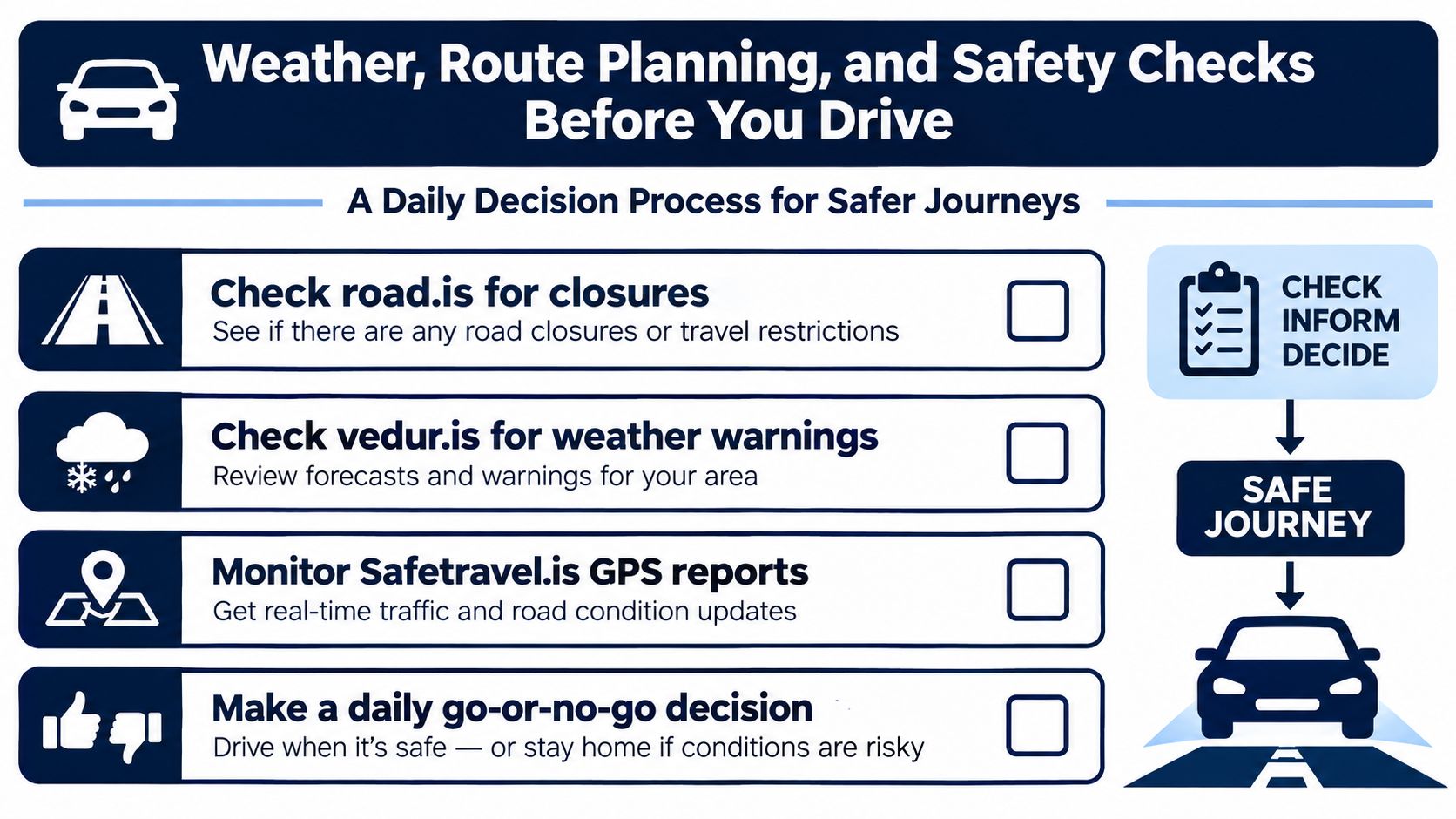
The official roads and driving conditions guidance recommends checking live conditions because closures and hazards can change quickly, particularly away from the main urban areas and on mountain or gravel routes. Build that check into your routine instead of treating it as something you do only after trouble begins.
The daily go-or-no-go routine
Check road.is for closures and surface conditions. Check vedur.is for weather warnings, wind, precipitation, and visibility. Check Safetravel.is for relevant travel alerts and GPS-based safety information. Do it the night before, again in the morning, and once more before leaving the rental lot if conditions look unsettled.
Then ask one practical question: can this route be completed safely with the daylight, fuel, vehicle, and driving experience we have today? If the answer is no, shorten the route. A missed viewpoint is a minor disappointment. A rushed drive into worsening weather can become a rescue problem.
Before moving, inspect the vehicle:
- Check the tires: Look for visible damage and confirm pressures against the vehicle's door placard.
- Test the lights: Confirm headlights, brake lights, indicators, and fog lights work.
- Locate the equipment: Find the spare or repair kit, jack, reflective triangle, and emergency instructions.
- Fill the washer reservoir: Winter grime and spray can obscure the windshield quickly.
- Save the route offline: Don't depend on continuous mobile coverage in remote areas.
Summer can bring busy roads, gravel, and sudden wind. Winter adds darkness, ice, snow, storms, and closures. Shoulder seasons can combine thawing surfaces with rapidly changing weather. Plan conservatively, and let the forecast overrule the itinerary.
Your Pre-Departure Checklist for Driving in Iceland
Put documents in your carry-on, not your checked bag. You need the original physical license, passport, payment card in the main driver's name, and any IDP or certified translation that your particular license or supplier requires. Keep the rental confirmation accessible offline because airport connectivity and fatigue make improvisation a poor strategy.
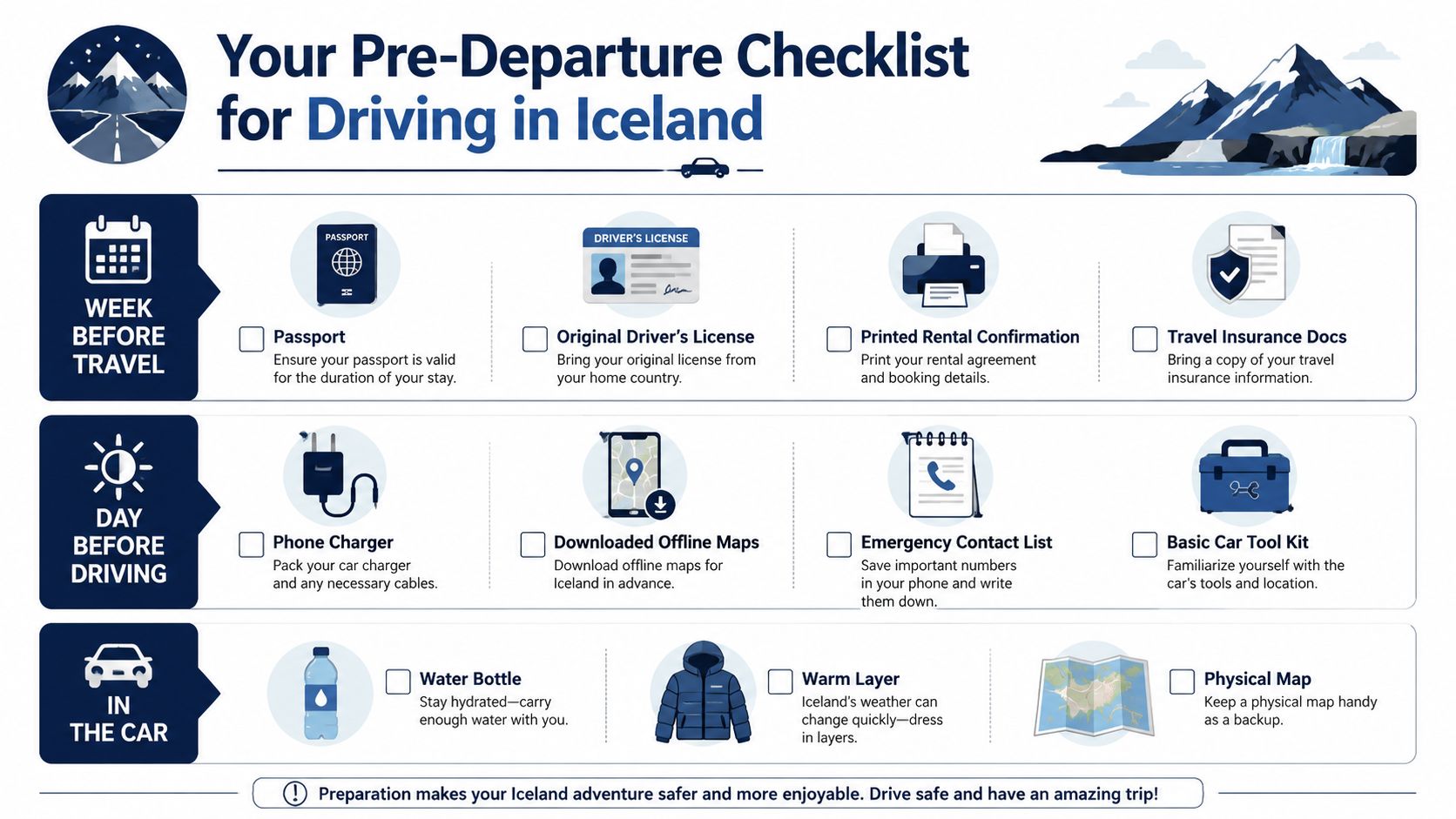
One week before travel
- Verify the license: Confirm it's original, physical, unexpired, full, readable, and held for at least one year.
- Email the supplier: Ask about temporary documents, digital credentials, age rules, vehicle category, and payment-card requirements.
- Choose the protection: Compare the excess, gravel terms, sand-and-ash exclusions, tire rules, and water-related exclusions.
- Match the car to the route: Use a suitable vehicle for paved roads, gravel sections, winter conditions, or approved F-roads.
- Review the contract: Check fuel policy, extra-driver rules, one-way arrangements, mileage terms, and roadside assistance.
- Save the booking: Download the rental confirmation and the broker's emergency contact details.
The day before driving
- Check road.is: Review closures, surfaces, and route changes.
- Check vedur.is: Read warnings rather than relying on a general weather app.
- Check Safetravel.is: Review current alerts and submit or monitor relevant travel information.
- Download offline maps: Save the route, accommodation, fuel stops, and fallback roads.
- Charge the phone: Carry a vehicle charger and keep the phone available for emergencies.
- Set a cutoff time: Decide when you'll turn back if the weather or road deteriorates.
Before leaving the rental lot
- Inspect every side: Photograph existing marks, wheels, windshield, roof, and interior.
- Test the controls: Check lights, wipers, washer fluid, heating, and the fuel gauge.
- Find the safety gear: Locate the jack, repair kit, reflective triangle, and emergency instructions.
- Confirm the return process: Ask where to park, how to handle after-hours return, and who to call after a breakdown.
- Drive the first kilometers slowly: Learn the vehicle's brakes, mirrors, dimensions, and wind response before settling into the route.
Don't let a valid U.S. license create false confidence. Confirm the rental company's document policy, check conditions before every departure, and choose the route your group can safely complete.
World Driving Permit provides certified translations of national driving licenses in multiple languages, with digital delivery and an optional printed booklet, while reminding travelers that local acceptance depends on the destination and rental company. If your license uses a non-Latin script or a supplier asks for readable supporting documentation, visit World Driving Permit to check the Iceland requirements and choose the appropriate translation or authorized permit route.